

Influence Is Not Determined by Economic Size Alone
Uzbekistan, Kazakhstan and Azerbaijan belong to an emerging category of states whose influence exceeds their formal political and economic weight. Zaur Shiriyev, the author of a Financial Times article, describes them as “mini-middle powers,” placing Qatar and Oman in the same group.
This is an analytical term rather than an official international designation. These countries cannot establish global rules independently, but they control resources, routes or diplomatic capabilities required by larger powers.
Their influence is particularly visible in energy, transport logistics, regional security and international diplomacy.
Each Country Has Its Own Source of Leverage
Uzbekistan is Central Asia’s most populous country and occupies a central position within the region. Its importance is supported by its domestic market, transport connections with neighbouring states and expanding economic relations with China, Russia, Türkiye, the EU and the United States.
Kazakhstan possesses substantial oil, uranium and critical-mineral resources. Its location between Russia and China, access to the Caspian Sea and participation in several Eurasian routes allow the country to act as both a commodity exporter and a transit hub.
Azerbaijan’s leverage comes from oil and gas exports, transport infrastructure and its position between the Caspian and Black Sea regions. The country also plays an important role in security and diplomacy in the South Caucasus.
The Middle Corridor Is Becoming a Source of Influence
One of the clearest examples is the Trans-Caspian International Transport Route, commonly known as the Middle Corridor. It connects China and Central Asia with Europe through Kazakhstan, the Caspian Sea, Azerbaijan, Georgia and Türkiye.
Kazakhstan and Azerbaijan control essential land, port and maritime sections of the route. Landlocked Uzbekistan is steadily expanding its access to Trans-Caspian logistics. In 2025, the Middle Corridor’s share of Uzbekistan’s freight transportation reached 28%, compared with 12% in 2021.
The World Bank estimates that freight volumes along the corridor could triple by 2030 and transit times could be halved if sufficient investment and coordinated reforms are implemented.
The projection remains conditional. The route still requires additional ferry capacity, expanded ports, railway modernisation, harmonised tariffs and digital customs procedures. Nevertheless, demand for alternative transport routes is already strengthening the negotiating position of the countries they cross.
Green Energy Could Create a New Corridor to Europe
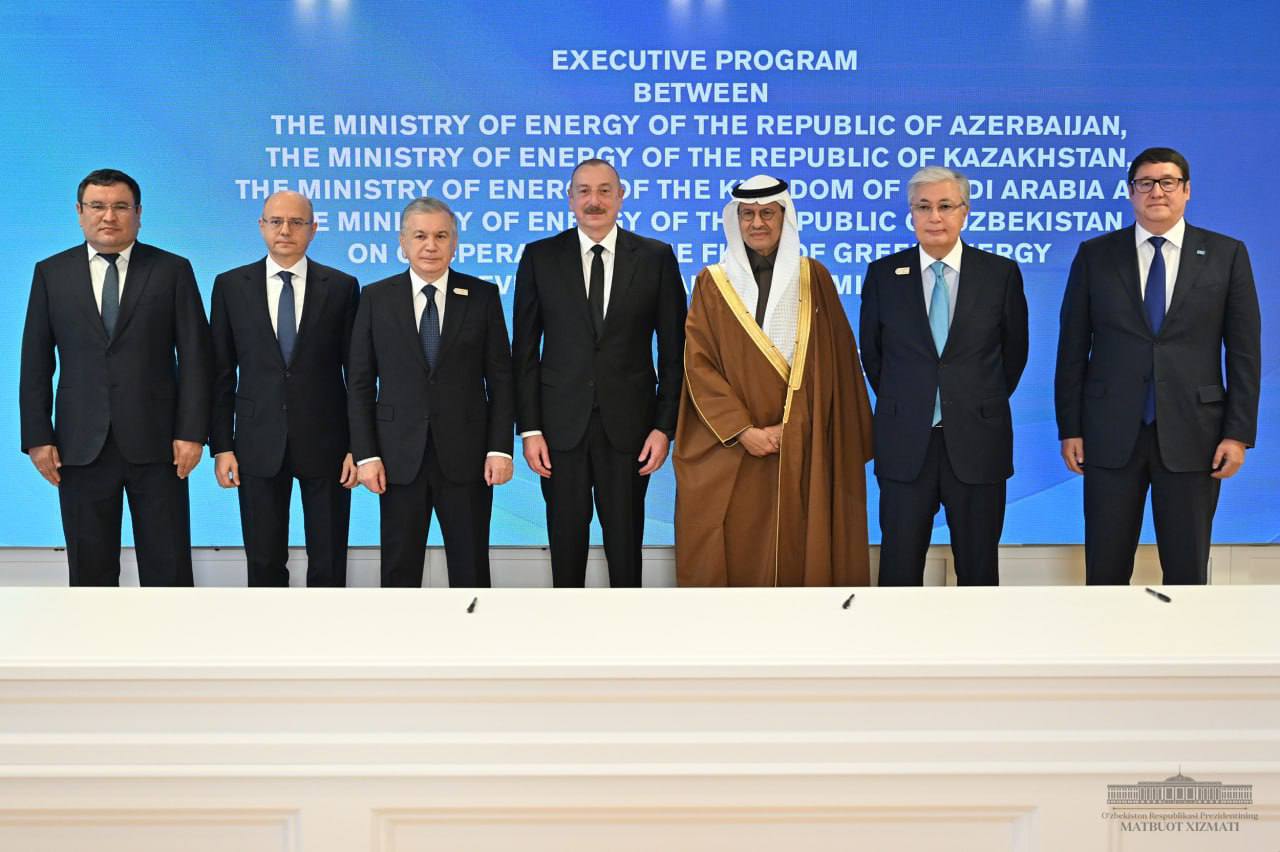
Transport cooperation is being supplemented by energy projects. In November 2024, Azerbaijan, Kazakhstan and Uzbekistan signed an agreement on strategic partnership in green energy development and transmission.
The initiative includes assessing the construction of an undersea electricity cable across the Caspian Sea. Renewable power generated in Central Asia could be transmitted to Azerbaijan and eventually connected to European markets through the planned Black Sea energy corridor.
The infrastructure is not yet operational. The project remains subject to technical studies, financing and intergovernmental coordination. However, it demonstrates how the three countries could convert their geography into long-term energy and political influence.
Multi-Vector Policies Preserve Room for Manoeuvre
Uzbekistan, Kazakhstan and Azerbaijan have avoided aligning exclusively with a single geopolitical centre. They maintain relations with Russia, China, Türkiye, the European Union and the United States, selecting partners according to the requirements of individual projects.
This approach should not be interpreted as complete neutrality. It is a pragmatic strategy intended to attract investment, diversify exports and reduce dependence on one market or transport direction.
“Mini-middle powers” will not shape the emerging global order on their own. Their importance will nevertheless increase whenever larger economies require the resources, energy infrastructure, transport routes or diplomatic support they control.
Read also: Central Asia: 39% of Manganese Reserves Draw U.S.-China Competition