

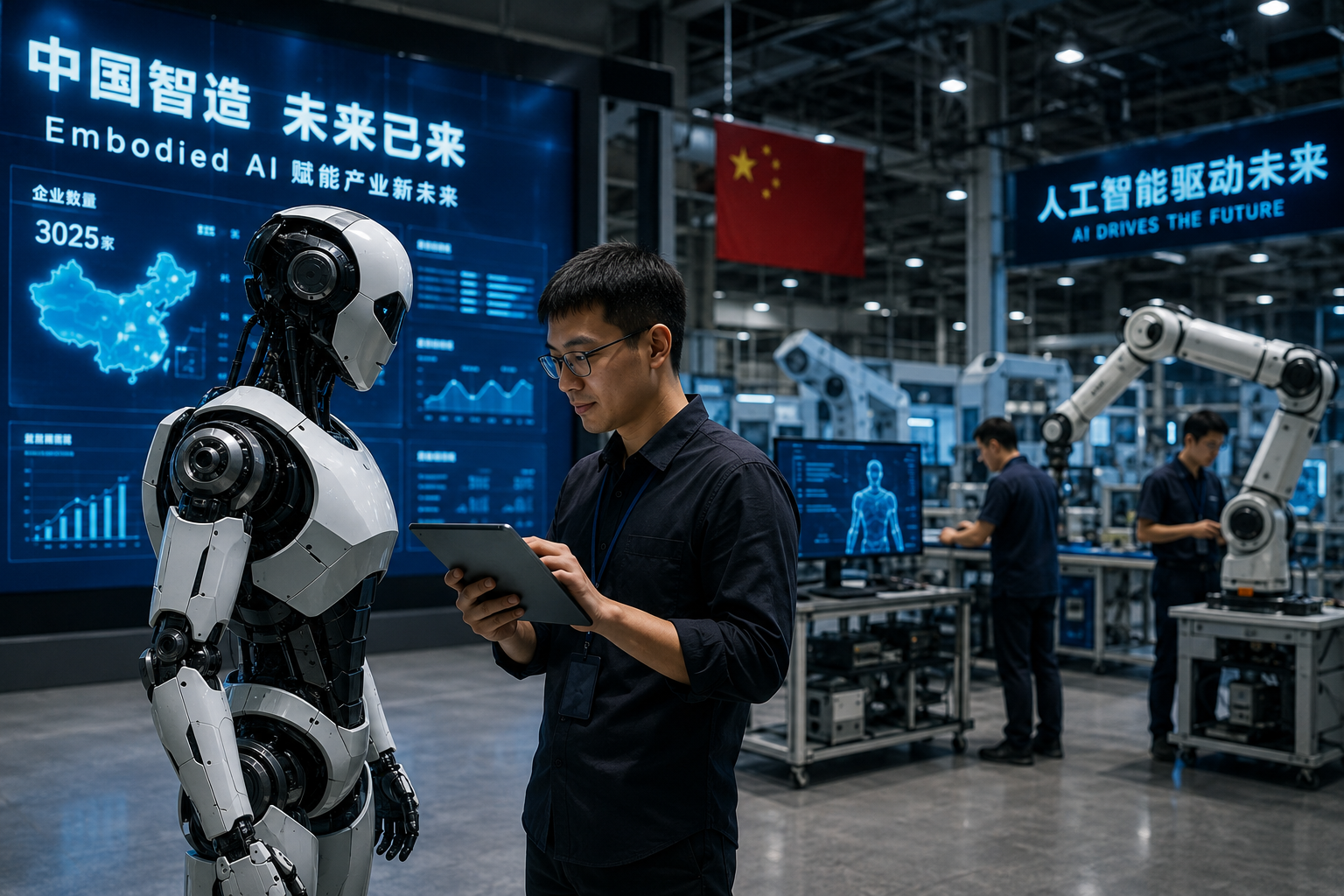
China is rapidly strengthening its position as a global leader in embodied AI, transforming humanoid robots and intelligent physical systems from experimental technologies into a fully-fledged industry with significant economic impact.
According to China’s State Taxation Administration, sales of companies operating in the embodied AI sector increased by more than 20% during the first half of 2026 compared with the same period last year.
The fastest-growing segments include:
- AI software algorithms (+24.5%);
- robotic platforms (+30.1%);
- system integration solutions (+27.9%).
The strongest indicator of the industry’s maturity is growing industrial demand. During the first five to six months of the year, Chinese manufacturers nearly doubled their purchases of AI-powered robots, while demand for robot integration, deployment, and maintenance services also almost doubled.
China is now home to 3,025 companies specializing in embodied AI technologies. More than 400 new businesses entered the market in 2025 alone, while over one-third of all companies have been operating for more than a decade, highlighting the country’s already well-established industrial foundation.
The industry’s rapid expansion is part of China’s long-term national strategy. Under the 15th Five-Year Plan (2026–2030), embodied AI has been designated as one of six strategic industries of the future, alongside quantum technologies and biomanufacturing. Chinese policymakers view embodied AI as the next stage in the evolution of artificial intelligence—moving beyond information processing toward autonomous interaction with the physical world.
Nearly 90% of China’s embodied AI companies are concentrated in the country’s five largest technology hubs. Guangdong Province alone accounts for 78.7% of the sector’s total sales, reinforcing its status as China’s leading robotics and AI manufacturing center.
Industry experts note that Chinese developers are increasingly moving beyond conventional robot training methods toward brain-inspired AI models that mimic the principles of human cognition. This approach significantly reduces the amount of training data required while accelerating the learning process of intelligent machines.
The scale of China’s progress has also drawn international attention. Bradley Nelson, a member of the Swiss Academy of Engineering Sciences, stated that China’s achievements in robotics have become the envy of many research centers worldwide and are the result of consistent government policy and sustained long-term investment.
Bottom line: while many countries are still developing strategies for humanoid robotics, China is already building a comprehensive embodied AI ecosystem—from fundamental research and advanced manufacturing to large-scale industrial deployment. If current growth continues, China could become the first nation to secure a decisive advantage in the next global technology race, where the most valuable resource will no longer be software alone, but intelligent machines capable of operating effectively in the real world.
Read also: BW LNG orders new FSRU at HD Hyundai shipyard