

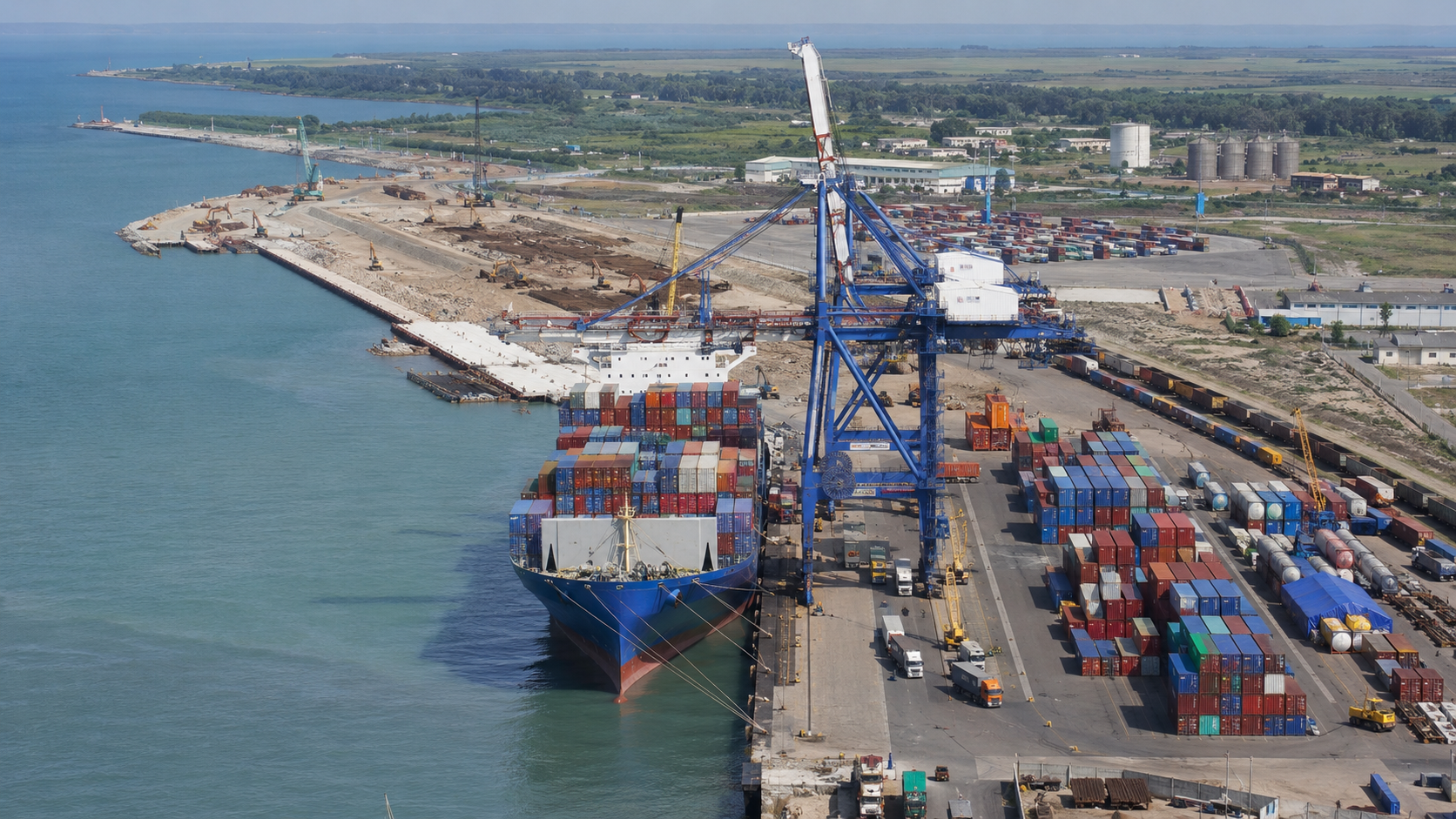
Georgia is accelerating the modernization of one of its most important maritime gateways. Construction has officially begun on a new berth at the Port of Poti as part of the second phase of a long-term expansion project designed to meet growing demand for cargo handling on the eastern coast of the Black Sea.
According to Georgia’s Ministry of Economy and Sustainable Development, the expansion will increase the port’s annual cargo handling capacity to 3 million tonnes, improve operational efficiency and create around 50 new jobs. With an additional $40 million allocated to the second phase, total investment in the project has now reached $93 million.
The project reflects Georgia’s broader ambition to become one of the principal logistics hubs connecting Europe, Central Asia and China through the Trans-Caspian International Transport Route (TITR), better known as the Middle Corridor.
As K2Cargo News recently reported in Can the Middle Corridor Become Eurasia’s Main Alternative? Infrastructure, Investments and New Trade Flows, infrastructure investment has become one of the key drivers behind the corridor’s rapid development.
Poti Is Becoming a Strategic Black Sea Gateway
The Port of Poti has long been one of Georgia’s primary maritime terminals, handling containerized cargo, bulk commodities and general freight arriving from Central Asia and the South Caucasus.
Its location gives it strategic importance. Cargo transported from China through Kazakhstan and across the Caspian Sea enters Azerbaijan before reaching Georgia by rail. From Poti, shipments continue toward Romania, Bulgaria, Türkiye and other European destinations.
As more companies diversify supply chains away from traditional transit routes, Georgia’s role within Eurasian logistics is expanding.
The latest investment demonstrates that the government expects this trend to continue for many years.
Cargo Growth Creates New Demand
Speaking during the groundbreaking ceremony, Minister of Economy and Sustainable Development Mariam Kvrivishvili described the project as a direct response to increasing demand for transport and logistics services.
According to the ministry, freight transported along the Middle Corridor increased by 21% during the first five months of the year, while vessel traffic through Georgian ports rose by 19%.
These figures indicate that international transport operators continue to increase their use of the corridor despite ongoing operational challenges.
Growing demand also explains why investment is taking place simultaneously across several countries along the route.
Kazakhstan continues expanding the ports of Aktau and Kuryk.
Azerbaijan is modernizing the Port of Baku.
Georgia is upgrading railway infrastructure and port terminals.
Türkiye is strengthening its position as the western gateway connecting Asia with Europe.
Rather than competing independently, these projects increasingly complement one another.
More Than Just a Port Expansion
The new berth is only one element of Georgia’s wider transport strategy.
The government is simultaneously investing in railway modernization, logistics centers and the East-West Highway, while construction of the deep-water Port of Anaklia remains one of the country’s largest infrastructure priorities.
The objective is clear: connect ports, railways and highways into one integrated logistics network capable of supporting growing international freight flows.
This integrated approach reflects changes taking place throughout Eurasia.
Instead of relying on a single transport corridor, logistics companies increasingly seek flexible multimodal solutions that reduce geopolitical and operational risks.
International Financing Shows Investor Confidence
The project has also received continued international financial backing.
As part of the second construction phase, the U.S. International Development Finance Corporation (DFC) signed a second $25 million financing agreement with PACE Group, providing additional capital for the development of port infrastructure.
International lenders rarely support projects without long-term commercial potential.
Their participation suggests that Georgia’s transport sector is increasingly viewed as a strategic component of future Eurasian trade.
Foreign investment also helps accelerate modernization while improving confidence among international logistics operators considering new transport routes through the South Caucasus.
Competition Between Black Sea Ports Is Intensifying
Georgia is not the only country expanding its maritime infrastructure.
Romania continues investing in Constanța.
Bulgaria is upgrading terminals along the Black Sea coast.
Türkiye is expanding several logistics hubs supporting trade between Europe and Asia.
Competition for transit cargo is becoming stronger every year.
Success will therefore depend not only on larger terminals but also on digital customs procedures, efficient railway connections, modern logistics services and predictable transit times.
Infrastructure alone no longer guarantees competitiveness.
Operational efficiency has become equally important.
What This Means for the Logistics Industry
The expansion of Poti represents more than another construction project.
It reflects a structural shift taking place across Eurasian logistics.
Rather than depending on one dominant transport corridor, international supply chains are gradually becoming more diversified.
Ports such as Poti are expected to play a larger role as companies seek alternatives that improve resilience while maintaining access to European markets.
If current investment plans continue and operational bottlenecks are gradually removed, Georgia could strengthen its position as one of the most important logistics hubs on the eastern Black Sea coast.
The Middle Corridor is unlikely to replace every traditional route, but expanding infrastructure at ports like Poti demonstrates that it is becoming a permanent component of the Eurasian transport network rather than a temporary geopolitical alternative.
Read also: Can the Middle Corridor Become Eurasia’s Main Alternative?