

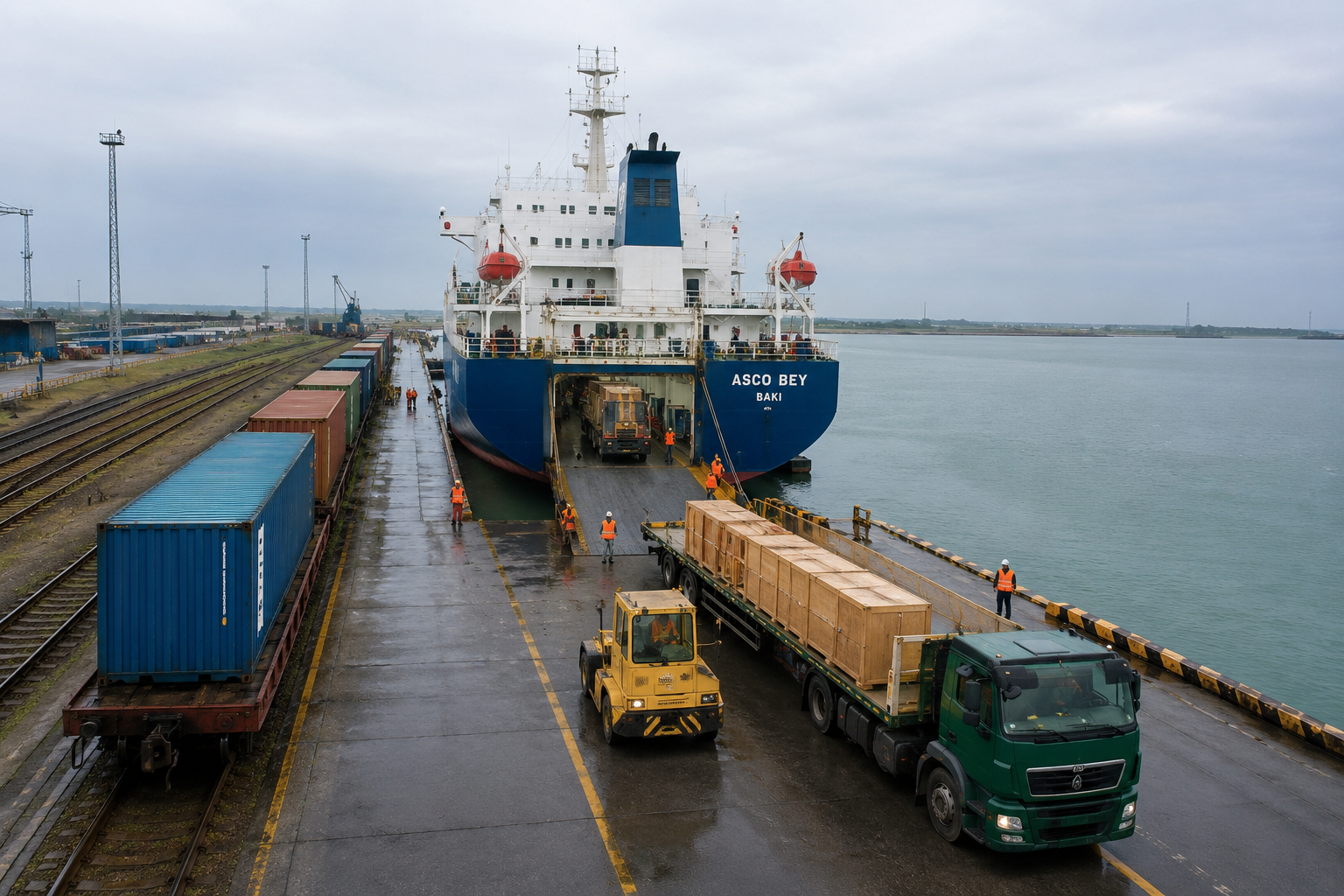
Growing cargo volumes, infrastructure investments in Kazakhstan, Azerbaijan, Georgia and Türkiye, and the need for alternative Eurasian routes are turning it into a real logistics option between China, Central Asia and Europe.
The Middle Corridor has become one of the most discussed transport routes in Eurasian logistics. Only a few years ago, many market participants saw it as a secondary alternative to the traditional northern land route through Russia or the maritime route via the Suez Canal. Today the situation has changed.
Sanctions, geopolitical uncertainty, security risks in maritime chokepoints, and the desire of many shippers to diversify supply chains have increased interest in routes that avoid both Russia and the most vulnerable sea corridors. Against this background, the Trans-Caspian route has moved from a theoretical concept to a practical logistics solution.
The route connects China with Kazakhstan, crosses the Caspian Sea to Azerbaijan, then continues through Georgia and Türkiye toward European markets. This makes it not just a transport corridor, but a strategic link between Central Asia, the South Caucasus, Türkiye and the European Union.
Earlier, K2Cargo News reported that Kazakhstan and Georgia are becoming key hubs of Eurasia’s new logistics network. The development of the Middle Corridor confirms this trend: countries that were once seen mainly as transit territories are now trying to become active logistics platforms.
Cargo Volumes Are Growing Quickly
The strongest argument in favor of the Middle Corridor is the growth of freight volumes.
According to Kazakhstan’s transport authorities and regional data, cargo traffic along the Trans-Caspian International Transport Route increased sharply in 2024, reaching around 4.5 million tons. This was more than 60% higher than the previous year and showed that the route is no longer marginal.
Container traffic has also grown rapidly. Although the absolute numbers remain modest compared with global maritime trade or the traditional northern railway corridor, the dynamics are important. The route is attracting more containerized cargo, especially goods that require more flexibility and shorter delivery times than classical ocean shipping can offer.
However, growth should not be confused with dominance. The Middle Corridor is expanding from a low base. Even with impressive percentage growth, it remains a much smaller route than the Suez Canal or the former China–Kazakhstan–Russia–Belarus rail corridor.
This is why the Middle Corridor should not yet be described as a replacement for existing routes. It is better understood as an additional strategic corridor that gives shippers more options in a fragmented geopolitical environment.
Kazakhstan Is Building the Eastern Gateway
Kazakhstan plays the central role in the eastern part of the Middle Corridor.
The country is investing in railway connections, dry ports, border terminals and Caspian port infrastructure. The ports of Aktau and Kuryk are especially important because they form the main maritime link between Kazakhstan and Azerbaijan.
Kuryk has already expanded its role as a multimodal hub. The development of new terminals, including facilities for grain and container traffic, is intended to make cargo flows more stable and reduce bottlenecks at the Caspian crossing.
Aktau is also being developed as a key port for container, bulk and energy-related cargo. Kazakhstan’s strategy is clear: the country wants to move beyond being a landlocked exporter of raw materials and become a logistics bridge between China and Europe.
This fits into a broader regional trend. K2Cargo News recently wrote about Kazakhstan and Iran strengthening transport corridor and port development cooperation. Together with the Middle Corridor, such projects show how Kazakhstan is trying to diversify export and transit routes in several directions at once.
Azerbaijan and Georgia Are Becoming Critical Links
After crossing the Caspian Sea, cargo enters Azerbaijan, which has become one of the most important transit states in the corridor.
The Port of Baku, railway infrastructure, customs digitalization and connections toward Georgia are all essential for the corridor’s efficiency. Azerbaijan’s geographic position allows it to connect Central Asia with the South Caucasus, Türkiye and the Black Sea region.
Georgia then becomes the next critical link. Its railways, ports and border crossings determine whether cargo can move efficiently toward Türkiye or onward to Black Sea connections.
The development of Georgian infrastructure is therefore not only a national issue but a regional one. Any delay at terminals, ports or railway sections can affect the entire corridor.
This is one of the key differences between the Middle Corridor and simpler routes. It depends on several countries, multiple transport modes and several border crossings. Its strength is diversification, but its weakness is complexity.
Türkiye Sees the Corridor as a Strategic Opportunity
Türkiye is also actively positioning itself as a key western gateway of the Middle Corridor.
For Ankara, the route is not only about freight transport. It supports Türkiye’s ambition to become a central logistics hub between Asia, Europe and the Middle East.
The Baku–Tbilisi–Kars railway, Turkish ports, logistics zones and road connections all form part of this wider strategy. If the Middle Corridor continues to grow, Türkiye could strengthen its role as a natural distribution point for cargo moving between Asia and Europe.
This is especially important at a time when global shipping routes are increasingly exposed to geopolitical shocks. Disruptions in the Red Sea, the Strait of Hormuz or the Black Sea make alternative inland and multimodal routes more attractive for certain categories of cargo.
As K2Cargo News noted in its analysis of the blockade of the Strait of Hormuz and risks for global maritime trade, transport security is becoming one of the main factors in route planning.
Digitalization May Decide the Corridor’s Future
Infrastructure alone will not be enough to make the Middle Corridor competitive.
The route needs predictable transit times, transparent tariffs, coordinated customs procedures and digital data exchange between all participating countries. This is why the creation of coordination mechanisms and digital platforms is just as important as building ports and railways.
For shippers, uncertainty is often more damaging than cost. A route that is slightly more expensive but predictable may be acceptable. A route with unstable delivery times is much harder to integrate into modern supply chains.
The Middle Corridor still faces this challenge. Cargo may pass through several jurisdictions, different railway systems, maritime crossings and customs regimes. Without digital coordination, each stage can become a source of delay.
In this sense, the future of the corridor depends not only on cranes, tracks and ferries, but also on data. Electronic documents, unified tariffs, cargo tracking and faster border procedures will be essential if the route wants to compete for higher-value container traffic.
The Middle Corridor Is Becoming Real, But Not Universal
The Middle Corridor has already passed an important test: it is no longer a symbolic route. Cargo volumes are growing, governments are investing, and logistics companies are testing new services.
But its future should be assessed realistically.
The route is most attractive for cargo linked to Central Asia, the South Caucasus, Türkiye and selected European destinations. It is also useful for shippers that want to reduce dependence on Russia or avoid maritime chokepoints.
At the same time, it is unlikely to replace the Suez Canal or the northern rail corridor completely. The Middle Corridor is more complex, more sensitive to coordination problems and still limited by Caspian ferry capacity, port infrastructure and border procedures.
Its role will probably be different: not as the single main route between Asia and Europe, but as a strategic third option.
For Eurasian logistics, this is already a major change. The old model relied heavily on a few dominant corridors. The new model is more fragmented, more political and more dependent on resilience.
The Middle Corridor fits this new reality. It may not become the cheapest or simplest route, but it is becoming one of the most important alternatives in Eurasian freight transport.
Read also: Analytical Report: The Blockade of the Strait of Hormuz During the U.S.-Israeli War Against Iran