

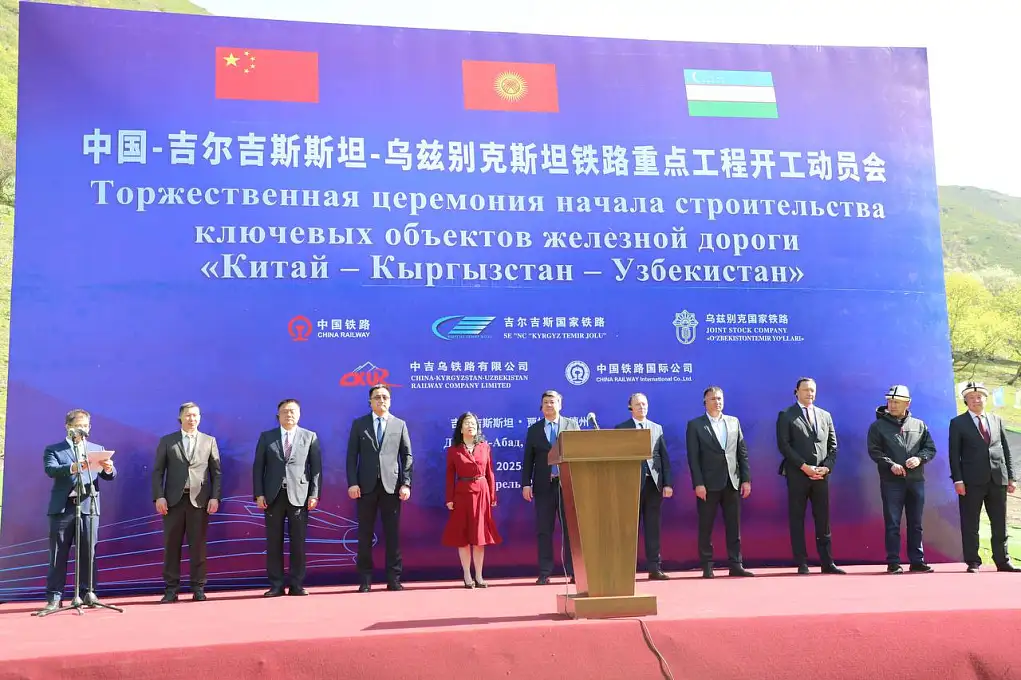
The $4.7 billion project will create another transport route between China and Central Asia, although its impact will depend on traffic volumes, border procedures and connecting corridors
Construction Could Finish Ahead of Schedule
Construction of the China–Kyrgyzstan–Uzbekistan railway is approximately 17% complete. Uzbek Transport Minister Ilkhom Makhkamov said the project, originally expected to require at least five years, could be completed one year earlier.
According to information released after officials inspected the construction sites, work is progressing simultaneously at several locations. Eight major bridges are under construction, with more than 10,000 workers and over 7,000 units of machinery and equipment deployed.
Early completion remains a forecast rather than an officially approved new commissioning date. The actual schedule will depend on tunnel excavation, equipment deliveries and construction progress across difficult mountainous terrain.
During talks in Cholpon-Ata on July 30, 2026, Uzbek President Shavkat Mirziyoyev described the railway as a project capable of changing Central Asia’s geopolitical position.
“This is the construction project of the century. This railway will completely change the region’s geopolitics,” Mirziyoyev said
Project Cost Is Estimated at $4.7 Billion
The international route, extending for roughly 530 kilometres, is intended to connect Kashgar in China’s Xinjiang region with Uzbekistan’s Andijan Region through Kyrgyzstan.
The most technically challenging section will run for approximately 304 kilometres across Kyrgyzstan. According to the Kyrgyz Cabinet of Ministers, the project includes 50 bridges and 29 tunnels with a combined length of around 120 kilometres.
Project specifications were revised during the design process. Earlier documents referred to a 312-kilometre Kyrgyz section with 81 bridges and 41 tunnels. Updated parameters were published after the financing agreement was concluded.
The total project cost is estimated at $4.7 billion. Around half of this amount will be provided by China through a 35-year loan to the joint project company, which will be responsible for repayment.
The remaining financing will be contributed as equity according to the following ownership structure:
- China — 51%;
- Kyrgyzstan — 24.5%;
- Uzbekistan — 24.5%.
The joint company will manage financing, construction and subsequent operation of the railway.
The Route Will Not Replace Existing Corridorsv
The project’s main geopolitical significance lies in creating an additional rail connection from China to Central Asia that does not pass through Kazakhstan or Russia.
Most rail freight between China, Central Asia and Europe currently moves through Kazakh border terminals before continuing along northern or Trans-Caspian routes. The new railway will allow part of this traffic to move directly through Kyrgyzstan into Uzbekistan.
However, the CKU railway will not displace existing corridors. Kazakhstan already has a much larger rail network, major border terminals and established container services. Northern and Trans-Caspian routes also have regular operators and established customer bases.
Instead, the new line is likely to intensify competition. Cargo owners will gain another routing option, while transit countries will increasingly compete on tariffs, border processing times and schedule reliability.
China Gains Another Western Gateway
For China, the railway will support the diversification of overland supply chains. It will provide a shorter connection between Xinjiang and the Fergana Valley, with access to Uzbekistan’s transport network.
Cargo could then continue:
- through Turkmenistan and Iran toward the Persian Gulf;
- across the Caspian Sea, Azerbaijan and Georgia toward Türkiye and Europe;
- through Afghanistan toward South Asian markets;
- through Uzbekistan’s rail network to other Central Asian countries.
The CKU railway is not itself a direct line to Iran or Türkiye. Its strategic value lies in creating an eastern link that can be integrated with several international corridors.
Uzbekistan’s official forecasts indicate that the route could carry up to 15 million tonnes annually and reduce delivery times to around ten days. Actual performance will depend on tariffs, capacity and coordination among all countries along the route.
Kyrgyzstan Gains a New Transit Role
For Kyrgyzstan, the project represents the development of its first major east–west railway. The country’s existing rail network remains fragmented, with northern and southern sections operating separately.
The CKU line will provide a foundation for new domestic rail connections, industrial sites, warehouses and transshipment terminals. Additional branches will still be required to fully integrate the national network.
Kyrgyz authorities and experts have estimated potential annual revenue from transit and related services at $150–200 million. These figures remain projections and will depend on actual freight volumes, infrastructure charges and the share of logistics services performed inside Kyrgyzstan.
The economic result will depend on whether the country can offer warehousing, consolidation, processing and rolling-stock services instead of serving only as a transit territory.
Uzbekistan Expands Access to Foreign Markets
For Uzbekistan, the railway will provide another direct route to China and strengthen the country’s role as a distribution hub between East Asia, Central Asia, the Middle East and Europe.
Tashkent will gain additional options for imports and exports, reducing dependence on any single transit direction. The route could be particularly important for industrial goods, machinery, textiles, agricultural products and containerized cargo.
Uzbekistan and Kyrgyzstan have also agreed to develop border and trade infrastructure along the railway, digitalize permit procedures and improve conditions for road carriers.
The three countries are considering a future permit-free road freight regime. This remains a policy objective, while existing permit requirements continue to apply.
Technical and Financial Risks Remain
One of the main technical challenges is the difference in rail gauge. China uses the 1,435 mm standard gauge, while Kyrgyzstan and Uzbekistan use the 1,520 mm gauge. The corridor will therefore require efficient transshipment facilities or bogie-changing technology.
Other factors affecting competitiveness will include:
- cargo handling costs at the gauge break;
- customs and border clearance times;
- tunnel and single-track capacity;
- availability of locomotives and wagons;
- schedule reliability in mountainous conditions;
- tariffs on connecting routes toward Iran, Türkiye and Europe.
The financial model also depends on future traffic. The joint company will have to service the Chinese loan, meaning lower-than-expected volumes or slow traffic growth could extend the payback period.
Geopolitics Will Change Through Corridor Competition
The China–Kyrgyzstan–Uzbekistan railway could significantly alter Central Asia’s transport geography. Kyrgyzstan will gain a new transit function, Uzbekistan will receive more direct access to China, and Beijing will secure another overland route toward western markets.
The change will not come through the disappearance of existing corridors, but through stronger competition among them. Kazakhstan, Russia, the Middle Corridor and southern routes through Iran will remain important.
The main result will be greater choice for carriers and cargo owners. If the participating countries can provide competitive tariffs, fast border processing and reliable schedules, the railway could develop from a political megaproject into a major component of Eurasian logistics.