

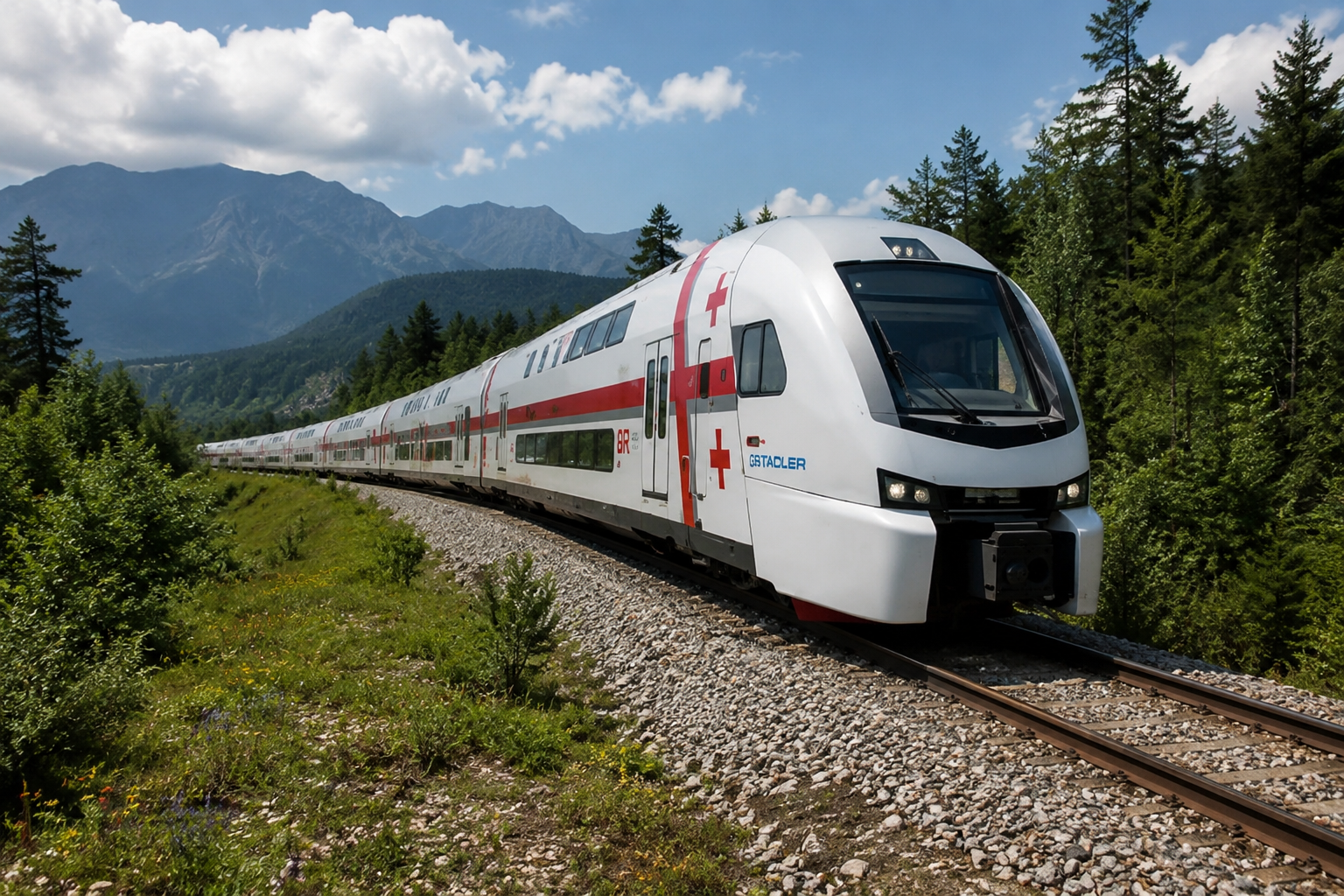
Georgia Plans to Raise Up to $1 Billion From ADB
The Georgian government plans to secure up to $1 billion in Asian Development Bank financing for road and railway infrastructure projects in 2026.
Finance Minister Lasha Khutsishvili previously said Georgia intended to sign the relevant financing agreements after discussions with ADB management. The figure therefore represents planned financing rather than $1 billion that has already been fully disbursed or secured.
ADB is one of Georgia’s largest international infrastructure financing partners. According to the Georgian government, the institution has provided nearly $6 billion to the country since the beginning of its operations there, with the Middle Corridor increasingly becoming a priority for transport investment.
Part of this investment is already being assembled through the Trans-Caspian Transport Corridor — Georgia Accessibility and Transport Enhancement, or TC-GATE, project. Its total value exceeds $750 million, including $372 million from the World Bank, with the remainder expected to be co-financed by the Asian Development Bank and Asian Infrastructure Investment Bank.
$1.7 Billion Planned for Railways Over Ten Years
At the same time, Georgian Railway has developed a unified ten-year railway development plan.
Deputy Economy and Sustainable Development Minister Tamar Ioseliani said indicative investment directly into the railway sector over the next decade would reach approximately $1.7 billion.
The program covers infrastructure, passenger and freight operations, rolling-stock renewal, digitalization and improvements in network efficiency.
A shorter Georgian Railway action plan for 2026–2028 was presented by Prime Minister Irakli Kobakhidze in April. It envisaged acquiring up to 50 new locomotives, 1,500 wagons and 10 passenger trains while introducing modern railway operating systems.
The government expects the program to double railway capacity and increase annual passenger numbers from around 2 million to 5 million.
As K2Cargo.News previously reported, Georgia and Kazakhstan are emerging as key hubs in Eurasia’s new logistics network, making railway modernization relevant well beyond Georgia’s domestic transport market.
Tender Launched for 45 Freight Electric Locomotives
The most concrete stage of the program began in August.
Georgian Railway launched an international tender worth around $350 million for 45 new mainline freight electric locomotives, with World Bank and ADB support.
The successful bidder will be responsible for design, manufacturing, delivery, testing and commissioning, together with warranty and long-term maintenance requirements.
The first locomotive is due within 27 months of contract award, while the entire fleet must be delivered within 55 months. Bids are scheduled to be submitted by October 30, 2026.
The contract also includes construction of a modern locomotive maintenance depot in Khashuri.
According to Georgian Railway, this will be the country’s first major purchase of new mainline freight electric locomotives since independence. The company currently operates 91 locomotives, many of which are more than 35 years old.
It is important to distinguish this procurement from the government’s earlier announcement. The three-year development plan referred to 50 new locomotives overall, while the active August tender specifically covers 45 mainline freight electric locomotives.
Tender for 10 Passenger Trains Has Not Yet Started
Passenger rolling-stock renewal is proceeding separately.
Georgian Railway has launched an international market survey for the acquisition of 10 new passenger electric multiple units with ADB support.
The purpose is to collect feedback from potential suppliers on technical specifications, qualification requirements, delivery schedules and procurement conditions.
Once the market consultation is completed, Georgian Railway plans to launch the international procurement process under Asian Development Bank procedures.
This means the purchase has not yet reached the formal tender stage. As of early August, it remained in market research and procurement preparation.
Five Existing Trains Are Also Being Modernized
Georgian Railway is simultaneously refurbishing part of its existing passenger fleet.
Five trains are scheduled for modernization during 2026, including upgrades to interiors, seating, flooring and lighting as well as other equipment required for passenger operations.
Deputy Economy Minister Tamar Ioseliani previously confirmed that five trains would be refurbished while Georgia prepares to acquire new rolling stock.
The approach allows Georgian Railway to improve available passenger capacity before the longer procurement process for entirely new trains is completed.
Tbilisi–Batumi Journey Has Already Fallen to Four Hours
Part of the infrastructure program is already producing visible results.
On August 6, Prime Minister Kobakhidze said railway travel time between Tbilisi and Batumi had been reduced from approximately 5.5 hours to four hours.
The four-hour target is therefore no longer only a future objective, as it was when the railway program was initially announced in spring 2026.
Plans also include developing a Tbilisi–Kutaisi service and restoring the Tbilisi–Akhaltsikhe passenger route, which has been suspended since 2009. The government has said the rebuilt connection should reduce the historical six-hour journey to around three hours.
Another project concerns the historic Borjomi–Bakuriani narrow-gauge railway. The government ordered the complete rehabilitation of the line, rolling stock and five stations, with services expected to return for the 2027 winter season.
Freight Investment Is Closely Linked to the Middle Corridor
For international logistics, the freight component of the program is particularly important.
Georgia’s railway network forms a central section of routes connecting Azerbaijan and the Caspian region with the Black Sea and Türkiye. It carries Middle Corridor freight, while the Baku–Tbilisi–Kars railway provides an onward land connection toward Türkiye and European markets.
New electric locomotives are intended to improve traction reliability and replace an ageing fleet. Under TC-GATE, the World Bank expects locomotive availability to rise to 95%, while improved railway performance is intended to support growing Trans-Caspian freight flows.
K2Cargo.News has examined these issues in detail in “Can the Middle Corridor Become Eurasia’s Main Alternative?”. The route’s competitiveness depends in part on how quickly Georgia, Azerbaijan, Kazakhstan and Türkiye can remove railway, port and border bottlenecks.
Georgian Railway Freight Volumes Are Already Increasing
The investment program comes as actual rail freight volumes are rising.
Georgian Railway transported 6.9 million tonnes of cargo during the first half of 2026, up around 10% year on year. Revenue increased 19% to GEL 352 million.
In June, the railway also handled 12,049 TEU of containers, its highest monthly container volume in the past decade, with increases across transit, import, export and domestic traffic.
These figures reinforce the importance of fleet renewal. Additional infrastructure capacity alone will not deliver its full benefit if ageing locomotives limit train availability, reliability and operating intensity.
Railways Must Develop Alongside Ports and Highways
Georgia’s strategy extends beyond Georgian Railway.
The Middle Corridor is a multimodal system, meaning rail investment has to be coordinated with the ports of Poti and Batumi, the developing Anaklia deep-sea port and the country’s international road network.
TC-GATE itself combines railway investment with road development in Kakheti. According to the World Bank, the road component is expected to reduce travel time between Telavi and the Port of Poti by around 43 minutes.
The combination of railways, highways, Black Sea ports and the Baku–Tbilisi–Kars line will ultimately determine how much additional freight Georgia can attract between Central Asia, the Caucasus, Türkiye and European markets.
For the transport industry, the key milestones will now be the signing of planned ADB financing agreements, the outcome of the 45-locomotive tender, the launch of formal procurement for the 10 passenger trains and progress on the proposed acquisition of 1,500 freight wagons.
Read also: Georgia Expands Poti Port to Strengthen the Middle Corridor