

Two New Truck Parks Open Between Latisana and Portogruaro
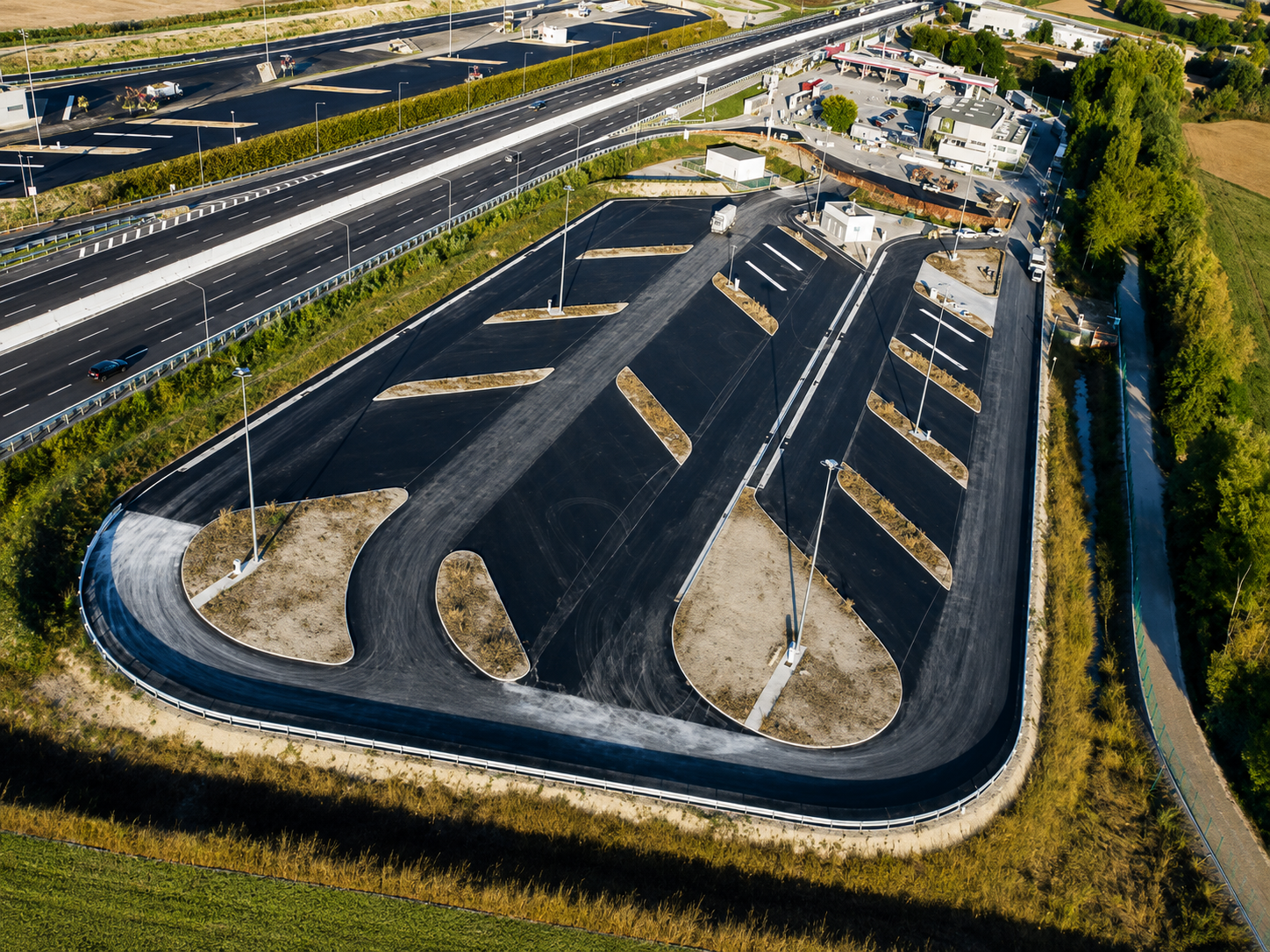
Two new heavy vehicle parking areas with a combined capacity of 161 spaces have opened on Italy’s A4 Venice–Trieste motorway.
Fratta Nord and Fratta Sud were officially inaugurated on July 24, 2026 between the Latisana and Portogruaro toll stations, near Fossalta di Portogruaro.
The project forms part of the modernisation programme for the motorway network managed by Autostrade Alto Adriatico. The total investment amounted to approximately €18.8 million.
One of the main objectives is to reduce the number of trucks stopping in emergency areas, acceleration and deceleration lanes, and other locations not intended for long-term parking.
The issue is particularly important on the A4 because of the high level of international freight traffic between northeastern Italy, Austria, Slovenia and Central Europe.
Fratta Nord Adds 107 New Spaces
Fratta Nord is the larger of the two facilities.
The parking area is approximately 500 metres long and 100 metres wide. Its fenced site covers 5.9 hectares, including around 2.8 hectares of paved surface.
A total of 107 new spaces have been provided. Another 35 existing truck parking spaces to the north of the service area remain available.
Part of the area near the service facilities has also been reorganised, with 11 spaces provided for coaches.
Fratta Sud is considerably smaller. It is around 200 metres long and covers approximately 2.4 hectares. The site provides another 54 spaces for heavy vehicles.
Eleven former parking spaces near the service area have been converted into seven coach bays.
Together, the two projects therefore add 161 new heavy vehicle parking spaces to this section of the A4.
Drivers Get Showers and Rest Facilities
The project involves more than simply adding paved parking capacity.
The new facilities include toilets, showers, food areas, rest facilities and self-service laundry services. Dedicated areas have also been created for damaged vehicles.
These sections include systems designed to collect possible leaks of fuel, oil and other hazardous substances.
The parking areas are monitored by video surveillance, while dedicated emergency access is available for rescue vehicles.
A grouted macadam surface has been used in the parking zones. The material is designed to withstand prolonged static loads from heavy trucks and provide greater long-term durability.
The quality of parking infrastructure is becoming increasingly important for European carriers. K2Cargo.News recently reported that Trimble CoPilot added booking access to more than 750 truck parks across 26 countries, highlighting growing demand not only for parking capacity but also for better journey planning.
Drivers Will See Real-Time Parking Availability
Fratta Nord and Fratta Sud include systems for displaying current parking occupancy.
Variable-message signs are being used to show drivers the number of available spaces in real time.
Some displays are located at the entrances, while additional signs are positioned along the motorway approximately 1.7 kilometres before the parking areas.
For carriers, this has a practical benefit. Drivers can determine whether a parking facility has available capacity before leaving the main carriageway.
This reduces the risk of entering a full rest area and then having to continue searching for parking shortly before reaching the legal driving-time limit.
A4 Recorded Around 15 Million Heavy Vehicle Passages
The scale of the parking project needs to be viewed in the context of traffic volumes on the A4.
More than 54 million vehicle passages were recorded on the corridor in 2025. Around 15 million involved heavy vehicles.
This means that more than a quarter of the traffic was linked to trucks.
The A4 Venice–Trieste forms part of one of Europe’s most important east–west freight corridors. It carries cargo between northern Italy’s industrial regions, Adriatic ports and markets across Central and Eastern Europe.
Heavy truck concentrations also create strong demand for safe rest areas. When official parking facilities are full, vehicles may stop on access ramps, exits or emergency lanes, increasing road safety risks.
Reducing this type of irregular parking is one of the main objectives of the Fratta project.
Italy Is Modernising More Than Parking Areas
The new truck facilities are part of a broader upgrade of the A4.
Several sections have already been expanded to three lanes. Around 76 kilometres of infrastructure have been modernised, including the transformation of the Villesse–Gorizia connection into the A34 motorway.
Autostrade Alto Adriatico plans to invest another approximately €1 billion over the next five years, including the completion of the third lane on the Veneto section of the A4.
Truck parking is becoming a separate infrastructure priority. Increasing motorway capacity without providing additional places for drivers to stop and rest would simply shift congestion into service areas and motorway access points.
Europe Is Expanding Truck Parking Capacity
Italy is not the only European country investing in heavy vehicle parking.
In Spain, Valencia’s regional government approved a project in July for a parking facility accommodating around 400 trucks at the Valencia Logistics Park in Riba-roja de Túria.
Another major Spanish development involves a covered truck parking facility with 383 spaces near the Bilbao–Zaragoza freight corridor.
These projects reflect a wider trend. Truck parking is gradually evolving from a basic roadside facility into a dedicated part of freight infrastructure offering security, digital occupancy monitoring and driver services.
The 161 new spaces on the A4 will not solve the truck parking shortage in northeastern Italy, but on a corridor handling millions of heavy vehicle movements every year, Fratta Nord and Fratta Sud should reduce pressure on existing rest areas and improve road safety.
Read also: Spain Builds Covered Truck Parking for 383 Trucks