

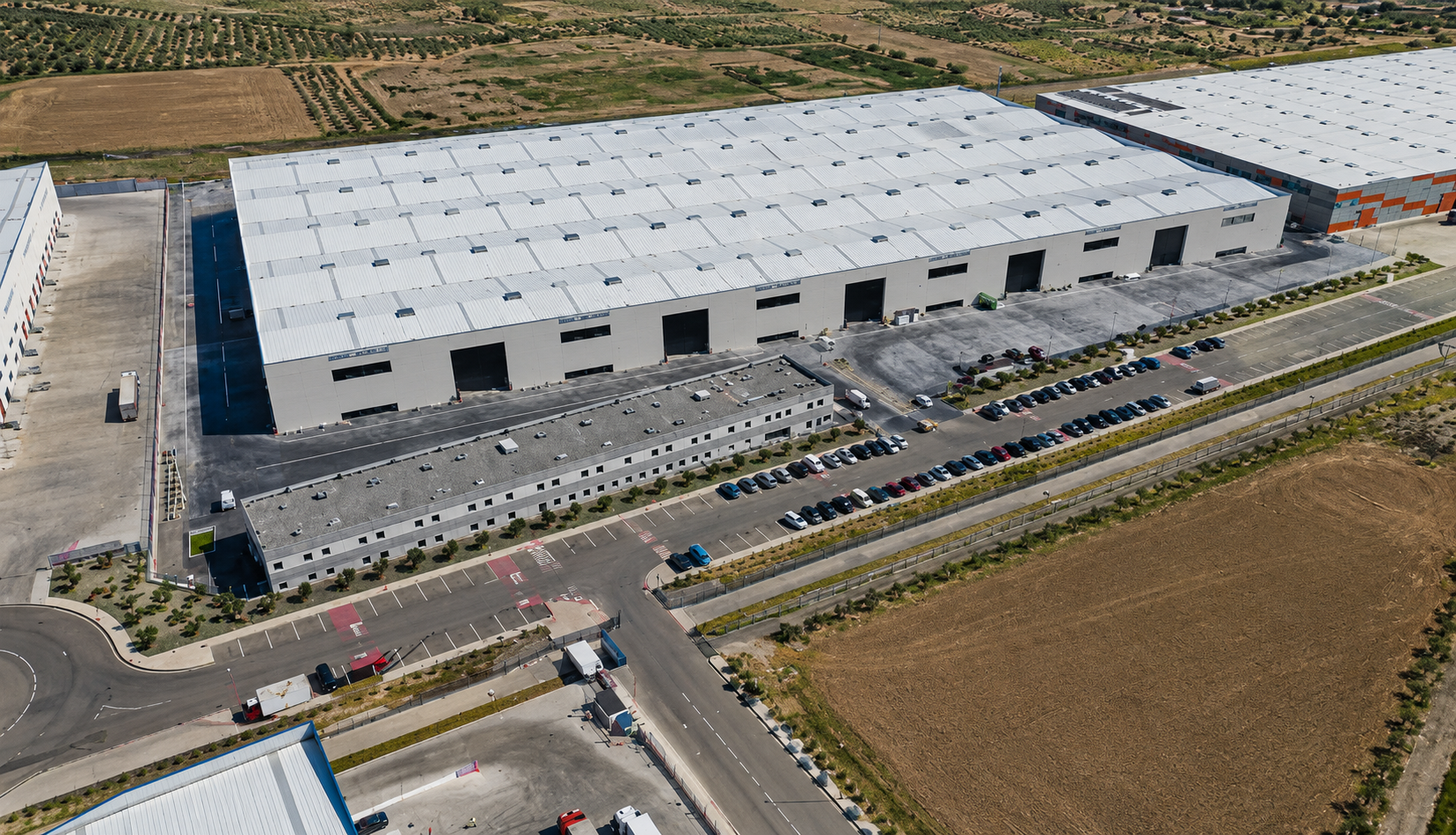
Spain is moving forward with one of the most ambitious truck parking projects in Europe. The Ecoparking Seguro Arnedo, developed by Grupo Arnedo, is located in El Villar de Arnedo, in the La Rioja region, near the important AP-68 and N-232 road corridors between Bilbao and Zaragoza.
The region in question is northern Spain, specifically La Rioja, an area positioned between the Basque Country, Aragón and the Ebro Valley logistics axis. For international road freight, this location is important because the Bilbao–Zaragoza route connects Atlantic port traffic, industrial regions, inland distribution networks and routes toward the Mediterranean corridor.
The project is unusual not only because of its scale, but also because of its format. Unlike traditional open-air truck parking areas, Ecoparking Seguro Arnedo is designed as a fully covered and enclosed structure located between two warehouse buildings. In practice, it resembles a logistics hall more than a conventional roadside parking site.
The facility will provide 383 truck parking spaces, protected from sun and rain, and will be supported by extensive services for professional drivers. The project also includes photovoltaic panels on the roof, charging infrastructure for electric trucks and a secured operating environment.
As K2Cargo News previously reported in “New Report Reveals Widespread Problems in Europe’s International Road Transport Sector”, driver fatigue, lack of safe parking and difficult working conditions remain key challenges for road freight across Europe. Spain’s new covered parking project directly addresses part of that problem — but also raises questions about the growing role of paid private infrastructure.
A Strategic Location Between Bilbao and Zaragoza
The Ecoparking Seguro Arnedo is located along one of Spain’s important freight corridors.
The AP-68 and N-232 routes connect Bilbao, Zaragoza and the wider Ebro Valley. This corridor is used by trucks moving between northern Spain, ports on the Atlantic side, inland logistics centers and industrial regions.
For carriers, parking availability along such corridors is not a secondary issue. Drivers need safe places to stop, rest, shower, eat and comply with EU driving and rest time rules. When such areas are missing or overcrowded, trucks often end up parked on road shoulders, industrial access roads, fuel stations or informal areas with limited safety.
That is why a secure parking facility with nearly 400 truck spaces can have regional significance. It can reduce pressure on roadside infrastructure and give carriers a more predictable option for route planning.
At the same time, the scale of the project also shows how serious Europe’s truck parking shortage has become. If a single private parking facility can become a major logistics event, it means the public network is still not providing enough capacity.
A Parking Hall Instead of an Open Yard
The most distinctive feature of Ecoparking Seguro Arnedo is its covered design.
The parking area is being built as a hall-like structure between two logistics buildings. It is fully enclosed and covered, with walls around the site, but open entrances without locked gates in order to ensure air circulation.
This design is intended to protect drivers and vehicles from sun, rain and harsh weather. In a country where summer temperatures can be high, covered parking can improve driver comfort and reduce heat exposure during rest periods.
Inside the hall, the layout includes six rows of parking spaces and four internal drive lanes, with room for 383 trucks. This makes the facility one of the largest secure truck parking areas of its kind in Spain and potentially one of the most unusual in Europe.
The concept reflects a broader shift in logistics real estate. Parking is no longer being treated as a basic asphalt surface. It is becoming part of a larger service ecosystem that includes security, energy, hospitality and fleet support.
Driver Services Go Far Beyond Parking
The project includes a separate services building for drivers.
According to Spanish transport media, the complex will offer 82 hotel rooms, a restaurant, cafeteria, self-service laundry, showers, free Wi-Fi, rest areas and even an outdoor swimming pool.
This is a major difference compared with many traditional truck parking areas, where drivers often face poor sanitary conditions, limited food options and low comfort levels.
For professional drivers, such services matter. Long-distance road freight is physically and mentally demanding. Drivers need rest facilities that allow them to recover properly, not just a place to park a vehicle.
Better services can also help carriers improve driver retention. In a market affected by driver shortages, working conditions are increasingly important. Parking facilities that offer real rest infrastructure may become part of the broader competition for professional drivers.
Security and Sustainability Are Central to the Project
The parking area is designed as a secure facility.
The site includes fencing, controlled access, 24-hour CCTV surveillance, lighting, fire protection systems, security personnel and intelligent parking management. These features are intended to reduce risks of cargo theft, vandalism and unauthorized access.
Security is a major concern for European road freight. Cargo theft, fuel theft and unsafe parking areas create costs for carriers, insurers and shippers. A secure parking area can therefore be valuable not only for drivers, but also for companies transporting high-value or sensitive goods.
The project also has a sustainability component. Photovoltaic panels are planned for the roof, and the site will include charging infrastructure for electric trucks. This fits the long-term transition toward lower-emission transport, although the practical use of electric truck chargers will depend on fleet adoption and route planning.
Ecoparking Seguro Arnedo also aims to meet high European standards for safe and secure truck parking, including ambitions linked to the EU’s top certification levels.
EU Funding Supports the Project
The investment is valued at €18.45 million, with €7.86 million co-financed by the European Union.
EU support reflects Brussels’ recognition that safe and secure truck parking is part of the trans-European transport network. The shortage of such facilities affects road safety, driver welfare, cargo security and the efficiency of freight corridors.
However, the project also highlights a more controversial issue.
Much of the European support for new secure truck parking is going to private, paid facilities. This can improve quality and security, but it does not fully solve the problem of free or affordable rest capacity along motorways.
For carriers, paid parking adds another operating cost. For drivers, it may create unequal access to safe rest if companies are unwilling to pay or if reimbursement procedures are unclear.
This is why the debate around Ecoparking Seguro Arnedo is bigger than one project. It reflects a wider European question: should safe truck parking be treated mainly as a private commercial service, or as essential public transport infrastructure?
Why Paid Secure Parking Is Controversial
The logic behind paid secure parking is clear.
High-quality facilities cost money. Land, construction, security staff, lighting, sanitation, maintenance, digital systems, fire protection, energy infrastructure and driver services require long-term investment. If the facility is to be secure and well maintained, operators need revenue.
But from the carrier’s perspective, the issue is more complex.
European road transport already faces rising costs: fuel, wages, tolls, fleet renewal, insurance, compliance and driver shortages. Adding parking fees can increase pressure on margins, especially for small and mid-sized hauliers.
There is also a practical problem. If safe parking is available but too expensive, some drivers may still choose informal or unsafe places to stop. That would weaken the safety objective.
For the EU, the challenge is to encourage high-quality parking without making basic rest infrastructure unaffordable for the transport sector.
What This Means for Logistics Companies
For logistics companies operating between Bilbao, Zaragoza and the wider Ebro Valley, Ecoparking Seguro Arnedo could become an important route-planning point.
The combination of parking capacity, driver accommodation, security and services may help carriers organize rest periods more predictably. It can also support companies transporting valuable, temperature-sensitive or time-critical cargo that requires higher security standards.
For shippers, secure parking can reduce the risk of cargo theft and delays. For drivers, it can improve rest conditions. For Grupo Arnedo, the project strengthens its logistics complex and positions La Rioja as a more important node in Spanish road freight.
At the same time, the project should not be seen as a full solution to Europe’s truck parking shortage. One advanced private facility cannot replace the need for a wider network of accessible, safe and affordable parking areas along major corridors.
A Model for the Future, but Not the Whole Answer
Ecoparking Seguro Arnedo is likely to attract attention because of its unusual covered design, scale and service level.
It shows what the next generation of truck parking could look like: secure, weather-protected, digitally managed, energy-efficient and integrated with logistics infrastructure. For drivers, this is clearly better than poorly maintained roadside areas or unsafe informal parking.
But the project also reveals the limits of the current European approach. If new high-quality parking capacity depends mainly on paid private projects, the continent may improve conditions for some drivers while leaving others without affordable options.
The real solution will require both models: private secure facilities for high-service needs and a broader public or mixed network of accessible rest areas along highways.
Spain’s project is therefore both a positive step and a reminder of the unfinished work. It improves safety and comfort on an important freight route, but it also shows that Europe still needs a more systematic parking strategy for truck drivers.
Read also: New Report Reveals Widespread Problems in Europe’s International Road Transport Sector