

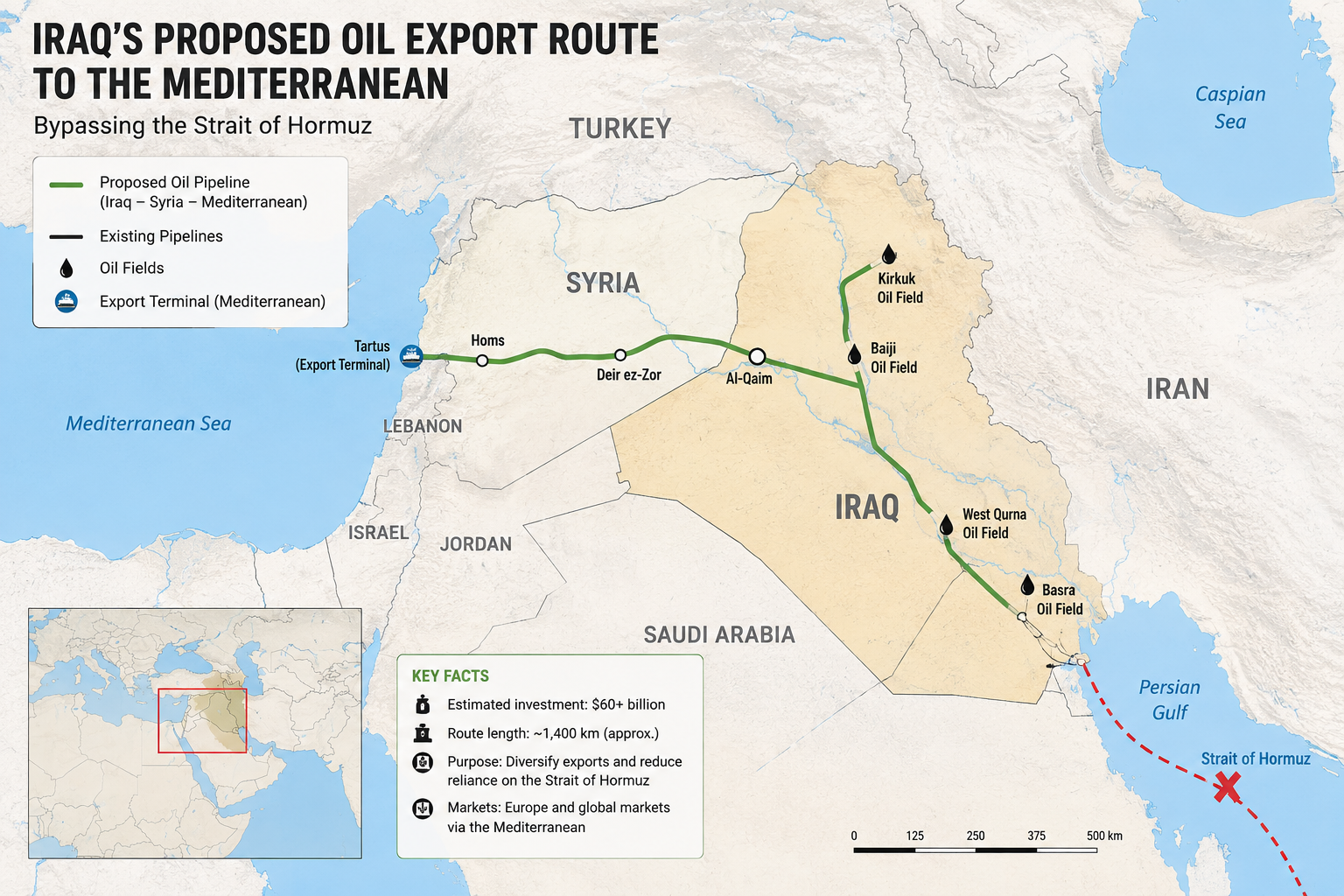
Iraq is preparing to reshape the Middle East’s energy map. Baghdad has signed more than $60 billion worth of agreements with Western energy companies aimed at developing new oil and gas fields while creating an alternative export corridor that bypasses the Strait of Hormuz.
The centerpiece of the strategy is a proposed pipeline running through Syria to the Mediterranean Sea. If completed, part of Iraq’s crude oil exports could reach global markets without passing through the Persian Gulf and one of the world’s most strategically vulnerable maritime chokepoints.
Why Iraq Wants an Alternative to Hormuz
The Strait of Hormuz remains one of the world’s most critical energy corridors, carrying a significant share of global crude oil and liquefied natural gas shipments. Every military escalation in the region immediately affects oil prices, shipping insurance premiums, and freight costs.
The new pipeline would allow Iraq to reduce its dependence on southern Gulf export terminals, strengthen its energy security, and improve access to European markets.
Among the project’s expected benefits are:
- an alternative export route during disruptions in the Persian Gulf;
- higher production through the development of new oil fields;
- billions of dollars in Western investment and advanced technology;
- shorter transportation distances to European refineries;
- reduced reliance on tanker traffic through the Strait of Hormuz.
Implications for Global Logistics
The new Mediterranean corridor could reshape regional energy logistics. Part of Iraq’s crude exports would shift away from the Persian Gulf toward Mediterranean ports, potentially shortening shipping distances to Europe while reducing dependence on both the Strait of Hormuz and the Suez Canal.
For shipping companies and marine insurers, the project could redistribute geopolitical risk. However, it would not eliminate those risks—it would move part of them from maritime routes to pipeline infrastructure crossing politically fragile territory.
Potential Risks from Iran
For Iran, the proposed corridor represents more than an infrastructure project—it could weaken one of Tehran’s most important geopolitical advantages.
For decades, Iran’s position along the Strait of Hormuz has provided strategic leverage over global energy markets. If a significant share of Iraqi oil begins flowing through Syria to the Mediterranean, that leverage would inevitably diminish.
Analysts believe Iran could respond through political pressure on Baghdad, increased influence over allied groups operating in Iraq and Syria, or diplomatic efforts aimed at slowing cooperation between Iraq and Western energy companies.
At the same time, direct interference could prove counterproductive by accelerating the development of additional export routes that bypass Hormuz altogether.
Syria Remains the Biggest Challenge
The pipeline would have to cross Syrian territory, where security concerns, political uncertainty, and territorial control remain unresolved. Protecting the pipeline, pumping stations, and export terminals would become a long-term operational challenge.
As a result, the project’s future will depend not only on financing and engineering, but also on the geopolitical relationship among Iraq, Syria, Iran, and Western governments.
A Project That Could Redraw the Region’s Energy Map
The planned $60 billion investment could transform Iraq into a more independent energy exporter while creating a new strategic corridor linking the Middle East with the Mediterranean.
But this is about far more than oil infrastructure. It is a contest over control of the trade routes that shape global energy security. If completed, the Strait of Hormuz will remain one of the world’s most important shipping lanes—but it may no longer be Iraq’s only gateway to international markets.