

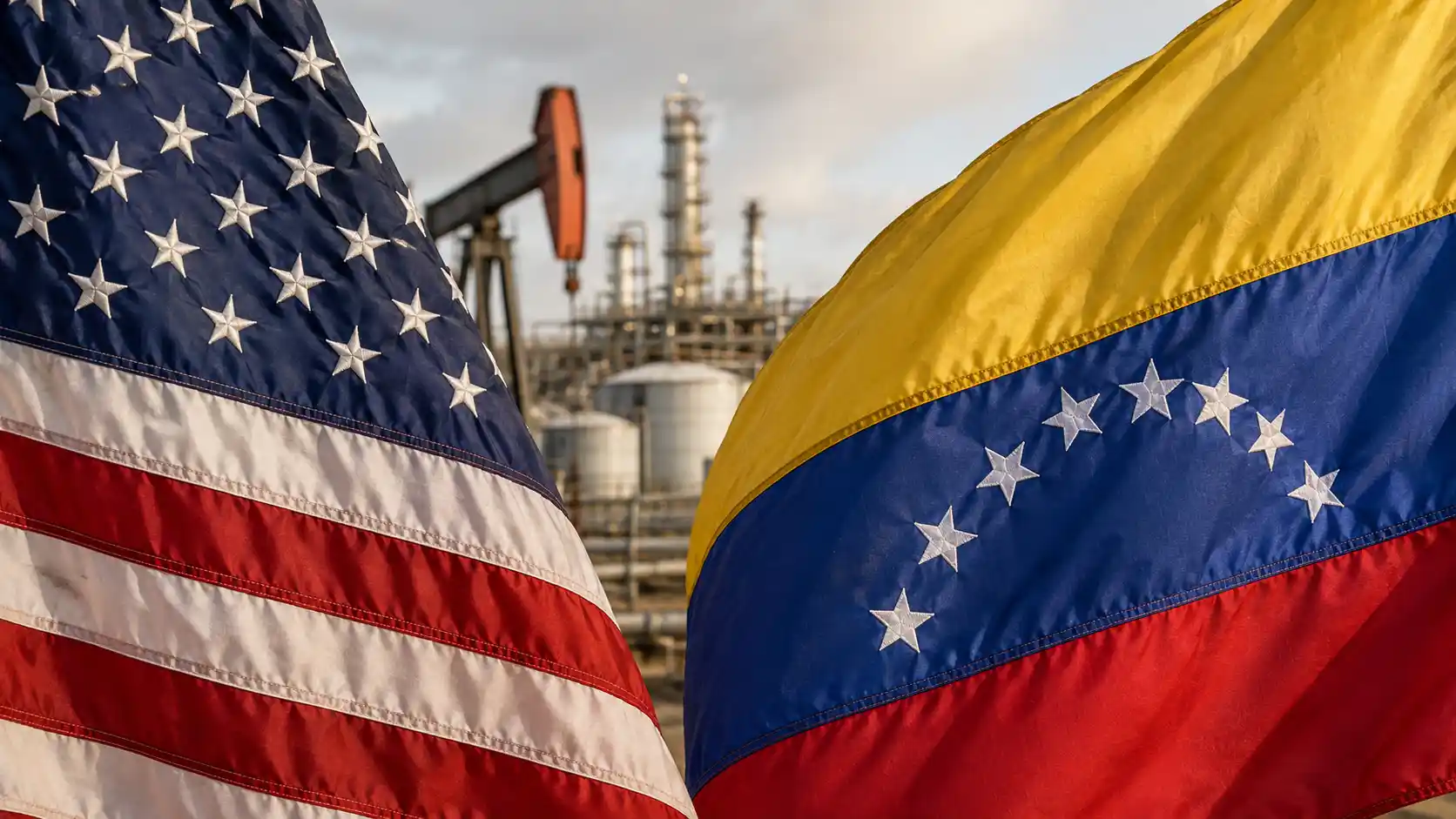
The agreement is intended to strengthen heavy-crude supplies to U.S. refineries and reduce energy risks before the congressional elections, but higher production will require major investment
U.S. Government Will Enter Venezuelan Oil Venture
The Trump administration plans to acquire a direct financial interest in a company expected to receive rights to develop 17 Venezuelan oilfields containing an estimated 65 billion barrels.
The volume represents approximately one-fifth of Venezuela’s proven reserves, which exceed 300 billion barrels. This does not mean, however, that Venezuela is transferring ownership of 20% of all national oil reserves directly to the United States.
According to The Wall Street Journal, development rights are expected to be granted to North American Blue Energy Partners, a private company associated with Venezuelan businessman Alejandro Betancourt.
The U.S. government would acquire a 35% passive stake in the company. The arrangement is also expected to give the United States the right to purchase 20% of future production at cost.
Negotiations Continued for Several Months
The agreement followed months of talks between Washington and Caracas. U.S. officials repeatedly visited Venezuela to discuss production recovery, operating conditions for foreign companies and future oil supplies.
The Pentagon is expected to participate in financing the venture. This would represent an unusual expansion of the Department of Defense’s role, giving it both a strategic interest and a financial stake in energy production.
“We have secured U.S. control over more than 65 billion barrels of Venezuela’s proven oil reserves,” Donald Trump said
The complete legal structure has not yet been publicly disclosed. The Wall Street Journal reported that the company could receive rights lasting up to a century, while Venezuela’s interim President Delcy Rodríguez described the project as a 25-year agreement.
The different periods may refer to separate corporate, licensing and production arrangements. They should not be treated as identical commitments until the full contract is published.
Seventeen Fields Are Included
Rodríguez said the project would cover 17 strategic oilfields and target production exceeding 1.5 million barrels per day.
Venezuela currently produces approximately 1.25 million barrels per day. Reaching the proposed level will require investment in wells, pipelines, storage facilities, export terminals and refineries.
The country’s oil infrastructure has suffered from years of limited investment, sanctions, equipment shortages and inadequate maintenance. Access to reserves therefore does not mean that the corresponding barrels can be brought to market immediately.
As K2Cargo.News previously reported, Venezuela is already shipping more than 500,000 barrels of oil per day to the United States. The United States is simultaneously supplying more than 100,000 barrels of naphtha per day to Venezuela to dilute its extra-heavy crude.
Venezuela’s Oil Infrastructure Requires Modernization
Most Venezuelan crude is heavy and has a high sulfur content. Its production, transportation and processing require specialized equipment and diluents.
Refineries along the U.S. Gulf Coast are configured to process these grades. Venezuela is therefore a practical supplier because the transportation distance is considerably shorter than routes from other sources of comparable heavy crude.
Raising production will require U.S. and international companies to invest in drilling, oilfield rehabilitation, electricity supply, pipelines and port infrastructure. Spare parts, drilling equipment and chemical products will also be needed.
Reuters has cautioned that substantial production growth will take time. The agreement is therefore unlikely to generate an immediate and significant reduction in U.S. gasoline prices.
Iran Crisis Increases the Deal’s Importance
Washington’s interest in Venezuelan oil has grown during the conflict with Iran and restricted navigation through the Strait of Hormuz. Before the war, approximately one-fifth of the world’s oil supply passed through the waterway.
Middle East instability is increasing tanker risks, insurance costs and fuel prices. Venezuelan supplies offer U.S. refiners a shorter route through the Caribbean and Gulf of Mexico.
For the tanker market, this could generate more regional voyages between Venezuela and U.S. oil terminals. Some crude previously shipped to Asia may also be redirected toward North America.
Venezuela cannot, however, replace the volumes exposed to the Hormuz crisis. Even the proposed production target of 1.5 million barrels per day is far below the prewar oil flow through the strait.
Venezuelan Oil Will Refill the U.S. Strategic Reserve
Trump said Venezuelan oil would be used to replenish the U.S. Strategic Petroleum Reserve. The stockpile held approximately 290 million barrels on August 21, placing it near a 44-year low.
“The topping-out process will begin shortly,” the U.S. president said
No detailed delivery schedule has been published. It remains unclear whether the oil will enter the reserve directly under the agreement, be purchased commercially or be exchanged for other crude grades.
Replenishing the reserve should improve Washington’s ability to respond to further supply disruptions. Additional government purchases could nevertheless support oil demand unless they are accompanied by a comparable increase in production.
The Deal Has Domestic Political Importance
The Wall Street Journal linked the accelerated oil agreement not only to energy security but also to the November 2026 midterm congressional elections.
Higher gasoline prices and unstable supplies could become a political problem for the Republican Party. The administration needs to demonstrate that it can protect the domestic market from Middle East disruption and secure sufficient crude for U.S. refineries.
The Venezuelan agreement allows Trump to present an alternative source of supply as a result of his foreign and energy policies. The actual benefit to consumers will depend on investment and production growth rather than the headline size of the reserves.
The agreement also ties Washington more closely to Venezuela’s current government. A U.S. government stake in a private oil company may raise questions about transparency, revenue distribution and the political terms of cooperation.
What Changes for Oil Logistics
If the project reaches its production targets, Venezuelan shipments to the Gulf Coast could become more regular. This would increase demand for tankers, terminal capacity, storage and Caribbean transshipment services.
U.S. refineries would gain additional access to suitable heavy crude, while Venezuela would receive investment, technology and a stable market. Reverse shipments of naphtha and equipment would create a two-way logistics chain.
The principal limitations remain infrastructure conditions, political risk, sanctions and the absence of published commercial terms. The 65 billion barrels should therefore be treated as the project’s resource base rather than oil that the United States will receive in the near term.
Read also: US Receives More Than 500,000 Barrels of Venezuelan Oil per Day