

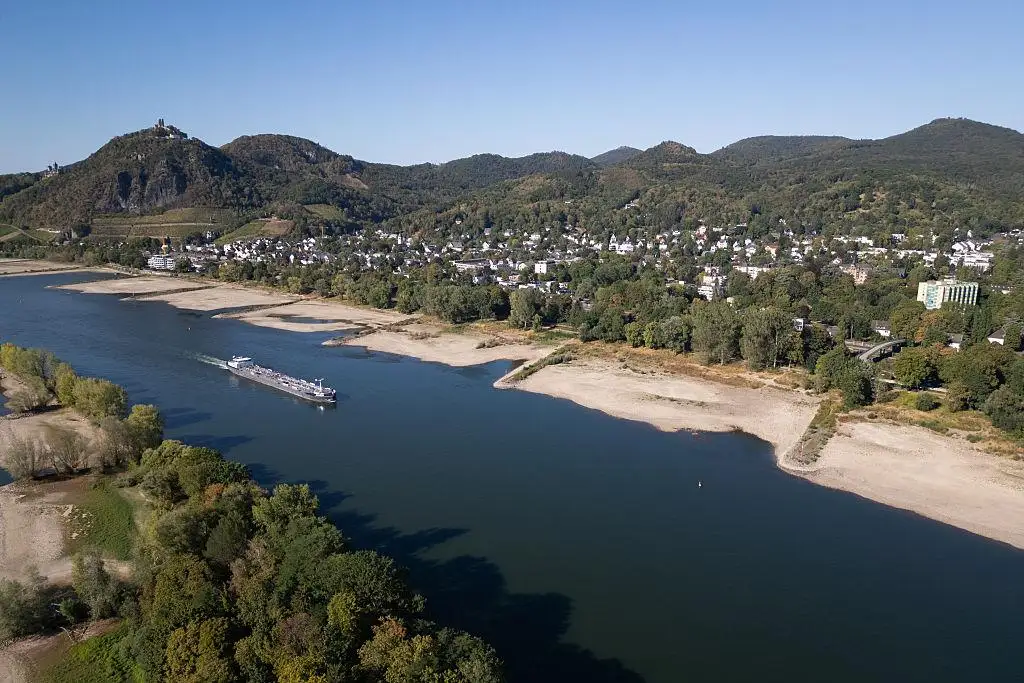
Rainfall has temporarily improved barge operations on the Rhine and Danube, although the level at the critical Kaub section remains below the equivalent low-water navigation mark
Heavy rainfall in parts of Europe has increased flows into the Rhine and temporarily reduced pressure on inland navigation.
According to Germany’s official ELWIS waterway information system, the Kaub gauge stood at approximately 60 centimetres on the morning of August 28. It briefly reached 75 centimetres during the initial rise following the rainfall.
This is substantially higher than the 6-centimetre reading recorded late on August 14. That figure represents a new provisional minimum, although it must undergo hydrological verification before being formally added to the historical record.
The latest forecast indicates a temporary increase to approximately 67–68 centimetres on August 29–30, followed by stabilization or a modest decline. The low-water period therefore cannot yet be considered over.
A 60-centimetre reading at Kaub does not mean that the Rhine is only 60 centimetres deep. The gauge measures the water level relative to a locally defined reference point and is used by operators to calculate the maximum safe vessel draught.
According to the Central Commission for the Navigation of the Rhine’s methodology, an equivalent water level of approximately 77 centimetres at Kaub corresponds to a guaranteed minimum fairway depth of around 190 centimetres. Operators must then subtract the required under-keel clearance.
The current 60-centimetre reading remains below the equivalent low-water mark. Barges can carry more cargo than during the most severe period in mid-August, but most vessels are still unable to use their full capacity.
The final loading decision depends on hull design, propulsion configuration, draught, cargo type and the safety margin required beneath the keel.
Water levels had been declining since June. By late July, the Kaub gauge had fallen below 40 centimetres, forcing some barges to operate at only around 20% of their normal loading capacity.
K2Cargo.News previously reported that the Rhine navigation gauge had fallen to 12 centimetres as cargo traffic nearly stopped. The subsequent decline to 6 centimetres made through commercial voyages across the shallowest section extremely difficult.
The entire Rhine was not formally closed. Some shallow-draught vessels continued to operate, but the passage through Kaub became technically impractical or commercially uneconomic for a substantial share of the fleet.
The transport system was therefore functionally divided. Vessels could continue operating between Antwerp, Rotterdam and Amsterdam and northern German destinations, as well as on selected southern sections, but reliable traffic between those areas was disrupted.
Reduced barge loading affected shipments of petroleum products, coal, ores, chemical feedstocks, grain, metals and containers. Transporting the same volume required more vessels and additional voyages, increasing freight costs.
Some cargo remained at maritime and inland terminals, complicating the movement of containers from Northern European ports and increasing the risk of storage congestion.
German industrial companies shifted part of their freight to road and rail. Land transport cannot quickly replace the Rhine, however: a single 1,500-tonne barge can carry approximately the same volume as 60 trucks.
In its latest market assessment, Drewry continues to identify low Rhine water levels as a factor disrupting cargo flows, despite the recent hydrological improvement.
On August 19, Drewry described the low-water situation as a serious threat to European supply chains. A Commerzbank scenario cited at the time estimated that critically low water persisting until mid-September could reduce Germany’s quarterly GDP by approximately 0.35 percentage point.
This was a conditional scenario rather than a calculation of damage already incurred. Higher water levels reduce the likelihood of the most severe outcome but do not reverse the disruption accumulated since June.
Companies have already faced higher freight rates, low-water surcharges, delivery delays and expenses associated with rerouting cargo. Some manufacturers reduced production because of raw-material shortages or difficulties shipping finished products.
The full economic impact will become clearer when third-quarter figures for industrial production, inland-waterway freight volumes and port operations are published.
Rainfall has also brought partial relief to the Danube basin, although conditions remain unstable. Barges on some sections had previously been limited to approximately 30% of their normal loading capacity, causing queues and longer delivery times.
Low water affected more than transport. Insufficient cooling water forced nuclear plants in Hungary and Romania to reduce output or temporarily shut individual reactors.
K2Cargo.News has reported how the Danube drought threatened nuclear power generation in Hungary and Romania. Authorities introduced temporary engineering measures to direct additional water toward cooling systems.
Higher river levels have allowed energy production to begin recovering. However, the Middle and Lower Danube normally experience their low-water season between August and October, leaving the region exposed to further restrictions.
The current rise has removed the immediate threat of a complete interruption at Kaub. Barges can load more cargo, and operators can begin moving some consignments accumulated during the crisis.
Nevertheless, a level of approximately 60–70 centimetres remains far below Kaub’s long-term average of about 208 centimetres. It also remains below the 77-centimetre equivalent low-water navigation mark.
A sustained recovery will require prolonged precipitation across the entire Rhine basin, including its Alpine tributaries. Local storms can rapidly lift the gauge, but their effect may disappear within several days.
Shippers should not yet return to normal loading assumptions or standard delivery schedules. Cargo moving through the Rhine and Danube corridors will continue to require additional lead time and the option of switching to rail or road transport.
Fuel, chemicals, coal and other bulk commodities require particular attention because replacing inland-waterway capacity is especially difficult.
Long-term adaptation will require more low-draught vessels, improvements to critical fairway sections, stronger railway alternatives and more accurate water-level forecasting.
The rainfall has given European logistics a temporary reprieve, but it has not removed the structural dependence of industrial supply chains on conditions along the Rhine and Danube.
Read also: HGK Proposes €12.5 Billion Renewal of 1,000 Inland Cargo Vessels