

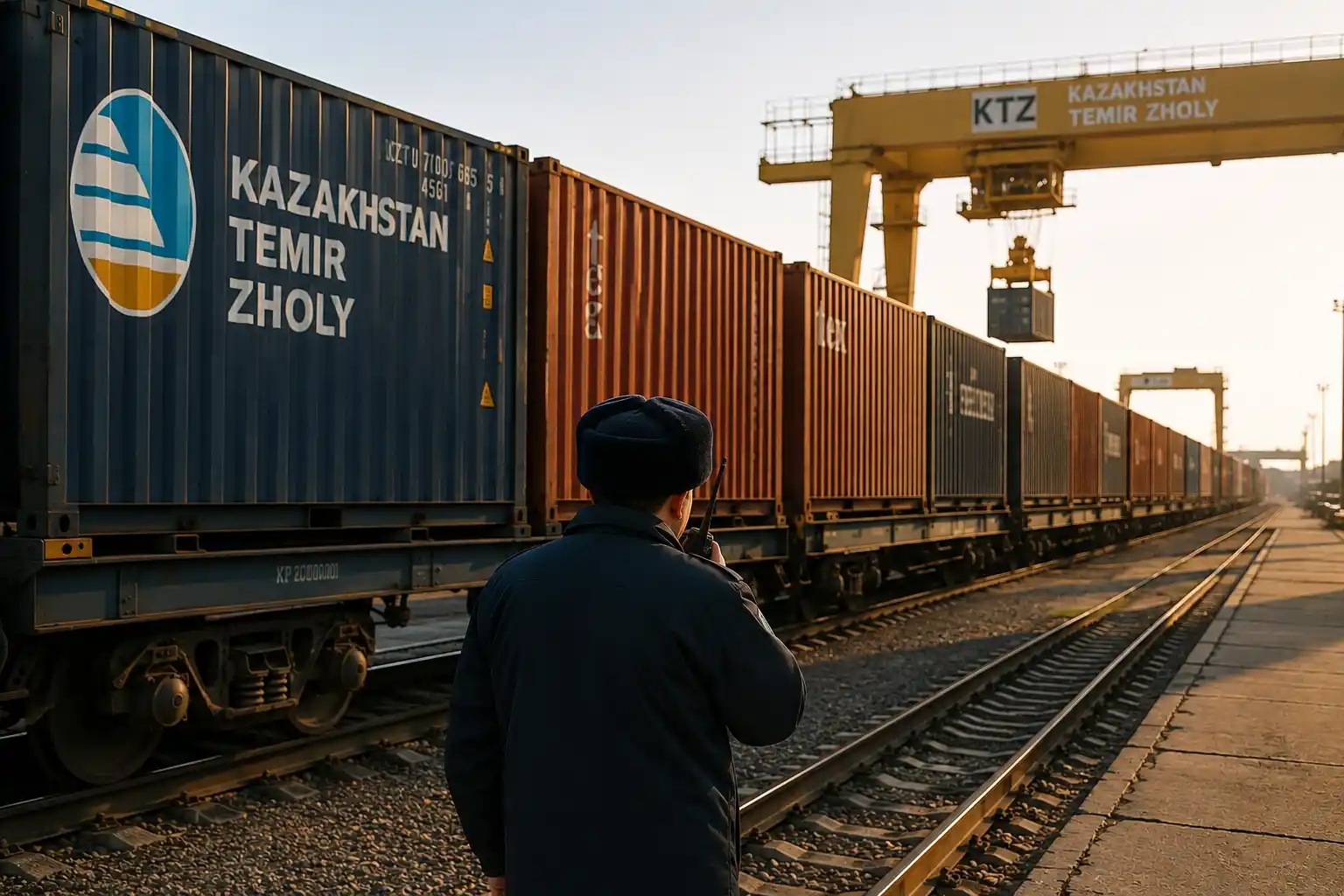
The automatic release of transit declarations has been expanded to new routes between China, Kazakhstan and Belarus. However, the sixfold reduction in processing time applies only to border control procedures.
Kazakhstan has expanded its pilot project for the automatic release of transit declarations for goods transported by rail. The new stage of the program took effect on August 17, 2026. The mechanism now applies to routes from Altynkol station via Brest-Vostochny to railway stations within the Brest Central hub, as well as the Temirzhol — Brest-Vostochny — Brest Central route.
The automation is designed to reduce the time required for government, including customs, controls and increase the capacity of railway border crossing points. Declarations are processed by an information system without the standard manual procedure when cargo information meets the established requirements and the operation does not require additional inspection.
The project is being implemented by Kazakhstan’s State Revenue Committee under the Ministry of Finance in cooperation with the national railway company Kazakhstan Temir Zholy.
Control Time Reduced Sixfold
According to the State Revenue Committee, automation has reduced the time required for a container train to pass through a border crossing from three hours to 30 minutes. This means that the control procedures themselves have become six times faster.
The program was launched in 2024 as part of the development of “through transit.” At the initial stage, automatic release was used on the Altynkol — Saryagash, Altynkol — Morport and Altynkol — Temirzhol — Brest-Severny routes.
During the first seven months of 2026, the number of declarations reached 92,100, or approximately 67% of the total recorded in the previous year. On European routes, 13,200 declarations were automatically released, 2.75 times more than during the whole of 2025. Central Asian routes accounted for 58,300 documents, while 20,600 were processed for the Trans-Caspian International Transport Route (TITR).
If the current pace continues, the annual figure could exceed the 2025 result. However, the number of declarations cannot be directly equated with the number of trains, containers or the volume of cargo transported, as a single train or logistics operation may involve different numbers of documents.
The statistics also indicate a change in the structure of transit flows. The share of European routes has increased, while Central Asia remains the largest category by the number of declarations processed.
Paper Documents Gradually Phased Out
The project provides for the elimination of paper documents and physical customs stamps. Data on trains, consignors, consignees, routes and goods are transmitted to information systems in advance.
The effectiveness of the system therefore depends on coordinated operations among shippers, freight forwarders, railway operators, customs representatives and government information platforms.
Automation is part of Kazakhstan’s strategy to strengthen its role as a transit hub connecting China, Central Asia and Europe.
Read also: Kyrgyzstan Launches Next Stage of Junda Refinery Upgrade for Euro 5 Fuel Production