

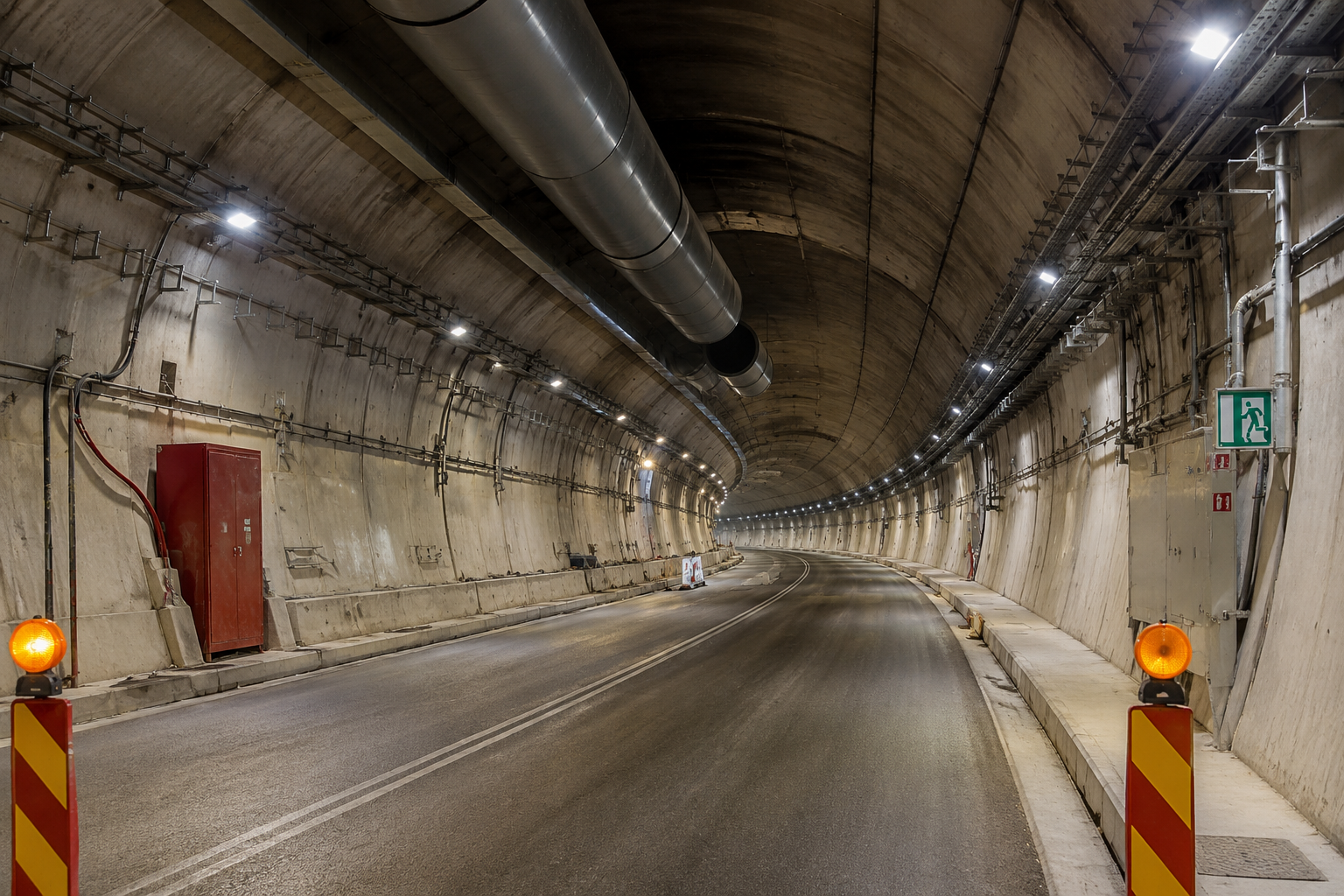
Tallinn and Helsinki Could Be Linked by Rail
Estonia is once again putting the proposed Tallinn–Helsinki railway tunnel on the European transport agenda.
Foreign Minister Margus Tsahkna has argued that the potential fixed link beneath the Gulf of Finland should be viewed as much more than a connection between two neighboring capitals.
According to Tsahkna, the tunnel could become part of a strategic corridor linking the Baltic states and Rail Baltica with Finland, Northern Scandinavia and potentially routes extending toward the Arctic Ocean.
Tsahkna raised the proposal on May 13, 2026, at the EU Strategy for the Baltic Sea Region Annual Forum, connecting infrastructure development with regional security, economic resilience and competitiveness.
Helsinki Mayor Daniel Sazonov also backed renewed consideration of the idea, describing the tunnel as a potential missing link between Rail Baltica and transport corridors extending into Northern Scandinavia.
No Construction Decision Has Been Made
The renewed political discussion does not mean that construction has been approved.
Neither Estonia nor Finland has announced a new approved budget, final alignment or construction schedule for the tunnel in 2026. Tsahkna’s comments are a call to reconsider the project under a changed geopolitical environment.
It would therefore be premature to say that Estonia is already building the tunnel or that the two governments have reached a final agreement to implement it.
Major obstacles remain, including cost, engineering complexity and the need for coordination between Estonia, Finland, European institutions and infrastructure operators.
Previous Study Estimated the Project at €13–20 Billion
The most detailed public examination of the idea came through the FinEst Link feasibility study carried out in 2016–2018.
The project involved the Helsinki-Uusimaa Regional Council, the cities of Helsinki and Tallinn, Harju County, Finnish transport authorities and Estonia’s Ministry of Economic Affairs and Communications.
The study proposed an alignment of approximately 103 kilometers, which would make it the world’s longest undersea railway tunnel if constructed.
At the time, investment costs were estimated at €13–20 billion, with a central estimate of around €16 billion. The calculation included the tunnel, stations, terminals, depots and two artificial islands.
The proposed link could reduce Helsinki–Tallinn journey time to around 30 minutes. Under the 2018 scenario, construction could take approximately 15 years, with operations envisaged around 2040. These are historical feasibility-study estimates, not a current approved budget or construction timetable.
Rail Baltica Changes the Strategic Case
One major difference between today and the discussions of a decade ago is that Rail Baltica has moved into large-scale construction.
The new 1,435-mm European-standard railway is designed to connect Tallinn, Pärnu, Riga, Panevėžys, Kaunas and Vilnius with Poland and the wider Central European rail system. Rail Baltica covers approximately 870 km across Estonia, Latvia and Lithuania.
According to RB Rail, more than 40% of the main line is already under construction or construction-ready. In Estonia alone, work is progressing on more than 100 km of the main line. The project continues to work toward a 2030 Phase I target, although the promoter says maintaining the schedule depends on timely financing.
This changes the economic logic of a Helsinki–Tallinn tunnel. Without a fixed link, Rail Baltica effectively reaches its northern end in Tallinn, while onward connectivity with Finland still depends on maritime transport.
A tunnel could potentially create a continuous rail axis from Finland through the Baltic states and Poland into Central Europe.
As K2Cargo.News has previously reported, European freight flows are expected to shift increasingly toward Central and Eastern Europe by 2030, increasing the strategic relevance of infrastructure across the Baltic region.
Freight Could Be as Important as Passenger Traffic
Although the tunnel is often presented as a way to shorten passenger journeys between the two capitals, its potential freight role could be equally important.
FinEst Link was designed as a combined passenger and freight railway concept. A permanent connection beneath the Gulf of Finland could provide Finnish industry with a direct rail route through Estonia, Latvia, Lithuania and Poland toward continental European markets.
Rail Baltica itself is also being developed as dual-use infrastructure supporting passenger and freight transport as well as military mobility during crises. Official project materials describe it as an important element of regional resilience and security.
This reflects a wider European shift in which major railway projects are increasingly viewed as both economic and strategic infrastructure. K2Cargo.News has also reported that Austria is committing €19.5 billion to railway infrastructure through 2032, including investment in major international corridors and tunnel projects.
The Corridor Could Extend Toward the Arctic
Under Tsahkna’s current vision, Tallinn–Helsinki would be only one section of a much longer transport system.
The Estonian foreign minister wants the tunnel to connect Rail Baltica with Northern Scandinavia and ultimately be viewed as part of a corridor extending toward the Arctic.
This approach corresponds with the broader TEN-T transport logic linking Warsaw, Kaunas, Riga, Tallinn, Helsinki and northern European regions.
For freight logistics, such a connection could provide an additional land-based route between Finland and continental Europe without requiring a maritime transfer between Helsinki and Tallinn.
The focus on resilient alternative corridors is also visible elsewhere in Europe. For example, Moldova and Ukraine recently agreed to develop alternative freight routes as part of efforts to strengthen transport resilience.
A Six-Hour Helsinki–Warsaw Journey Is Not Yet Confirmed
Some reports about the project claim that a future rail journey from Helsinki to Warsaw could take only six hours.
That figure should be treated cautiously.
Current official Rail Baltica material gives an estimated Tallinn–Riga journey time of 1 hour 42 minutes and Tallinn–Vilnius of 3 hours 38 minutes. Historical projections have also suggested very fast Tallinn–Warsaw connections, but there is currently no approved operating timetable for a direct Helsinki–Warsaw train.
FinEst Link separately estimated approximately 30 minutes between Helsinki and Tallinn.
The eventual total journey time would therefore depend on the final Rail Baltica configuration, Polish infrastructure, stopping patterns and tunnel operations. A guaranteed six-hour Helsinki–Warsaw journey cannot yet be treated as an established project parameter.
Chinese Capital Was Considered in an Earlier Proposal
The tunnel attracted significant attention between 2017 and 2019.
Alongside the publicly backed FinEst Link study, entrepreneur Peter Vesterbacka and FinEst Bay Area Development promoted a separate private project.
In March 2019, the company announced a memorandum with China’s Touchstone Capital Partners covering potential financing of around €15 billion. The proposal was associated with China’s Belt and Road initiative, although the highly ambitious construction timetable announced at the time was never realized.
The current Estonian proposal should therefore not be interpreted as an automatic revival of the previous Chinese-funded model.
Tsahkna’s arguments instead focus on integration with Europe’s transport network, regional security and the connection with Rail Baltica.
Geopolitics Has Changed the Value of Transport Corridors
Since 2022, major infrastructure projects in Northern and Eastern Europe have increasingly been evaluated not only in economic terms but also through the lens of security.
Rail Baltica is officially described as dual-use infrastructure capable of supporting civilian transport and military mobility. It will also connect the Baltic states more closely to Europe’s 1,435-mm standard-gauge rail network, reducing dependence on the region’s legacy 1,520-mm system.
In this context, a permanent Finland–Estonia connection could have significance well beyond tourism and passenger mobility, affecting freight, industrial supply chains and strategic logistics.
However, moving the tunnel from political discussion back into a practical development phase would require a new feasibility and financing assessment. The cost estimates produced in 2018 are now outdated, and a project of this scale would be extremely difficult to implement without EU participation and firm political support from Finland.
For now, the Tallinn–Helsinki tunnel remains a strategic proposal rather than an approved construction project.
Read also: European Freight Transport by 2030: Major Cargo Flows Shift Eastward