

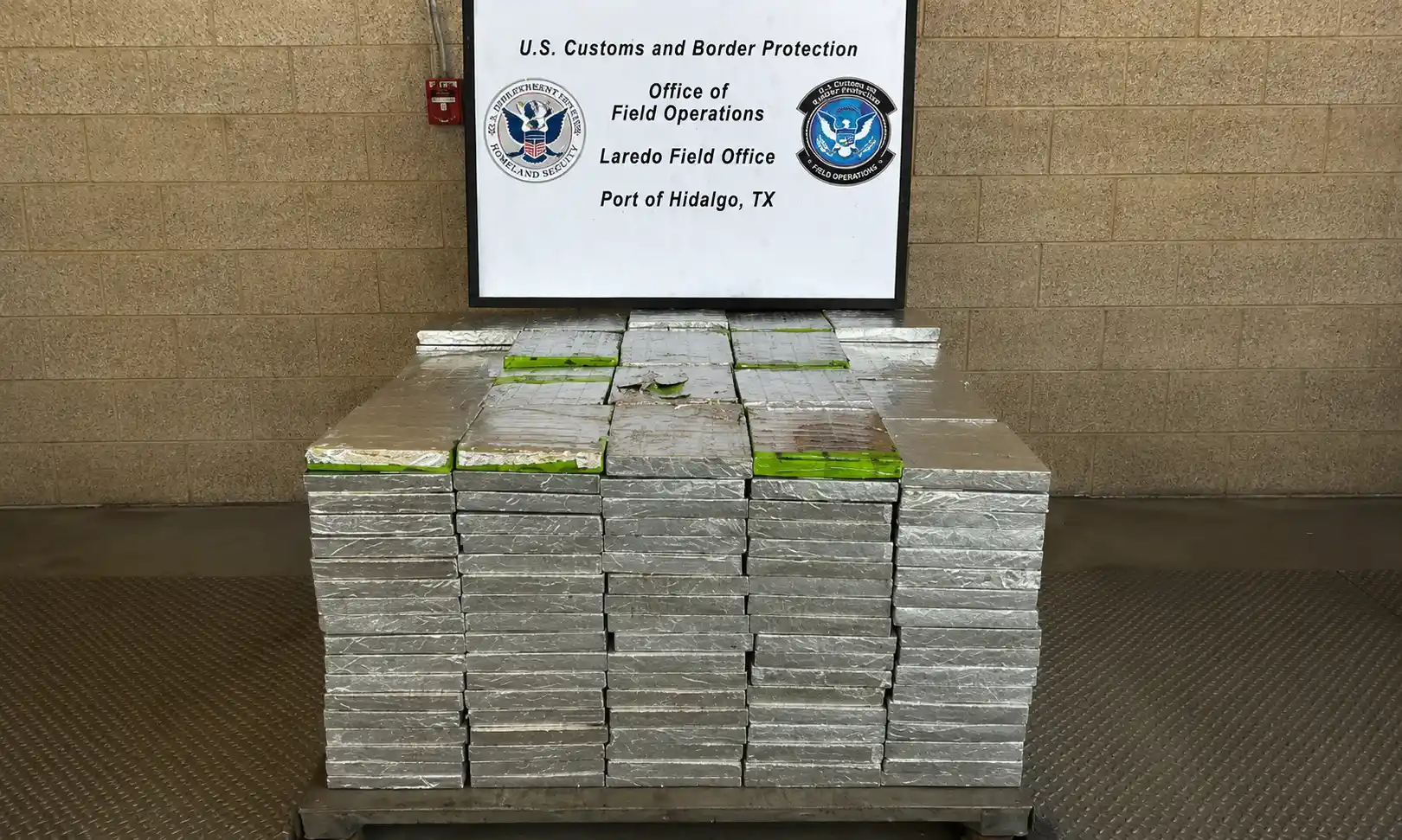
Officers discovered 395 packages during an inspection of a commercial shipment at the Pharr International Bridge before seizing the vehicle and referring the case to federal investigators
Truck Arrived from Mexico with a Shipment of Leeks
U.S. Customs and Border Protection officers discovered 395 packages of alleged methamphetamine inside a tractor-trailer travelling from Reynosa, Mexico, to Texas. The incident occurred on August 22, 2026, at the Pharr International Bridge cargo facility.
The shipment was manifested as leeks. This means the declared cargo was not ordinary bulb onions but a commercial shipment of the vegetable commonly transported in refrigerated or enclosed trailers.
The suspected narcotics had a combined weight of 1,204.82 pounds, or 546.5 kg. CBP estimated their value at $10.75 million, according to the agency’s official announcement.
Secondary Inspection Revealed Anomalies
After the truck arrived at the border crossing, CBP officers referred it for secondary examination. They used nonintrusive inspection equipment capable of examining the contents of a commercial vehicle before the cargo is physically unloaded.
The screening revealed anomalies inside the trailer. A canine team subsequently examined the vehicle, and the dog alerted officers to the possible presence of narcotics.
During the physical inspection, officers extracted 395 packages from the cargo area. CBP described the substance as alleged methamphetamine, a legally cautious formulation used before laboratory testing and criminal proceedings are completed.
The agency did not disclose precisely how the packages were concealed within the declared leek shipment.
CBP Valued the Shipment at $10.75 Million
The stated $10.75 million figure represents CBP’s estimated value of the suspected narcotics. It does not refer to the value of the legitimate vegetable cargo or financial losses incurred by the carrier.
CBP’s Office of Field Operations seized the suspected drugs and the tractor-trailer. Special agents with Homeland Security Investigations initiated a criminal investigation.
At the time of publication, authorities had not announced any arrests or criminal charges. CBP also withheld the identities of the driver, carrier, shipper, consignee and customs broker, as well as the shipment’s intended final destination.
The absence of this information means that no conclusion should be drawn about the involvement of the driver or transportation company until investigators release verified findings.
CBP Reports a Major Disruption to Smuggling
Carlos Rodriguez, port director for the Hidalgo/Pharr/Anzalduas Port of Entry, credited frontline officers with disrupting the suspected smuggling operation.
“The efforts of our CBP officers continue to be illustrated with massive disruptions of smuggling attempts at our international crossings,” Carlos Rodriguez said
The Pharr International Bridge is an important commercial crossing between Pharr, Texas, and Reynosa in the Mexican state of Tamaulipas. It handles substantial volumes of cross-border truck freight, including agricultural and perishable products.
The large flow of time-sensitive goods makes rapid customs clearance commercially important. At the same time, criminal networks may attempt to exploit legitimate supply chains to conceal prohibited cargo.
What the Case Means for Carriers
The incident demonstrates that a cargo description matching routine transport documents does not prevent a shipment from undergoing additional screening. Trucks may be referred to secondary inspection following document analysis, risk assessment, imaging results or a canine alert.
For compliant carriers, such cases highlight the importance of controlling access to vehicles, checking seals and documenting every stage of loading. Companies should preserve records showing who supplied the cargo, where the truck was parked and who had access to the trailer.
Additional caution is appropriate when dealing with unfamiliar shippers, intermediaries or unusually profitable transport orders. Even full compliance cannot eliminate the possibility of delays if border officers identify an anomaly and order a physical examination.
As K2Cargo.News previously reported, logistics companies and freight forwarders have become part of the enforcement system governing cargo, routes and transport documentation. Deliberately false information can lead not only to delivery delays but also to criminal investigations.
Criminal Investigation Continues
Homeland Security Investigations is leading the criminal inquiry. Investigators will seek to determine the origin of the suspected narcotics, identify the parties who organized the shipment and establish its intended route after entering the United States.
Until laboratory analysis and the criminal process are complete, the seized substance should be described as alleged methamphetamine. Its discovery does not by itself establish the guilt of a specific driver, carrier or cargo owner.
Read also: Freight Forwarding Manager Sentenced for Violating U.S. Export Controls