

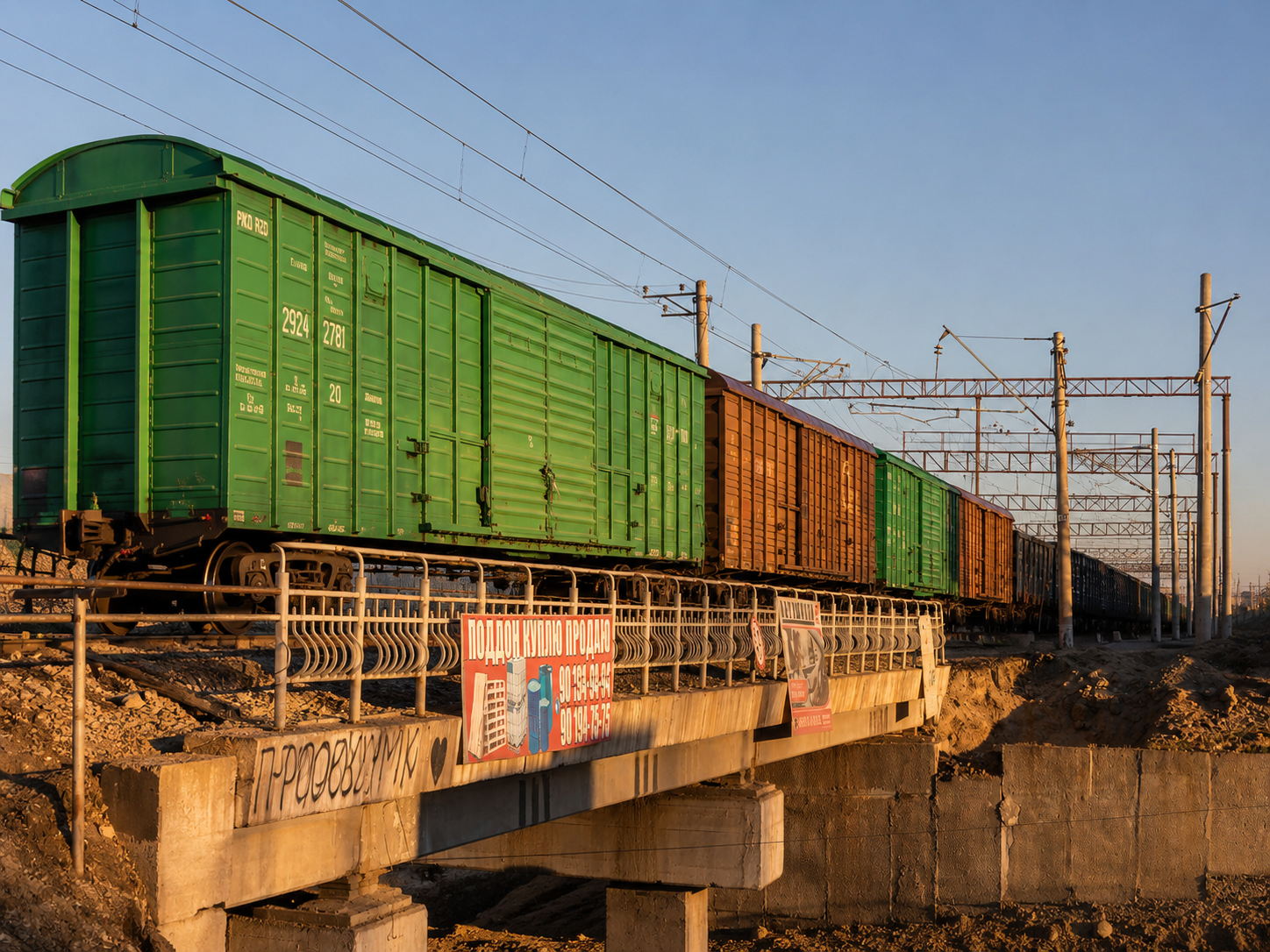
Businesses Face a Severe Wagon Shortage
Uzbekistan plans to attract approximately 10,000 available freight wagons from partner countries with the participation of private transport and logistics companies.
The initiative follows renewed complaints from businesses about shortages of rolling stock and difficulties organizing rail shipments.
Railways carry approximately 70% of Uzbekistan’s foreign-trade cargo, equal to about 46 million tonnes annually. A lack of wagons therefore affects domestic deliveries as well as exports, imports and transit operations.
Government agencies have been instructed to prepare calculations within ten days and determine how private operators can participate.
Possible arrangements may include leasing, long-term rental, joint operation or agreements with foreign rolling-stock owners. The final commercial model has not yet been announced.
Domestic Production Cannot Meet Demand
Uzbekistan is expanding its own freight-wagon production, but current output remains insufficient.
Since the beginning of the year, cement manufacturers have not received approximately 2,800 wagons they requested.
A plan to supply around 1,300 additional freight wagons in the second half of the year will not fully cover the shortage.
Authorities had previously set a target of increasing annual production to 2,000 freight wagons. Another $100 million is expected to support industrial capacity and the supply of 1,350 wagons. Between 2023 and 2025, domestic manufacturers produced 1,590 gondola wagons.
Foreign Wagons Could Provide a Faster Solution
Attracting existing rolling stock from neighbouring markets would increase capacity more quickly than waiting for the entire fleet to be manufactured domestically.
Producing 10,000 wagons would require several years, substantial capital and larger industrial facilities.
Foreign rolling stock may be available from countries using the 1,520-millimetre railway gauge, including Kazakhstan and other members of the wider regional rail network.
The parties will need to negotiate rental rates, maintenance responsibilities, border procedures, return conditions and the allocation of wagons among shippers.
Empty mileage will also affect costs. A wagon that has to return without cargo may become significantly more expensive to operate.
Cement Producers Have Been Unable to Ship Products
The shortage is particularly serious for industries transporting large quantities of bulk commodities.
Cement manufacturers depend heavily on gondola wagons and specialized rolling stock. Road transport can serve shorter routes, but it is generally more expensive for large long-distance shipments.
When a plant does not receive the requested wagons, finished products accumulate in storage. Production may need to slow, while customers and export contracts face delays.
Similar problems may affect coal, ore, fertilizer, grain, metal and construction-material shipments.
The rolling-stock deficit has therefore become a constraint on broader industrial growth rather than an issue affecting the railway sector alone.
Three Major Routes Are Overloaded
Uzbekistan is also experiencing capacity limitations on several key railway lines.
The Angren–Pap, Tashguzar–Kumkurgan and Tashkent–Samarkand routes are operating under heavy pressure.
Angren–Pap connects the Tashkent region with the densely populated Fergana Valley and is strategically important for domestic freight.
Tashguzar–Kumkurgan provides access to southern Uzbekistan and routes toward Afghanistan.
Tashkent–Samarkand carries both passenger and freight trains, limiting the number of additional services that can be added to the timetable.
More Wagons Alone Will Not Solve the Problem
Increasing the rolling-stock fleet will have limited effect unless the network can accommodate more trains.
Additional tracks, station modernization, better signalling, new locomotives and faster train processing are all required.
Sending more wagons into an already congested corridor may increase turnaround times. Rolling stock would spend longer waiting for train formation, locomotive availability or clearance through overloaded sections.
As a result, the productivity of every wagon could decline.
The foreign-wagon programme must therefore be coordinated with infrastructure expansion and digital traffic management.
Uzbekistan Seeks $200 Million from the World Bank
The government has been instructed to agree on $200 million in World Bank financing for railway infrastructure development by the end of the year.
The funds could support capacity upgrades, station modernization, digital systems and work on congested sections. A final project list and financing terms have not yet been disclosed.
International-bank financing normally requires feasibility studies, environmental and social assessments, competitive procurement and monitoring of project results.
The proposed funding would allow investments to be spread over several years while reducing immediate pressure on the state budget.
However, $200 million will cover only part of the railway network’s total requirements.
Prosecutors Will Review Previous Spending
Uzbekistan’s Prosecutor General’s Office has been instructed to examine how funds allocated for freight-wagon expansion were used.
The agency will also review the current system through which wagons are provided to businesses.
When demand exceeds supply, transparent allocation becomes particularly important. Authorities will need to determine whether wagons remain idle, whether applications are processed fairly and why businesses experience prolonged shortages.
A digital allocation platform could show application order, wagon availability, expected delivery time and reasons for rejecting a request.
The review is expected to result in proposals for improving transparency.
Private Operators May Gain a Larger Role
The plan to involve private companies indicates a gradual shift toward a more competitive wagon market.
Private operators can purchase or lease rolling stock and offer it to businesses on commercial terms.
This reduces shippers’ dependence on one state-controlled source and encourages companies to improve wagon turnaround.
The model will require equal infrastructure access, predictable locomotive-service charges and transparent approval procedures.
Private ownership alone will not guarantee timely transport if congested railway lines remain the main bottleneck.
Trade Growth Is Increasing Pressure
Demand for rolling stock is rising alongside foreign trade and industrial output.
Uzbekistan’s foreign-trade turnover reached $32.8 billion in January–May 2026. Imports rose to $20.1 billion, while non-gold exports reached $6.5 billion. The country traded with 185 markets.
Because Uzbekistan is landlocked, most international cargo must cross neighbouring states before reaching major consumer markets or seaports.
Rail remains the principal option for moving large shipments over long distances.
Growth in trade therefore requires additional wagons, locomotives, terminals and border capacity.
Domestic Manufacturing Will Continue
Attracting 10,000 foreign wagons does not replace Uzbekistan’s longer-term production strategy.
Existing plans include manufacturing 10,000 freight wagons, restoring more than 6,000 units and overhauling electric locomotives.
Leased foreign rolling stock could cover immediate shortages while domestic factories gradually expand.
Local manufacturing would reduce dependence on external operators, create jobs and simplify maintenance.
Factories will nevertheless require stable orders, access to components and investment in automation.
The Network Will Expand Through 2030
Uzbekistan plans to build 151 kilometres of new railway and electrify 182 kilometres of existing track.
The programme also includes modernization of 27 stations and approximately 100 kilometres of railway infrastructure.
Another 15 local passenger routes have been proposed.
Passenger expansion will place additional pressure on lines shared with freight trains, making track and station development essential.
The government has also announced a five-year domestic railway programme and new high-speed connections.
International Corridors Will Require More Rolling Stock
Demand for wagons will increase further as Uzbekistan develops new cross-border railways.
The China–Kyrgyzstan–Uzbekistan line is intended to create a shorter connection between China and Central Asia.
Tashkent is also promoting the Trans-Afghan Railway, which would connect Uzbekistan with Pakistani seaports. The Trans-Afghan Railway project is currently estimated at approximately $7 billion.
Once these corridors open, Uzbekistan could receive additional container, industrial and bulk cargo flows.
Without enough rolling stock, the country could build new routes but lack the equipment needed to use them effectively.
Containerization Could Improve Efficiency
The railway industry also needs more container platforms and containers alongside traditional gondola and covered wagons.
Containerization simplifies transfers between rail and road, accelerates terminal handling and supports a wider range of cargo.
Uzbekistan’s containerization level remains relatively low, while the logistics system lacks modern warehouses and terminals. Transit freight reached 15.3 million tonnes in 2025, but the country still handles only around 1–2% of China–Europe cargo flows.
Greater use of block container trains could improve rolling-stock productivity, provided that terminals, cranes and digital documentation are developed simultaneously.
Faster Wagon Turnaround Is Essential
Fleet size is only one measure of capacity.
The number of journeys each wagon completes during the year is equally important. Delays during loading, paperwork, train formation or border inspection reduce the performance of the entire system.
Reducing wagon turnaround by several days could release substantial capacity without new purchases.
This requires digital applications, real-time train planning and coordination between the railway, shippers and customs authorities.
Uzbekistan is considering artificial-intelligence systems for transport accounting, traffic management and cost analysis. Officials expect digital tools to reduce railway-sector expenses.
Shortages Could Raise Freight Rates
Commercial wagon-rental rates normally rise when available supply is limited.
If foreign rolling stock is introduced without transparent competitive conditions, higher costs may be passed on to manufacturers and exporters.
Expensive rail transport would reduce the competitiveness of cement, metals, fertilizers and agricultural commodities.
Authorities must therefore increase wagon supply while encouraging competition between operators.
Businesses also need predictable information about prices, delivery times and contractual responsibilities.
Rolling Stock and Infrastructure Must Develop Together
Attracting 10,000 foreign wagons could quickly ease the present shortage, but it will not solve every problem in Uzbekistan’s rail-freight system.
The country must also expand congested routes, modernize stations and increase border capacity.
A transparent digital allocation system and equal infrastructure access for private operators will be equally important.
World Bank financing could accelerate the work, although the scale of required investment is considerably larger.
The central challenge is to coordinate foreign leasing, domestic manufacturing, refurbishment and railway infrastructure development.
Without an integrated approach, additional wagons could simply spend more time waiting on the same congested lines that already restrict freight transport.
Read also: Trans-Afghan Railway Project Estimated at $7 Billion
