

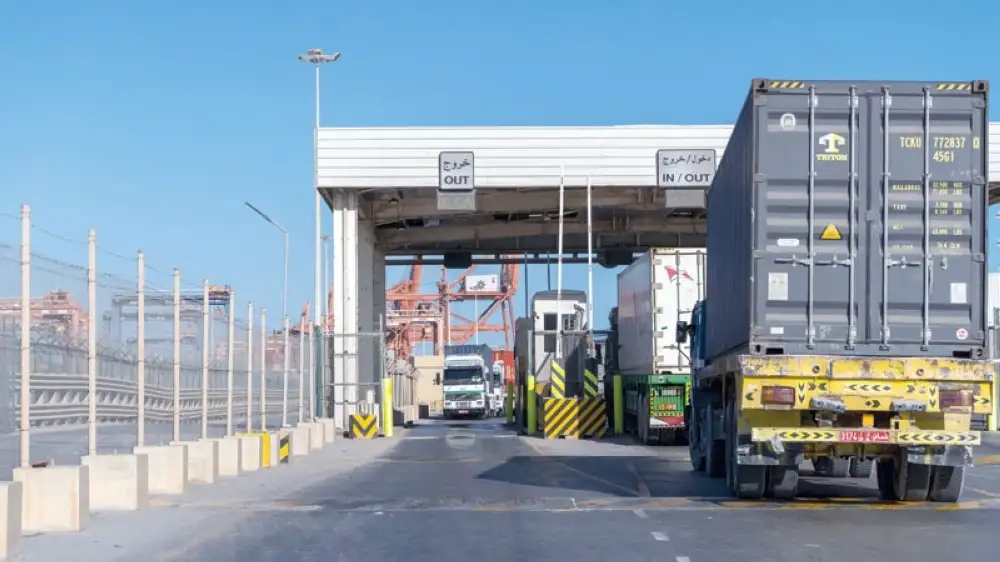
Strait of Hormuz shipping disruption has redirected containers to Omani ports, but shortages of storage space, trucks and terminal capacity are already forcing carriers to suspend some overland services
Salalah and Sohar have become critical contingency gateways for cargo that would previously have been delivered directly to ports inside the Persian Gulf. Containers are discharged in Oman before third-party logistics providers arrange overland transportation to the United Arab Emirates, Saudi Arabia and other regional markets.
The surge is placing pressure not only on container terminals but also on warehouses, temporary storage yards, customs operations and trucking capacity. Industry participants describe available facilities as operating near peak capacity, although port operators have not published a single official utilization figure covering all warehousing facilities.
A clear sign of the constraint came when Maersk temporarily paused new landside bookings from Salalah and Sohar to the UAE, Saudi Arabia, Kuwait, Bahrain and Qatar. The measure indicates limited capacity across the entire multimodal chain rather than at warehouses alone.
Hormuz Shipping Remains Severely Restricted
Claims that all vessels are formally prohibited from entering the Persian Gulf require qualification. No universal international ban has been imposed, but many container lines have reduced or suspended services because of security threats, limited insurance coverage and risks to crews.
Some vessels continue to transit the strait, with carriers assessing voyages individually. Maersk has introduced an additional $1,000 charge per container for shipments crossing Hormuz, on top of other emergency freight rates.
The company has also suspended significant parts of its booking network involving Iraq, Kuwait, Qatar, Bahrain and some Saudi ports. Cargo already in transit may be placed in temporary storage, returned to its origin or redirected to a different destination.
Salalah and Sohar, both located outside the Strait of Hormuz, have consequently become natural discharge points for containers moving into the Arabian Peninsula by road.
Sohar Container Volumes Rise 40%
The diversion is already visible in port statistics. According to industry data, Sohar handled approximately 545,000 TEU during the first half of 2026, an increase of about 40% compared with the same period a year earlier.
Sohar is located on Oman’s northern coast close to the UAE border, making it a practical gateway for container trucking to Dubai, Abu Dhabi and the other emirates.
Shipments can also move from Sohar to Saudi Arabia. However, these routes require additional customs procedures and border crossings, increasing transit times and placing further pressure on drivers and trucking companies.
Salalah is much farther south but has an important role as a major transshipment port on routes connecting Asia, Africa and Europe. During some weeks in the spring of 2026, average import container bookings at Salalah were approximately four times higher than in early February.
Maersk Suspends Some Overland Routes
In its August 31 operational update, Maersk confirmed a temporary pause on new landside bookings from Salalah and Sohar to five Gulf countries.
Some alternative services remain available. Export cargo from Kuwait, Qatar, Bahrain and the UAE can be routed through Salalah or Khor Fakkan, while containers for destinations inside Oman continue to move inland from Salalah.
The carrier stresses that all overland transportation remains subject to capacity availability. This reflects shortages involving trucks, drivers, storage space and terminal appointment slots.
Maersk offers up to 14 days of temporary storage for some affected shipments. After this period, a charge of $25 per TEU per day applies, with additional monitoring and electricity costs for refrigerated containers.
3PL Providers Rebuild Delivery Chains
Under the new model, the seaport becomes an intermediate point rather than the final gateway. Once a container is discharged, a logistics provider must arrange customs processing, temporary storage, truck allocation and one or more border crossings.
Sohar is generally better positioned for cargo moving to the UAE. Salalah can be used for shipments bound for Saudi Arabia, although the distance to the country’s main consumer and industrial centers substantially increases transportation costs.
Some containers must be transferred to another vehicle or placed under a different customs procedure. Operators also need to consider driver working-time limits, cross-border permits and restrictions governing the entry of foreign trucks.
Container imbalance is another challenge. After cargo is delivered to the UAE or Saudi Arabia, the empty unit must be returned to an approved terminal or depot. Maersk has changed its regional empty-return arrangements, designating Salalah and Jeddah as principal return points in several cases.
Transportation Costs Are Increasing
Replacing direct maritime delivery with a port–warehouse–truck–border–consignee chain inevitably adds costs. Extra terminal handling, storage, customs processing and long-distance trucking are required.
Logistics providers previously reported rate increases of 5–15% on Saudi-bound road shipments because of stronger demand, route complexity and fuel costs. In individual cases, the increase may be higher when trucks are scarce or delivery is urgent.
Maersk applies an emergency freight rate of $1,800 for a 20-foot dry container, $3,000 for a 40-foot dry container and $3,800 for reefer, special or dangerous cargo. The charge covers alternative routing, temporary storage and onward transportation but may be adjusted as conditions change.
Food Cargo Requires Priority Handling
Food, pharmaceuticals and refrigerated shipments remain particularly vulnerable to disruption. These containers need more than an available storage yard: they require power connections, temperature monitoring and expedited customs processing.
Costs can rise quickly during extended storage. In addition to standard container-storage charges, customers may need to pay for electricity, monitoring and additional terminal movements.
If warehouse and trucking capacity becomes more constrained, some importers may turn to air freight. This option is considerably more expensive and is generally viable only for limited volumes of high-value or perishable products.
Oman Gains a Strategic Opportunity
The crisis has demonstrated the advantage of Oman’s geographic position. Salalah, Sohar and Duqm have direct access to the Arabian Sea, allowing regional supply chains to operate without necessarily passing through the Strait of Hormuz.
This gives Oman an opportunity to strengthen its role as a distribution center between the Indian Ocean and inland markets across the Arabian Peninsula. Higher cargo volumes could attract investment in warehouses, container depots, customs zones and road freight terminals.
At the same time, current pressure reveals the limits of the existing network. To retain part of the diverted cargo after maritime conditions normalize, Oman will need additional storage capacity, better access roads, expanded border facilities and a larger available truck fleet.
As K2Cargo.News previously reported, Gulf countries are investing billions of dollars in ports, pipelines, railways and overland corridors designed to reduce the region’s dependence on the Strait of Hormuz.
Read also: Gulf States Invest Billions in Routes Bypassing the Strait of Hormuz