

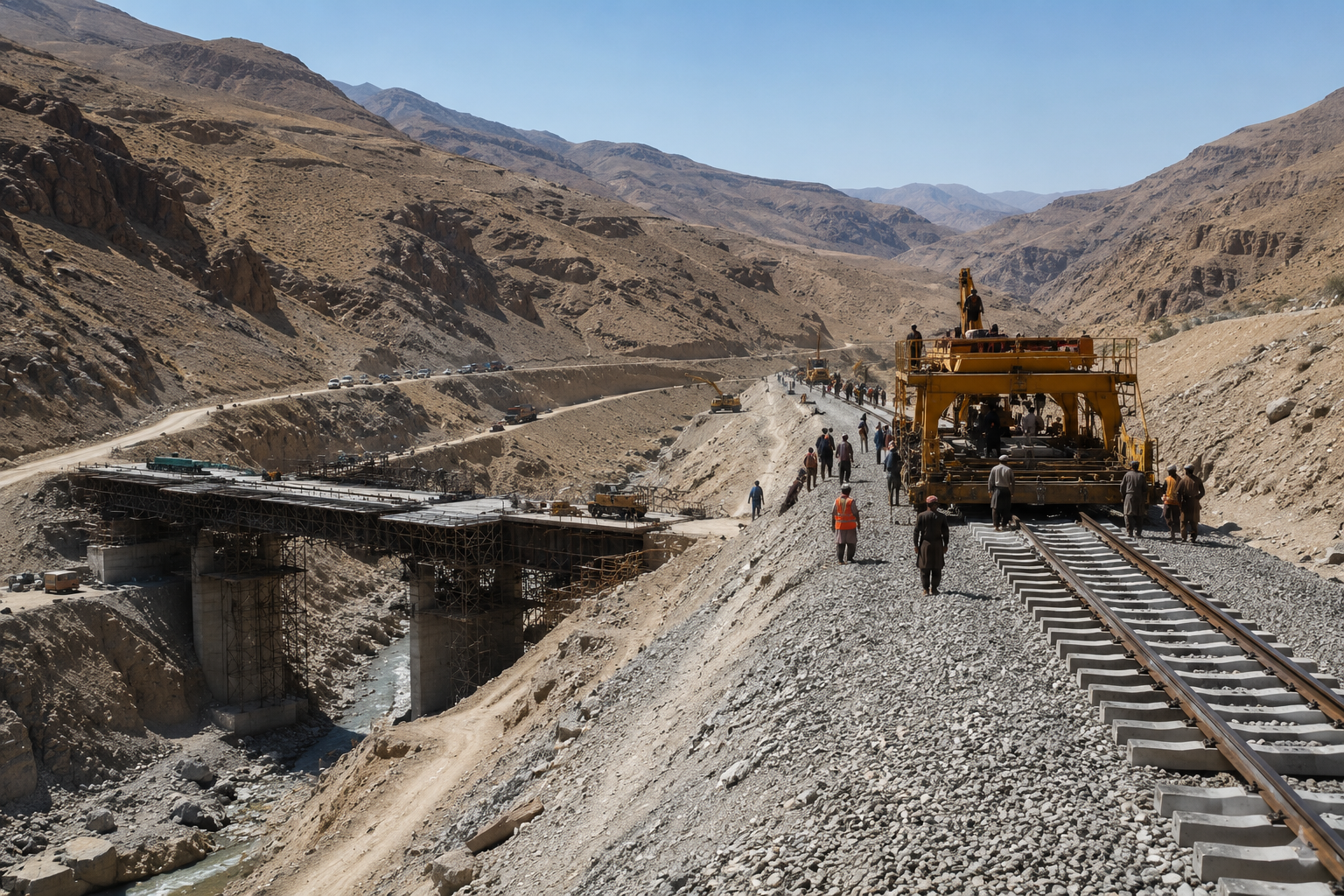
The Trans-Afghan Railway remains one of the most ambitious infrastructure projects in Central and South Asia. Once completed, the railway will create a direct rail connection between Uzbekistan, Afghanistan, and Pakistan, providing landlocked Central Asian countries with faster access to seaports and global markets.
Speaking at the Tashkent International Investment Forum, Jasurbek Choriyev, Secretary General of TRACECA and Deputy Minister of Transport of Uzbekistan, announced that the full feasibility study for the Termez–Mazar-i-Sharif–Kabul–Peshawar railway is scheduled for completion by the end of 2026.
According to Choriyev, the governments of Uzbekistan, Afghanistan, and Pakistan have already allocated funding for field surveys and engineering studies required for the project.
The preliminary cost of constructing the 649-kilometer railway line is estimated at approximately $7 billion. Construction costs are expected to average around $4 million per kilometer on flat terrain and up to $10 million per kilometer in mountainous sections, where engineering challenges are significantly greater.
A New Trade Corridor for Central and South Asia
The Trans-Afghan Railway is widely viewed as a strategic transport corridor that could reshape regional trade flows. By connecting Central Asia directly with Pakistan’s ports on the Arabian Sea, the route is expected to reduce transit times and lower transportation costs for international freight.
The project could become a key component of the broader Eurasian logistics network, offering exporters and importers an alternative route to global markets.
Interest in financing the railway is growing. Choriyev noted that investors from the United Arab Emirates, Qatar, and Kazakhstan have already expressed interest in participating in the project.
Work on the corridor has been underway for several years. In July 2023, Uzbekistan, Afghanistan, and Pakistan agreed on the final route of the railway. A preliminary feasibility study was prepared jointly by Uzbek engineering company Boshtransloyiha and international consulting firm EY.
In October 2024, Uzbekistan’s Ministry of Transport estimated the project cost at $4.8 billion and indicated that construction would require at least five years. However, following additional engineering assessments and route evaluations, the estimated investment requirement was revised upward to approximately $7 billion.
A major milestone was reached in the summer of 2025, when the foreign ministers of the three countries signed a framework intergovernmental agreement for the preparation of the full feasibility study. One year later, it was confirmed that specialists from Russian Railways (RZD) and Uzbekistan Railways (Uzbekiston Temir Yollari) were involved in developing the project documentation.
Industry experts believe the Trans-Afghan Railway could significantly transform the logistics landscape of the region. Beyond improving transport connectivity, the corridor has the potential to boost international trade between Central Asia, South Asia, the Middle East, and broader Eurasian markets, creating new opportunities for economic growth and regional integration.
Read also: Tajikistan Strengthens Its Role as a Central Asian Logistics Hub