

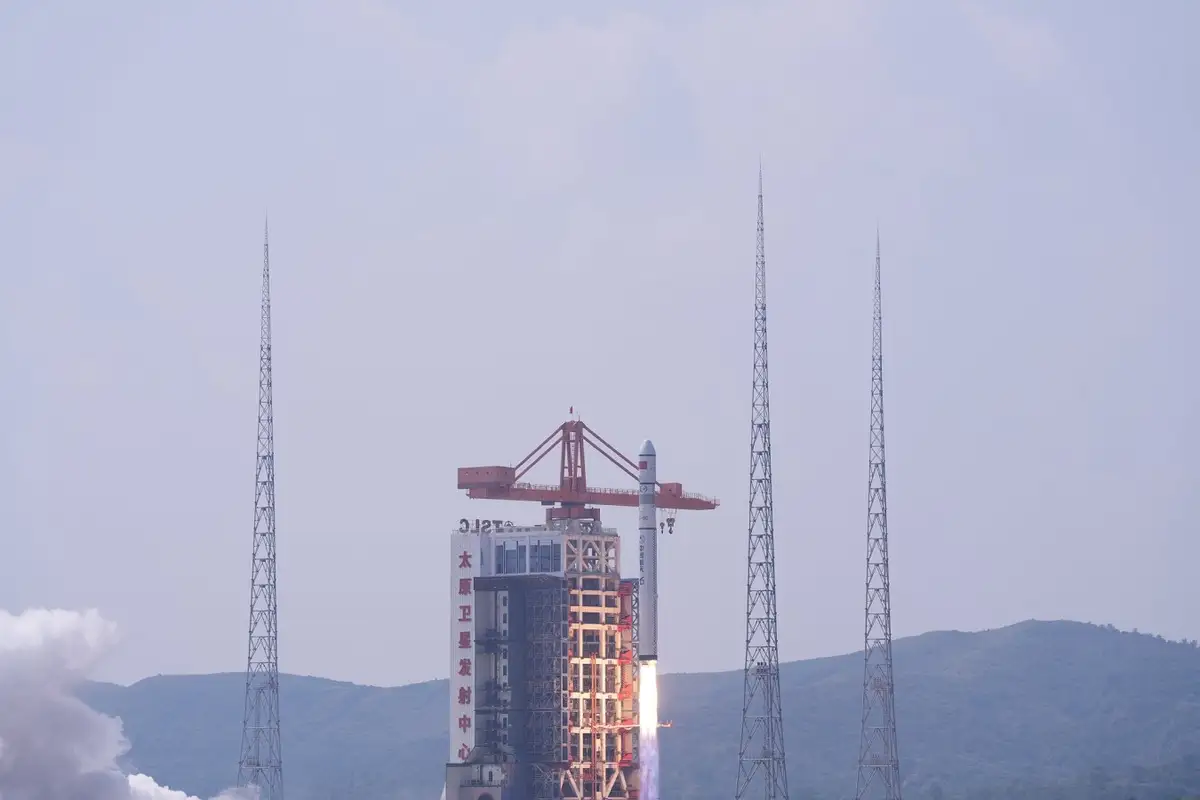
China continues to expand its space activities as a Long March 6C rocket successfully placed seven satellites into orbit. The payload included satellites for communications and remote sensing, as well as Thailand’s first CubeSat launched as part of a Chinese commercial space mission
On August 25, China launched seven satellites into orbit aboard a Long March 6C launch vehicle. The launch took place at 11:21 a.m. local time from the Taiyuan Satellite Launch Center in Shanxi Province.
According to China Daily, the 43-meter rocket successfully delivered the satellites into their designated orbits. The Long March 6C was developed by the Shanghai Academy of Spaceflight Technology and has a liftoff mass of 215 metric tons.
Particular attention was drawn to the Thai CubeSat Lingzhi-09. It was developed by Beijing-based commercial space company GalaxySpace. The satellite marks the company’s first overseas project in which it provided the customer with a complete package of services, from satellite and ground system development to launch and orbital delivery.
Two other satellites, AirSat 14 and AirSat 15, were developed for Chinese satellite communications operator AirSat. They are equipped with high-resolution synthetic aperture radar systems and computing capabilities designed to form a space-based information platform.
For GalaxySpace, the launch marks another step in the development of China’s commercial space sector. The company has already launched more than 10 of its own SAR satellites, bringing the total number of satellites it has independently developed to 49.
The mission highlights the growing international reach of Chinese commercial space companies, which are increasingly offering customers not just individual satellites but complete end-to-end space services.
Read also: China postpones Chang’e-7 launch originally planned for 2026