

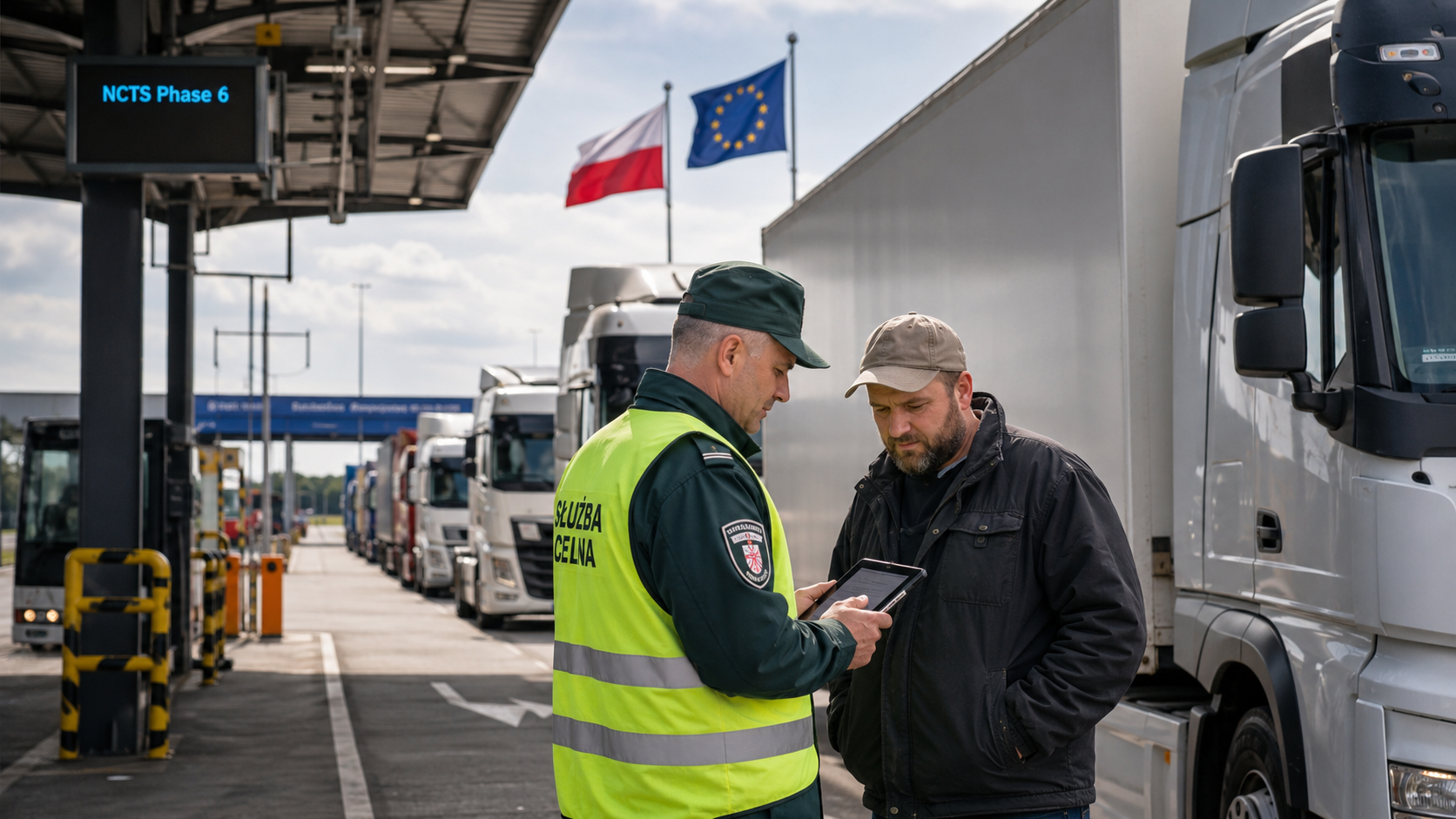
Poland Goes Live With NCTS Phase 6 on August 3
Poland is completing its migration to Phase 6 of the New Computerised Transit System.
NCTS Phase 6 is scheduled to go live at 00:00 Polish time on August 3, 2026.
Before deployment, the Polish NCTS2 PLUS system will be temporarily unavailable while technical work and software configuration are carried out.
The outage is scheduled from 18:00 on August 2 until 00:00 on August 3 Polish time.
For users in Ukraine, this corresponds to approximately 19:00 on August 2 until 01:00 on August 3 Kyiv time.
Carriers and customs representatives planning transit operations through Poland during this period should take the interruption into account and complete time-sensitive procedures in advance where possible.
The Key Change Is Poland’s Opt-In Model
For logistics companies, the most important element is not the software upgrade itself but the configuration selected by Polish Customs.
Poland is moving to NCTS Phase 6 under the Opt-in model.
This allows transit declarations to include the complete safety and security information required for an Entry Summary Declaration, or ENS.
When a valid combined transit declaration containing the necessary ENS data is lodged, operators do not need to make a second standalone ENS filing directly into ICS2.
For road freight moving from Ukraine into the EU through Poland, this can significantly simplify border formalities.
What NCTS Phase 6 Does
NCTS is the Europe-wide electronic platform supporting Union and Common Transit procedures.
It is used across EU Member States and countries participating in the Common Transit Convention.
For Ukraine, the system has been particularly important since the country joined the Convention in 2022.
Goods can move under common transit through several participating countries without requiring full import clearance at every border crossing.
Phase 6 is the next development stage after NCTS Phase 5.
Its most important new functionality is closer integration between transit declarations and the EU’s ICS2 safety and security requirements.
NCTS and ICS2 Can Now Work as One Process
Previously, carriers could face two separate electronic requirements.
The first was the transit declaration processed through NCTS.
The second was the ENS submitted through Import Control System 2 for pre-arrival safety and security risk analysis.
Phase 6 can combine those requirements.
Under Opt-in, the ENS data is incorporated into the transit declaration, while NCTS communicates with ICS2.
Customs authorities still receive the information needed for security analysis, but the operator does not have to create a separate ENS in a second system.
This is the model Poland will now fully implement.
Separate ENS Is Not Required for Poland — With One Condition
The change should not be interpreted as an abolition of ENS requirements.
Safety and security data still have to be provided.
Only the method of filing changes.
If a combined transit declaration contains the complete ENS dataset required by EU law, a separate ICS2 ENS is not needed when entering through Poland.
If the required safety and security data is not included, the underlying ENS obligation does not disappear.
It must then be met through the procedure applicable to that particular movement.
The accurate description is therefore that Poland allows ENS obligations to be fulfilled through NCTS Phase 6, rather than that Poland has abolished ENS.
Slovakia Uses the Same Approach
A similar arrangement already applies for movements entering the EU through Slovakia.
Slovakia deployed NCTS Phase 6 under the Opt-in approach in March 2026.
A correctly completed combined transit declaration can therefore also replace a separate ICS2 ENS filing there.
For Ukrainian road freight, Poland and Slovakia consequently become the two neighbouring EU entry routes where NCTS can perform both the transit and safety-security functions through one declaration.
That reduces the number of separate electronic submissions and lowers the risk of inconsistent data between systems.
Hungary Still Requires a Separate ENS
The position remains different at the Hungarian border.
For movements entering the EU through Hungary, Ukrainian carriers still need to complete two procedures.
The first is the transit declaration in NCTS.
The second is a separate ENS filing in ICS2.
Ukraine’s State Customs Service advises road operators to submit the ENS roughly one hour before the vehicle reaches the border crossing.
The same cargo may therefore require a different set of electronic formalities depending on whether it enters the EU through Poland or Hungary.
Romania Also Requires a Separate ICS2 Filing
The same distinction currently applies to Romania.
Romania migrated to NCTS Phase 6 on May 25, 2026, but does not yet technically accept Ukrainian combined transit declarations in a way that eliminates the need for a separate ENS.
Carriers entering the EU from Ukraine through Romania therefore still have to submit the Entry Summary Declaration separately through ICS2.
The recommended timing is approximately one hour before the vehicle arrives at the border crossing.
This arrangement is expected to remain in place until Romania is technically ready for full NCTS Phase 6 and ICS2 integration under an Opt-in configuration.
Route Planning Now Includes Customs Architecture
For transport operators, Phase 6 adds another variable to route selection.
A dispatcher previously compared Poland, Slovakia, Hungary and Romania mainly in terms of distance, fuel, road tolls and border queues.
The customs configuration of the entry country now matters as well.
A movement through Poland or Slovakia can use a combined declaration.
A movement through Hungary or Romania still requires an additional ENS.
For a single truck, the difference may appear small.
Across hundreds of monthly movements, however, an additional electronic filing means extra brokerage work, administrative cost and another opportunity for an error.
Incorrect Safety Data Can Stop the Truck
The main advantage of Opt-in comes with an important condition: the data must be complete and accurate.
ICS2 is not simply a declaration repository.
It is designed to allow customs authorities to conduct safety and security risk analysis before goods arrive at the external EU border.
Information concerning the goods, consignor, consignee, route and transport documents may all contribute to that analysis.
Incomplete or inaccurate data can lead to rejection or requests for additional information.
An error entered in a forwarding office can therefore turn into a truck delay at the border.
Phase 6 reduces the number of separate declarations, but increases the importance of data quality within the combined filing.
One Filing Reduces Data-Mismatch Risk
The combined model also offers a practical advantage.
When NCTS and ENS are prepared separately, some information has to be entered into two different systems.
That creates opportunities for transport-document references, cargo details, parties or routing information to differ.
Under Opt-in, one dataset can support both the transit procedure and safety analysis.
This reduces the potential for inconsistencies.
For international road freight operators, that matters because electronic data mismatches can cause delays even when the physical cargo and commercial documentation are otherwise correct.
The August 2 Outage Requires Planning
The immediate issue for carriers is the six-hour technical interruption of Poland’s NCTS2 PLUS.
The outage begins at 18:00 Polish time on August 2.
That is 19:00 in Kyiv.
The system is scheduled to return at midnight in Poland, or approximately 01:00 Kyiv time on August 3.
Trucks requiring customs processing during that window may therefore encounter transitional arrangements.
Operators should coordinate with customs representatives in advance and be familiar with any applicable Polish business-continuity procedures if their movement falls directly within the outage period.
Customs Software Will Also Need to Be Ready
The upgrade affects more than government servers.
Customs brokers, large shippers and companies directly integrated with NCTS have to use current technical specifications.
Polish authorities have published updated XML specifications for NCTS2 PLUS Phase 6 and revised system instructions.
A carrier using an external customs broker may never see these technical changes.
For companies with direct IT integration, however, compatibility is essential.
Software continuing to generate obsolete message structures may fail automated validation after the migration.
Ukraine Is Already on NCTS Phase 6
Ukraine switched to NCTS Phase 6 on June 22, 2026.
Its system is also deployed under the Opt-in model and supports combined transit declarations containing safety and security data.
Once Poland completes its migration, both neighbouring customs systems will operate on the same NCTS phase and support integration with ICS2.
That is particularly important because Poland remains one of Ukraine’s main road gateways to the European Union and one of Europe’s largest international trucking markets.
K2Cargo.News previously reported that Poland’s heavy-truck market rebounded sharply in the first half of 2026.
Phase 6 Does Not Remove Transit Guarantees
Another important point is that the migration does not fundamentally rewrite the Common Transit procedure.
Existing authorisations for transit simplifications remain valid.
Requirements involving guarantees, the holder of the procedure, offices of departure and destination, and proper discharge of the transit operation also remain in place.
Phase 6 primarily changes electronic data exchange and the interaction between NCTS and security systems.
Businesses should therefore view it as a technical and procedural upgrade rather than an entirely new transit regime.
What Carriers Need to Check Before Departure
The key operational question is no longer simply whether the truck has a transit declaration.
The declaration must match the selected EU entry point.
For Poland or Slovakia, operators should confirm that the transit filing is genuinely a combined declaration and contains the complete safety and security dataset.
For Hungary or Romania, a separate ICS2 ENS must currently be arranged.
MRNs, cargo descriptions, commodity information, transport documents and the identities of the parties should all be checked carefully.
A late change of route can also affect the required customs formalities.
This matters particularly when trucks are redirected because of congestion at the border.
Changing the Border Can Change the Filing Requirement
Consider a truck originally routed through Poland.
Its combined declaration may satisfy the Opt-in requirements for the Polish border.
If the dispatcher redirects the vehicle through Hungary because of a long queue, the customs position changes.
A separate ENS may now be required in ICS2.
If this is discovered only when the driver reaches the crossing, the vehicle can lose valuable time.
NCTS Phase 6 therefore turns customs-data management into an operational route-planning issue alongside queue times and road restrictions.
Digitalisation Can Speed Up the Border — If Data Is Correct
Poland’s transition to NCTS Phase 6 should ultimately simplify transit movements.
One combined declaration instead of two separate filings reduces administrative workload and the possibility of mismatched information between NCTS and ICS2.
But the largest gains will go to operators that prepare accurate data before the truck reaches the border.
From August 3, carriers entering through Poland will not need a separate ICS2 ENS if a correctly completed combined transit declaration contains the full safety and security information.
Slovakia follows a similar model.
Hungary and Romania currently still require separate ENS submissions.
And on the evening of August 2, carriers must also account for the planned Polish system outage beginning at 19:00 Kyiv time.
Poland’s Phase 6 migration reflects the wider direction of European customs: fewer separate submissions, more automated data exchange and a much higher cost for mistakes in digital declarations.
Read also: Polish Truck Market Rebounds in H1 2026