

Global logistics has entered an era where competition is no longer fought solely between ocean carriers, airlines, or warehouse operators.
Today, the real battle is for control of the entire supply chain.
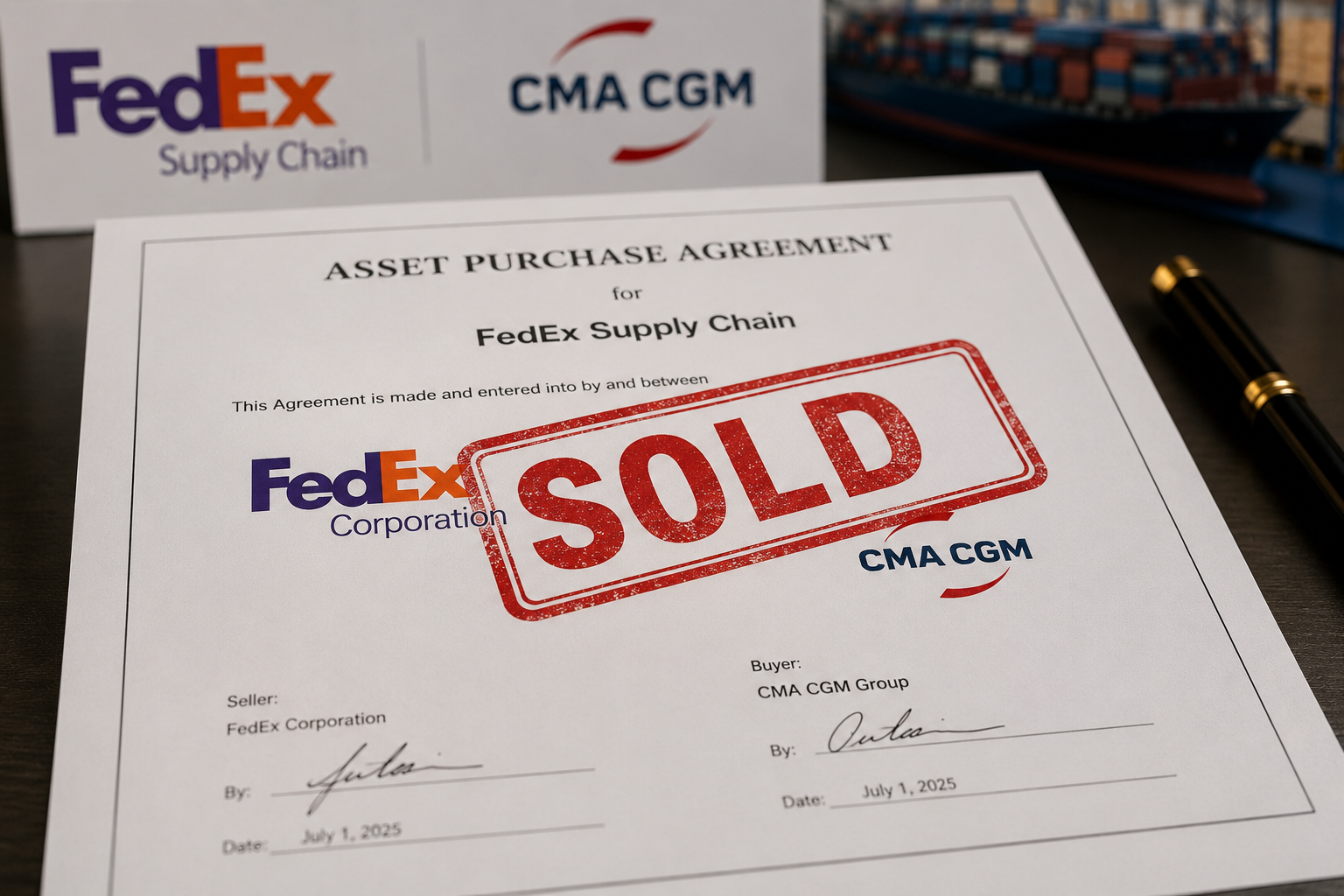
That is why the agreement announced on July 1 between French shipping giant CMA CGM and U.S.-based FedEx represents far more than a traditional corporate acquisition.
For $1.4 billion, CMA CGM will acquire FedEx Supply Chain, one of North America’s largest contract logistics businesses. At the same time, the two companies plan to establish long-term commercial partnerships covering both ocean and air freight services.
A Shipping Line Becomes a Complete Logistics Ecosystem
For decades, CMA CGM has been recognized primarily as one of the world’s leading container shipping companies.
Over the past several years, however, the French transportation group has been steadily transforming its business model. It has expanded into air cargo, invested in port terminals, acquired warehousing operations, strengthened its digital capabilities, and, through its logistics subsidiary CEVA Logistics, built one of the world’s fastest-growing contract logistics businesses.
The acquisition of FedEx Supply Chain marks another major milestone in that transformation.
Once completed, the transaction will nearly triple CEVA Logistics’ contract logistics footprint in North America—the world’s largest consumer market.
The combined North American organization will employ approximately 20,000 people, operate more than 240 facilities, and manage approximately 150 warehouses.
For customers, that means access to integrated logistics solutions—including ocean transportation, warehousing, fulfillment, distribution, and inland transportation—through a single logistics provider.
Why FedEx Is Selling a Successful Business
At first glance, FedEx’s decision to divest its contract logistics division may seem surprising.
In reality, the move is fully aligned with the company’s broader corporate strategy.
Only weeks earlier, FedEx completed the spin-off of FedEx Freight, creating an independent publicly traded company focused exclusively on the North American less-than-truckload (LTL) market.
The sale of FedEx Supply Chain represents another step toward concentrating investments on business segments that offer the greatest long-term growth and profitability.
According to FedEx President and CEO Raj Subramaniam, the company intends to strengthen its position in several high-value industries, including:
- Healthcare
- Automotive
- Aerospace
- Data centers
- Advanced manufacturing
Rather than remaining a broad-based logistics provider, FedEx is increasingly positioning itself as a transportation specialist serving the world’s most complex and mission-critical supply chains.
Partnership Instead of Competition
Perhaps the most significant aspect of the announcement is not the acquisition itself, but the long-term strategic partnerships the two companies intend to build after the transaction closes.
Despite the ownership change, FedEx and CMA CGM plan to continue working closely together.
Under a multi-year commercial agreement, CMA CGM will become FedEx’s preferred ocean freight carrier, providing international ocean transportation and related logistics services.
The companies also plan to cooperate through separate air cargo capacity agreements designed to improve aircraft utilization and provide greater flexibility for long-haul freight movements across their global networks.
Implementation of these ocean and air freight partnerships is expected to occur gradually between 2026 and 2028.
The agreement reflects a growing trend across global logistics: even the industry’s largest companies increasingly recognize that strategic partnerships often create greater value than building every capability independently.
What This Means for the Logistics Industry
The transaction reinforces one of the defining trends shaping today’s supply chain industry.
The world’s largest logistics companies no longer want to depend on a single mode of transportation.
Ocean carriers are investing in warehousing and contract logistics.
Air cargo companies are expanding into integrated supply chain services.
Warehouse operators are investing heavily in digital technologies and transportation management.
Every acquisition strengthens control over the supply chain and increases the ability to retain customers within a fully integrated logistics ecosystem.
In this model, companies are no longer simply moving containers or pallets.
They are managing the entire journey of a product—from the factory floor to the customer’s doorstep.
What This Means for Small and Mid-Sized Logistics Providers
For regional logistics companies and mid-sized providers, transactions like this send an important message.
Competing with global logistics giants based solely on infrastructure scale is becoming increasingly difficult.
Instead, competitive advantage will increasingly depend on three key capabilities:
- Deep industry specialization
- Advanced digital capabilities
- The ability to integrate seamlessly into global supply chain networks
Regional logistics providers that position themselves as reliable partners for multinational companies may discover new growth opportunities despite ongoing industry consolidation.
The Bigger Picture
The acquisition of FedEx Supply Chain is about much more than adding warehouses to a portfolio.
It is another clear indication that global logistics is entering the age of integrated supply chain ecosystems.
Tomorrow’s market leaders will not necessarily be the companies operating the largest fleets of ships or aircraft.
The competitive advantage will belong to organizations capable of combining ocean shipping, air cargo, trucking, warehousing, digital platforms, and supply chain management into one seamless customer experience.
That is the market global logistics leaders are competing to dominate today.