

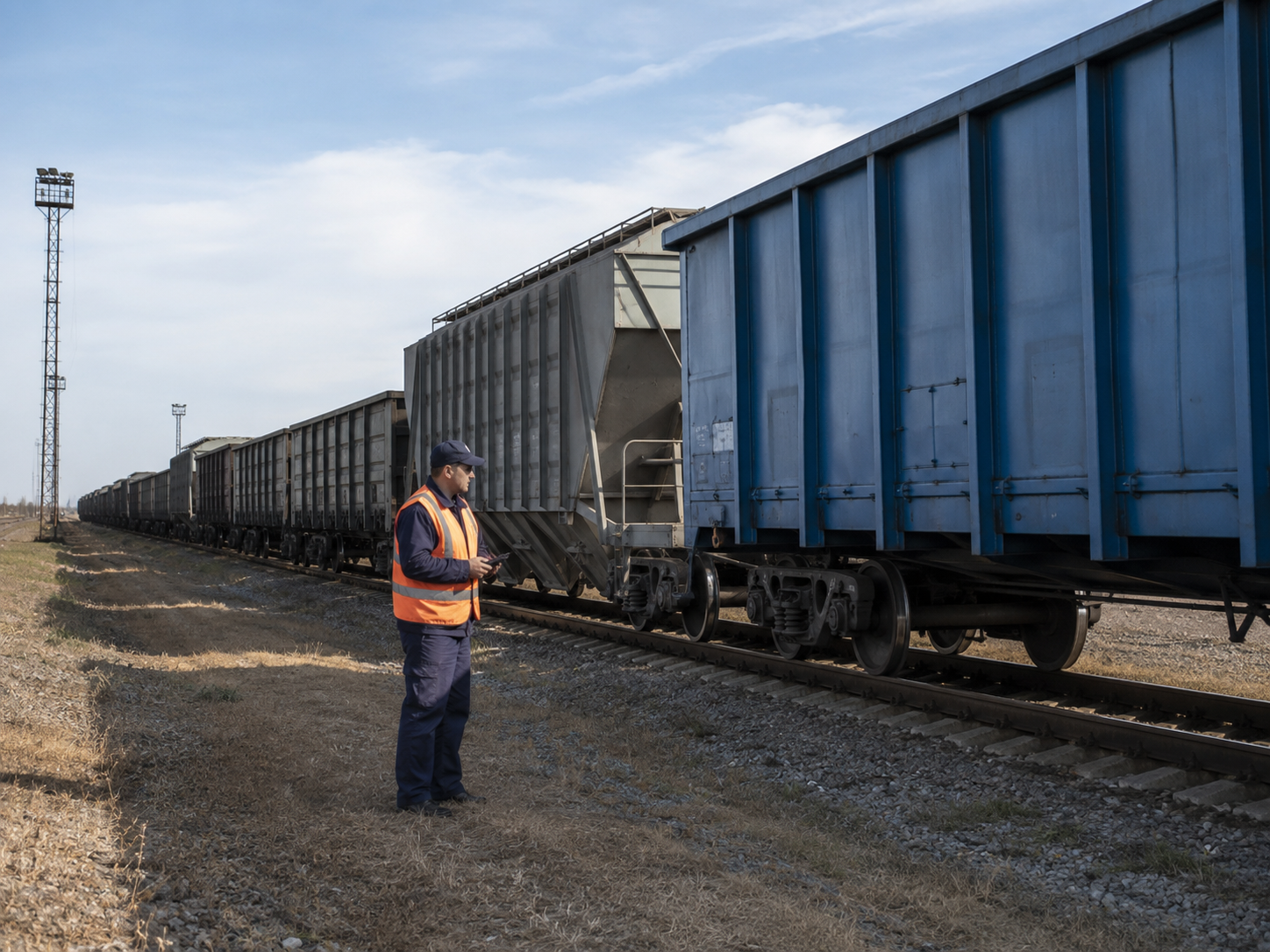
Kazakhstan’s decision to limit the registration of used foreign rolling stock is being viewed by local freight rail operators as a defensive step rather than a sudden market closure. The new rules, which become mandatory from July 12, 2026, mainly affect freight and passenger wagons imported from abroad.
According to Ramia Sarayeva, head of the Association of Freight Rail Carriers, the restrictions are linked to three core problems: an oversupply of wagons in Kazakhstan, pressure on railway infrastructure, and the risk of a mass inflow of used rolling stock from neighbouring countries where surplus fleets have already formed.
The measure also has an industrial dimension. By limiting the registration of older foreign wagons, Kazakhstan is trying to protect domestic wagon owners and support local manufacturing. For a country that wants to strengthen its role in Eurasian logistics, the quality and balance of its rolling stock fleet are becoming strategic issues.
As K2Cargo News previously reported in Trans-Afghan Railway Project Estimated at $7 Billion, Central Asian rail infrastructure is increasingly tied to regional trade corridors. Kazakhstan’s new wagon rules should be seen in the same context: infrastructure capacity is becoming as important as fleet size.
The First Reason: Too Many Wagons
The main concern is not a shortage, but a surplus.
Kazakhstan already has an excessive freight wagon fleet, according to the Association of Freight Rail Carriers. A large number of idle or inefficiently used wagons can create congestion on the rail network, reduce throughput and slow down the overall transport process.
In rail logistics, more wagons do not always mean more capacity. If the infrastructure cannot move them efficiently, an oversized fleet can increase wagon turnaround times and make operations less predictable.
This is one of the key reasons why the authorities are trying to stop further uncontrolled growth of the wagon fleet. A sudden inflow of used foreign railcars could worsen the imbalance and create additional pressure on stations, sidings, terminals and main lines.
The Second Reason: Protecting Local Owners
The second reason is the protection of Kazakhstan’s wagon owners.
If large volumes of cheaper used wagons enter the market from abroad, local owners may face stronger price pressure and lower utilisation of their existing fleets. This is especially sensitive when the domestic market already has a surplus.
For operators that invested in wagons earlier, a flood of second-hand rolling stock could reduce the value of their assets and weaken the economics of fleet renewal.
The new restrictions therefore act as a market filter. They do not ban all imported rolling stock, but they make it harder to register older used equipment. This protects companies that already operate in Kazakhstan and encourages a more controlled approach to fleet development.
The Third Reason: Supporting Wagon Building
The third reason is industrial policy.
Kazakhstan has been developing its own wagon-building capacity, and the new rules may support demand for local production. According to industry estimates cited by LogiStan and Rollingstock, the country’s existing industrial capacity can reach up to 12,000 freight wagons of different types per year.
Several companies already form the backbone of the sector, including RWS WAGON in Petropavlovsk, the Kazakhstan Wagon Building Company in Ekibastuz, the Atyrau Wagon Building Plant, the Semipalatinsk Machine-Building Plant and Cool Infinity in Petropavlovsk.
This does not mean that Kazakhstan can replace all old rolling stock immediately. The Ministry of Industry has reported significant wear in the freight wagon fleet, and renewal will take years. But the registration restrictions create a stronger market signal: investment should move toward new or specialised equipment, not toward mass import of ageing wagons.
What Exactly Changes
From July 12, 2026, Kazakhstan will restrict the registration of foreign used railcars.
Under the new requirements, rolling stock with less than 60% of its assigned service life remaining will fall under the restriction. For freight and passenger wagons, registration will generally be possible only for new wagons that are not more than one year old from the date of construction.
There are exceptions. Special-purpose rolling stock, such as hopper-dispensers, tank cars for acids and chemicals, refrigerated wagons, thermos wagons and similar specialised units, may still be treated differently. Unique track maintenance equipment with no Kazakhstan-made analogue is also excluded from the ban.
Sarayeva also stresses that there have been no fundamental changes for locomotives. As before, traction and special rolling stock may be imported and registered if at least 60% of the assigned service life remains.
The rules do not affect rolling stock that has already been registered and is already operating on the network.
A Temporary Rule Until 2030
Another important point is timing.
The restrictions are not permanent. They will remain in force until the end of 2030. This gives the government several years to assess whether the policy improves fleet balance, infrastructure performance and domestic production.
If the measures work, Kazakhstan may keep a more selective registration system. If they create too much pressure on operators or slow fleet renewal, the rules could be adjusted.
This is important because the policy carries risks. Some market participants may face higher investment costs if they have to buy more expensive new wagons instead of used foreign equipment. There is also a risk that local production may not be able to fully cover replacement needs quickly enough.
According to LogiStan’s rough estimate, renewing the worn part of the fleet could take at least six years, and additional wagons will reach the end of service life by 2030. This means Kazakhstan will need a careful balance between protection, production capacity and real demand from freight operators.
Why It Matters for Rail Logistics
Kazakhstan’s decision reflects a wider shift in railway policy.
The country is not only trying to expand transit routes and international corridors. It is also trying to manage the quality of assets that operate on its own network. An overloaded or ageing wagon fleet can reduce the benefits of new terminals, border crossings and corridor investments.
For freight customers, the result may be mixed. In the long term, a more modern and better-balanced fleet could improve reliability. In the short term, some operators may face higher costs and more complicated procurement decisions.
The core message is clear: Kazakhstan wants fewer outdated imported wagons and more control over how its railway fleet develops. The next question is whether domestic manufacturing can grow fast enough to match the country’s renewal needs.
Read also: Trans-Afghan Railway Project Estimated at $7 Billion
