

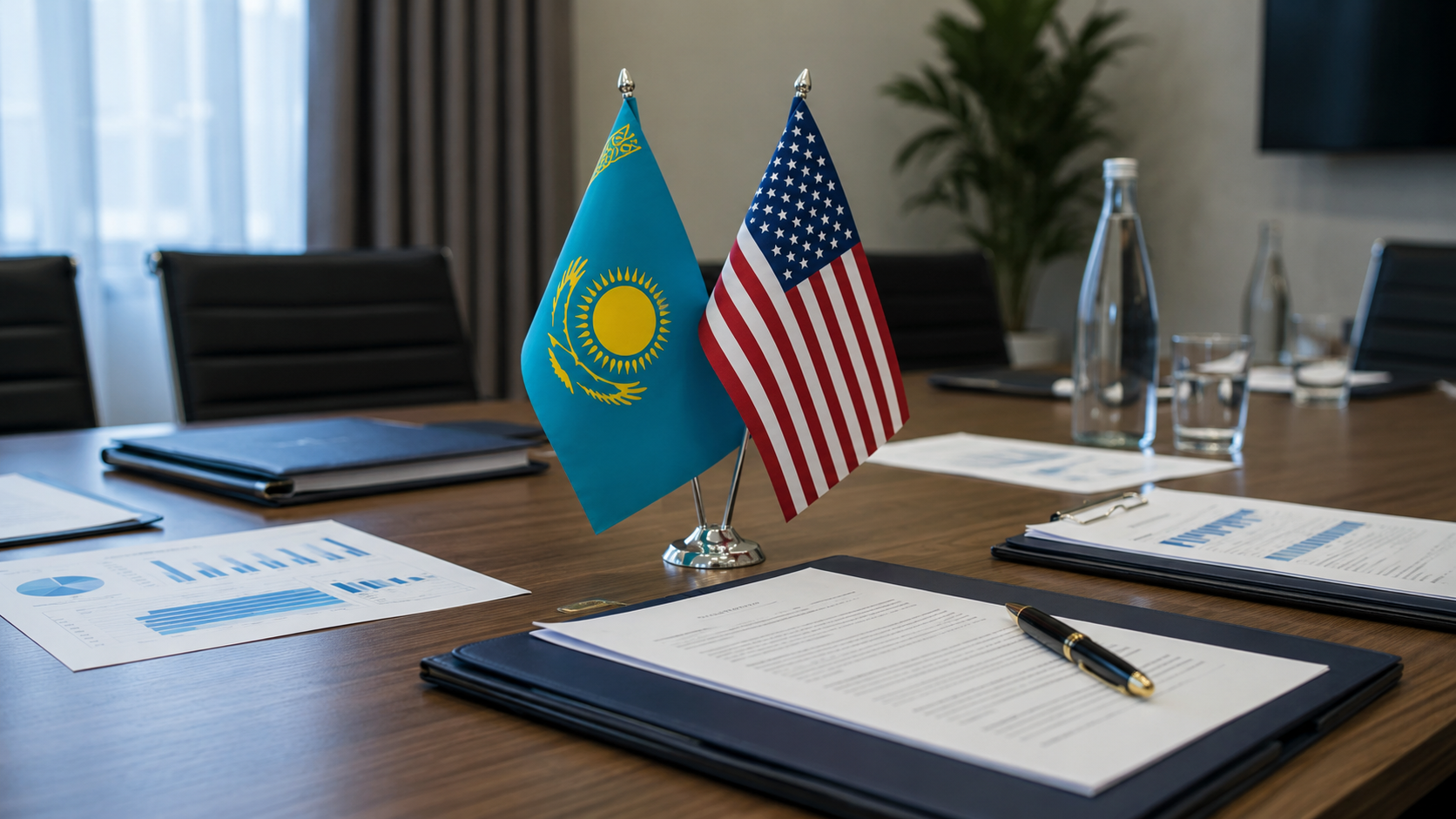
American investment in Kazakhstan has passed the $100 billion mark, confirming the United States as one of the country’s key foreign economic partners. Speaking at the Kazakhstan–United States business roundtable in Astana, Deputy Foreign Minister Alibek Kuantyrov said more than 600 American companies operate in Kazakhstan, while total U.S. investment has exceeded $100 billion and could grow to $137 billion in the future.
For many years, U.S. capital in Kazakhstan was strongly associated with oil and gas. Companies such as Chevron and ExxonMobil remain major investors in the country’s energy sector and continue to participate in large international projects. But the current investment agenda is becoming broader.
The new priorities include critical minerals, railway engineering, transport infrastructure, digital technologies, artificial intelligence, agriculture and financial services. For Kazakhstan, this shift creates an opportunity to move from a resource-export model toward deeper processing, industrial localisation and higher-value production.
As K2Cargo News previously reported in EDB and Griffin Partners to Build $125 Million Logistics Park in Almaty, Kazakhstan is increasingly positioning itself as a regional platform for logistics, investment and industrial development.
Oil and Gas Still Form the Base
The traditional foundation of U.S. investment remains energy.
The clearest example is Tengizchevroil, the operator of the Tengiz oil field. Its Future Growth Project, estimated at about $48.9 billion, reached full production capacity after commissioning work was completed in January 2025.
This project shows why Kazakhstan has long been attractive to American investors. The country has large hydrocarbon reserves, established export routes and a long history of cooperation with major international energy companies.
However, oil and gas alone no longer define the whole partnership. Kazakhstan is trying to diversify its economy, while the United States is looking for stable partners in industries linked to energy security, industrial supply chains and strategic materials.
Critical Minerals Become a New Priority
One of the biggest new areas is critical minerals.
A major example is the agreement between Kazakhstan’s Tau-Ken Samruk and U.S. company Cove Capital to jointly develop the Severny Katpar and Verkhne-Kairakty tungsten deposits in the Karagandy region. The project is valued at about $1.1 billion and is expected to include local processing and production of higher-value tungsten products.
For Washington, tungsten is strategically important because it is used in industrial and defence applications. The United States has been trying to reduce dependence on concentrated foreign supply chains, especially where China dominates mining or processing.
For Kazakhstan, the project fits a different but complementary goal: earning more from its mineral resources by developing processing capacity inside the country. Instead of exporting raw materials only, Kazakhstan wants to create more value domestically.
Rail and Transport Also Matter
U.S. investment interest is also expanding into rail and transport.
One of the largest recent examples was an agreement with Wabtec worth about $4.2 billion, focused on railway engineering and service infrastructure. For Kazakhstan, this is important because rail remains the backbone of domestic freight movement and international transit.
Kazakhstan’s position between China, Central Asia, the Caspian region and Europe makes transport infrastructure a strategic asset. Investments in locomotives, rail services and engineering can improve the reliability of freight corridors and strengthen the country’s role in Eurasian logistics.
This also supports Kazakhstan’s wider ambition: to become not only a raw materials exporter, but a transport and industrial hub linking major markets.
Digital Finance and New Platforms
Another area of interest is digital transformation.
Kazakhstan has continued developing a regulatory framework for digital assets and financial instruments. The country is also working on a National Digital Investment Platform based on a “single window” principle and a Golden Visa programme for foreign entrepreneurs.
For U.S. technology and financial companies, these tools may create new entry points into Kazakhstan’s market. For Kazakhstan, the goal is to become a regional centre for fintech, digital investment services and technology-driven business.
But success will depend on execution. Digital platforms need predictable regulation, investor protection, cybersecurity and transparent rules. Without these conditions, interest may remain limited to pilot projects rather than large-scale investment.
Why the U.S. Shift Matters for Kazakhstan
The changing structure of U.S. investment is important because Kazakhstan is trying to diversify its external economic links.
President Kassym-Jomart Tokayev has said that Kazakhstan accounts for around 70% of all foreign investment attracted to Central Asia. In that context, American capital is valuable not only because of its size, but because it can bring technology, management expertise, access to global markets and higher standards of corporate practice.
This is especially important in sectors such as critical minerals, energy processing, rail engineering, AI and financial services. These industries can support long-term industrial growth if projects move beyond declarations and into implementation.
Kazakhstan’s task is to make sure that foreign investment does not remain concentrated only in extraction. The real economic impact will depend on how much technology, processing capacity and local employment are created inside the country.
From Agreements to Implementation
The next stage will be practical.
After Tokayev’s visit to the United States in November 2025, Kazakh and American companies signed 29 agreements worth nearly $17 billion. But agreements alone do not create industrial growth. Projects must reach financing, construction, production and export stages.
For American companies, the key factors will be legal stability, transparent regulation, project economics and infrastructure readiness. For Kazakhstan, the priority is to attract not just capital, but also technologies, expertise and production capacity.
The partnership is entering a new phase. Oil and gas will remain important, but the future agenda is broader: critical minerals, rail, digital systems, energy security and high-value manufacturing.
If Kazakhstan can turn this investment wave into local processing, modern infrastructure and stronger industrial capability, the country may strengthen its role not only as a resource base, but as one of the main investment and logistics platforms of Central Asia.
Read also: EDB and Griffin Partners to Build $125 Million Logistics Park in Almaty
