

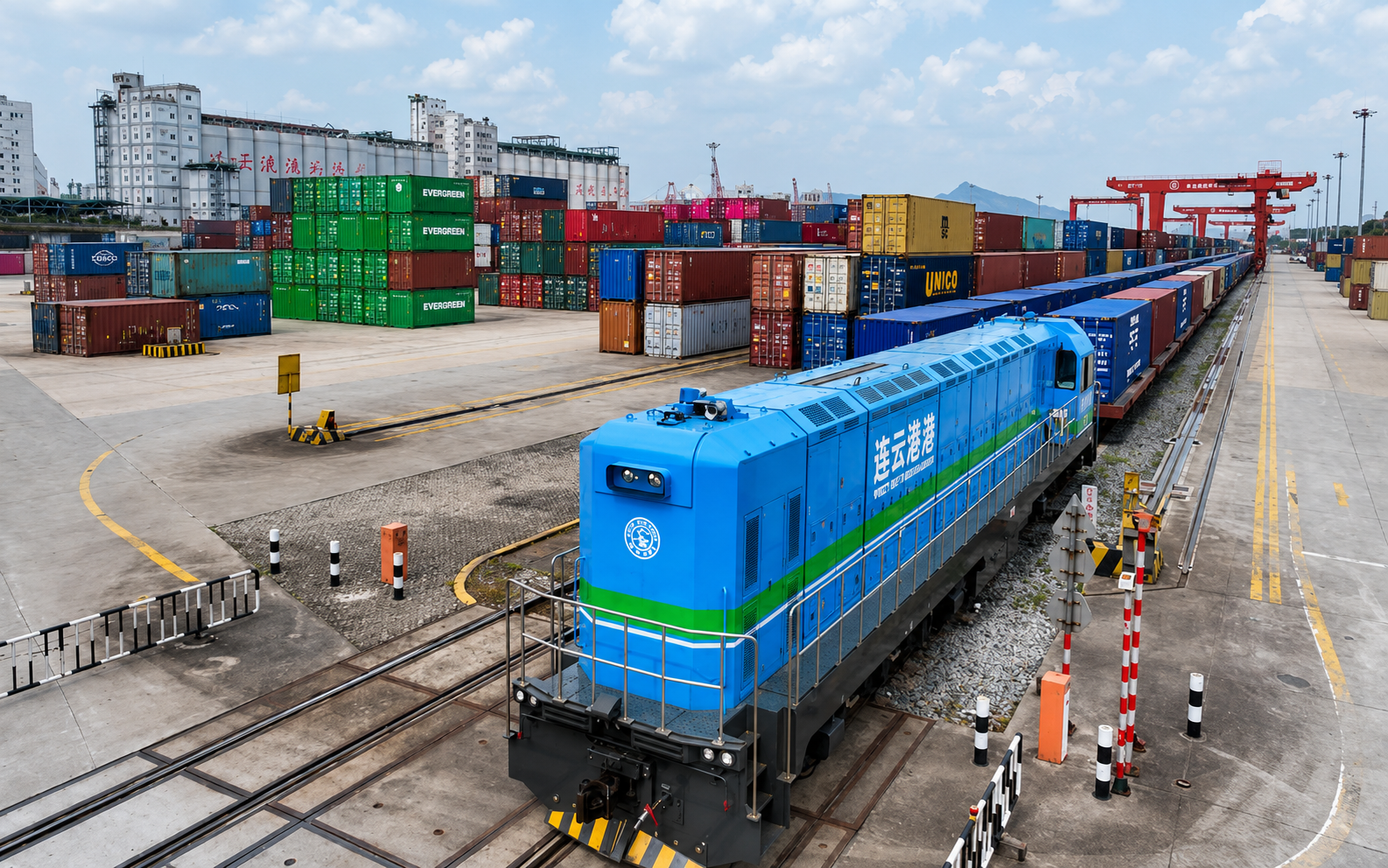
The China-Kazakhstan logistics cooperation base in Lianyungang has reached a new milestone: the 8,000th international freight train has departed from the site since it began operations. The train, loaded with auto parts, left the port area in Jiangsu province for the Ablyk railway station in Uzbekistan.
For Kazakhstan and China, the milestone is more than a statistical result. Lianyungang has become one of the most important eastern gateways for cargo moving between China, Central Asia and Europe. The base connects sea, rail and inland logistics and gives Kazakhstan access to a Chinese Pacific port, while giving China a structured platform for cargo flows toward Central Asia.
According to Nanjing Customs, in the first half of 2026 the base handled 485 China-Europe and China-Asia freight train services in both directions, up 3.8% year-on-year. In June, monthly train volume exceeded 100 for the first time, showing that traffic through the hub is still expanding.
As K2Cargo News previously reported in Can the Middle Corridor Become Eurasia’s Main Alternative?, Eurasian logistics is increasingly shaped by alternative corridors, multimodal hubs and the search for faster connections between China, Central Asia, the Caucasus and Europe.
Why Lianyungang Matters for Kazakhstan
The Lianyungang base was officially launched on May 19, 2014, as a concrete cooperation project between Kazakhstan and China under the Belt and Road Initiative.
Its strategic value is clear: Kazakhstan is a landlocked country, while Lianyungang gives it access to maritime logistics on China’s east coast. This allows Kazakh and Central Asian cargo to connect with sea routes, while Chinese cargo can move inland by rail toward Kazakhstan, Uzbekistan and other regional destinations.
The base is located at the eastern starting point of the New Eurasian Continental Bridge. That position makes it important not only for bilateral trade, but also for wider Eurasian cargo movement. It works as a transfer and consolidation point for containers, industrial goods, auto parts, consumer goods and other cargo categories.
For Kazakhstan, the project supports its ambition to act as a transit country between China and the rest of Eurasia. For China, it strengthens inland connectivity from the Pacific coast to Central Asia.
Traffic Continues to Grow
The latest figures show steady development.
In 2025, the base handled 915 China-Europe and China-Asia freight trains. These trains carried 75,030 TEU, while total cargo turnover through the base reached 5.1597 million tonnes, up 13.74% year-on-year.
The first half of 2026 continued this growth trend. The base processed 485 train services, and the June result — more than 100 trains in a single month — became a new record for monthly activity.
This does not mean that every operational challenge has been solved. Cross-border rail logistics still depends on schedules, customs clearance, wagon availability, terminal capacity and coordination between countries. But the growth shows that the route has become a regular logistics product, not just a political symbol.
Uzbekistan Becomes Part of the Growth Story
The 8,000th train’s destination — Ablyk station in Uzbekistan — is also important.
Uzbekistan is increasingly active in regional logistics, using connections through Kazakhstan and China to diversify trade routes. Cargo flows to Uzbekistan include industrial goods, auto parts, equipment, consumer products and other containerized shipments.
For Chinese exporters, Central Asia offers growing demand and shorter inland routes compared with long maritime supply chains. For Uzbekistan, rail links through Kazakhstan and Lianyungang provide access to Chinese industrial regions and global maritime channels.
This strengthens the role of Kazakhstan as a transit bridge. Cargo from China can move through Kazakh rail infrastructure toward Uzbekistan, while Central Asian exports can use the same network in the opposite direction.
A Hub for Multimodal Eurasian Logistics
The Lianyungang base reflects a broader trend in Eurasian transport: logistics is becoming more multimodal and more corridor-based.
Cargo no longer moves only from port to port or from rail terminal to rail terminal. Increasingly, supply chains combine sea access, inland rail, border terminals, dry ports and regional distribution hubs. Lianyungang is one of the points where these systems connect.
The base is also important because it allows cargo owners to choose between different routes depending on price, time and destination. Some shipments may move toward Central Asia. Others may continue toward Europe. Some may connect with maritime services through the port.
For shippers, this flexibility matters. It reduces dependence on one corridor and helps companies adapt when geopolitical risks, border delays or market changes affect traditional routes.
What the Milestone Means for the Region
The 8,000-train milestone shows that the China-Kazakhstan logistics base has moved from an experimental project to a mature part of regional trade infrastructure.
The next stage will depend on capacity, reliability and service quality. If train frequency continues to grow, terminals will need to process more containers without delays. Customs and documentation procedures will need to remain predictable. Rail operators will need enough wagons, locomotives and slots to keep the system moving.
For Kazakhstan, this is an opportunity to deepen its role as a Eurasian transit country. For China, it supports the Belt and Road transport network. For Uzbekistan and other Central Asian states, it creates more access to Chinese and global markets.
The Lianyungang base has already proved that rail logistics between East China and Central Asia can operate at scale. The question now is how far this network can expand — and whether it can remain fast, reliable and cost-effective as demand grows.
Read also: Can the Middle Corridor Become Eurasia’s Main Alternative?