

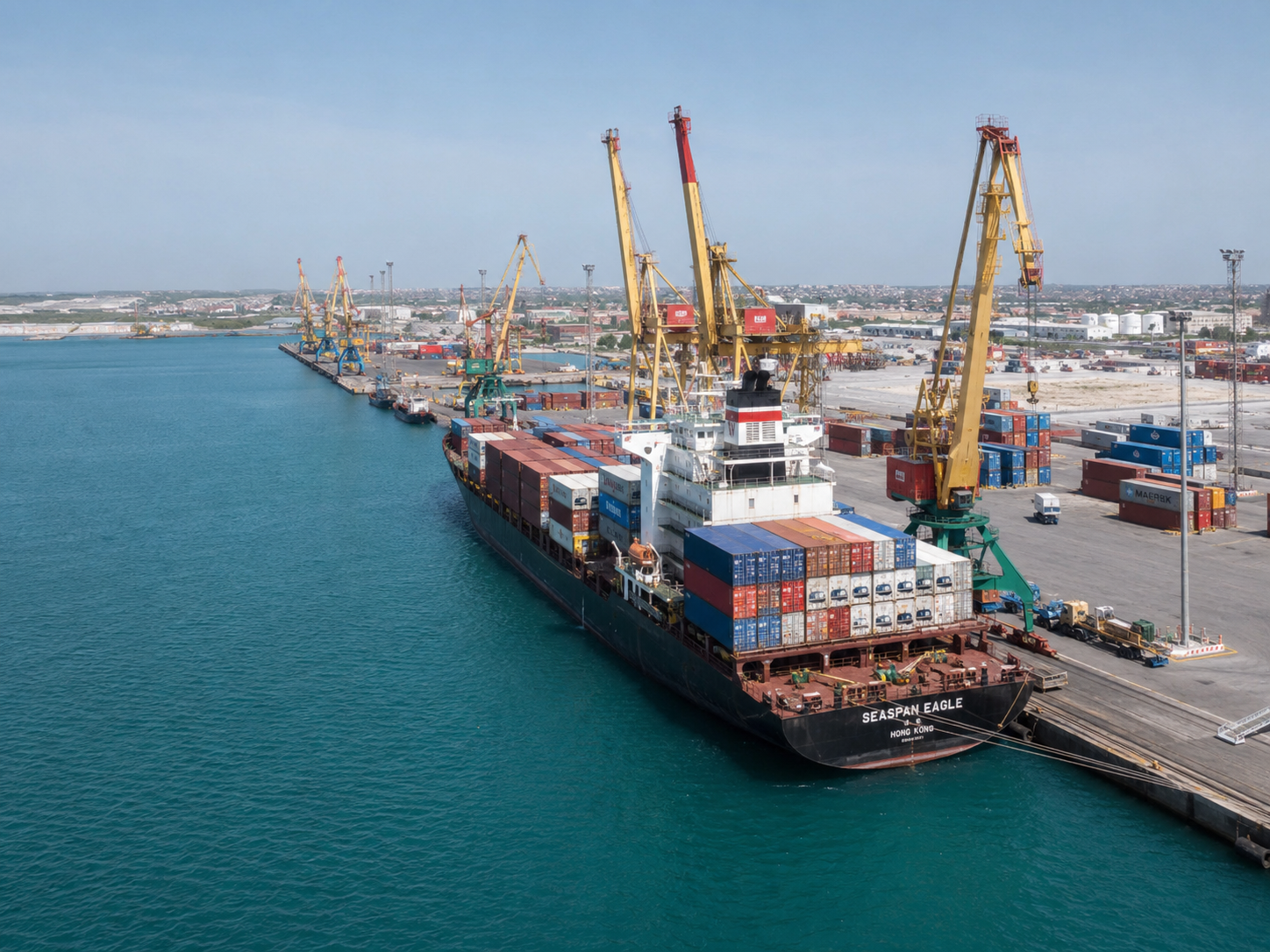
Container transportation from China to Azerbaijan through Kazakhstan has become more expensive again, although the increase was weaker than some market participants expected. According to Argus data cited by regional logistics sources, the cost of moving a 40-foot high-cube container from Xi’an in China to Baku in Azerbaijan via the Trans-Caspian International Transport Route rose by 0.7–1.4% over the past month.
In practical terms, average rates increased by around $100–150 per 40HC container, while some carriers had expected a much sharper rise of about $500 per container. This means the market is still under cost pressure, but not yet facing a shock increase.
In June, the rate for a 40HC container on the route stood at $6,450–6,900. In May, the range was $6,400–6,800, in April $6,300–6,700, and in March $6,000–6,500. From March to June, the corridor therefore became roughly 6–7% more expensive, depending on the reference point within the quoted range.
The route runs from Xi’an through the Altynkol border crossing in Kazakhstan, then to Aktau on the Caspian Sea, across to Alat in Azerbaijan and onward toward the Absheron logistics area. The average transit time for a container train on the Xi’an — Altynkol — Aktau — Alat — Absheron route is estimated at 14–18 days.
As K2Cargo News previously reported in Can the Middle Corridor Become Eurasia’s Main Alternative?, the Trans-Caspian route is becoming one of the most important alternatives for Eurasian trade, but its competitiveness depends on price stability, transit time and infrastructure coordination.
Why Rates Are Rising
The latest increase is mainly linked to two factors: fuel costs and insurance.
Fuel affects almost every part of the route. The corridor combines rail transport across China and Kazakhstan, port handling at Aktau, maritime movement across the Caspian Sea and further rail or road logistics through Azerbaijan. Even a moderate increase in energy prices can gradually move through the full multimodal chain.
Insurance is another important factor. The Middle Corridor passes through a region where geopolitical risk, route complexity and maritime exposure are all priced into logistics services. Even if the corridor itself remains operational, insurers and carriers may adjust their risk calculations as regional conditions change.
The result is a slow but steady increase in freight costs. The market avoided the sharper jump that some participants expected, but the direction remains upward.
The Route Remains Competitive
Despite the increase, the Xi’an–Baku corridor remains attractive for many shippers.
The main advantage is time. A transit period of 14–18 days gives cargo owners a faster alternative to some maritime routes and a more predictable option than certain road-based solutions. For inland Chinese exporters and Azerbaijani importers, a rail-Caspian connection can reduce unnecessary detours through distant ports.
The route is especially relevant for consumer goods, electronics, machinery, components, textiles and other containerized cargo. These shipments often need a balance between cost and speed. Air freight is too expensive, while ocean freight may be too slow or indirect for some supply chains.
The Trans-Caspian route also gives shippers a way to diversify away from traditional corridors. Since 2022, logistics companies have placed more emphasis on alternatives that avoid excessive dependence on one route, one border or one geopolitical zone.
Growth Is Creating New Pressure
The Middle Corridor’s biggest advantage is also becoming one of its challenges: demand is growing.
In 2024, 358 container block trains were dispatched from China toward Azerbaijan, a sharp increase compared with the previous year. Market participants expected the figure to grow further in 2025, potentially reaching around 600 container trains.
Rising demand supports the corridor’s development, but it also increases pressure on terminals, rail capacity, Caspian ferry services, documentation procedures and port handling. If infrastructure does not expand in parallel, higher volumes can lead to congestion and higher prices.
This is why a rate increase of only 0.7–1.4% in one month should not be viewed in isolation. It is part of a larger trend: the corridor is becoming more popular, but every additional container train tests its ability to remain fast, predictable and affordable.
Aktau and Alat Are Key Bottleneck Points
The route’s performance depends heavily on the Caspian section.
Aktau in Kazakhstan and Alat in Azerbaijan are the key transfer points where rail cargo meets maritime transport. The efficiency of these ports determines how smoothly container flows can move across the Caspian Sea.
If train arrivals, vessel schedules and terminal handling are not synchronized, containers can wait at the port and lose the time advantage that makes the route attractive. If the Caspian crossing works smoothly, the corridor can remain competitive even with slightly higher rates.
Aktau is also trying to diversify cargo handling. Plans to resume the transshipment of rolled steel show that the port is not only focused on containers, but also on broader cargo flows. That can support regional logistics, but it also increases the need for careful capacity management.
Azerbaijan Gains From Transit Growth
For Azerbaijan, the rise in China–Baku container flows strengthens the country’s role as a regional logistics hub.
Baku is not just the final destination for many shipments. It is also a gateway to the South Caucasus, Türkiye and potentially European markets. The Alat port area and related rail connections are central to Azerbaijan’s strategy of becoming a transit and distribution center between Asia and Europe.
Higher container traffic can support port services, rail operations, warehousing, customs brokerage, trucking and distribution. But it also requires investment in digitalization, tariff coordination and terminal capacity.
If Azerbaijan can keep cargo moving quickly through Alat and onward routes, it can capture more value from the Middle Corridor. If delays grow, some shippers may look for alternative options.
Kazakhstan’s Transit Role Strengthens
Kazakhstan remains one of the main land bridges on the route.
Cargo from Xi’an enters Kazakhstan through Altynkol, one of the most important rail gateways between China and Central Asia. From there, containers cross Kazakhstan toward Aktau and the Caspian Sea.
This gives Kazakhstan a central position in the Trans-Caspian chain. The country benefits from transit fees, rail activity, terminal services and the broader development of logistics infrastructure.
At the same time, Kazakhstan must maintain capacity at border crossings, rail corridors and Caspian ports. Any bottleneck on the Kazakh section affects the whole Xi’an–Baku route.
What This Means for Shippers
For cargo owners, the current rate increase is manageable but important.
A $100–150 rise per 40HC container may not change every shipping decision, but it affects margins, especially for lower-value goods. Importers and exporters working on tight contracts need to monitor whether the increase becomes a short-term adjustment or the start of a longer upward trend.
For logistics providers, the key issue is communication. Customers need clear expectations on price, transit time, possible delays and insurance costs. The Middle Corridor is attractive, but it is still more operationally complex than a single-mode sea route.
For forwarders, the best strategy may be flexible planning: use the route where speed and diversification justify the cost, but continue comparing alternatives depending on cargo type and urgency.
A Moderate Rise With Strategic Meaning
The latest increase in China–Azerbaijan container rates is not dramatic. It is much smaller than the $500 per container rise that some carriers expected. But it is still significant because it confirms a broader cost trend on the Middle Corridor.
The route is becoming more important for Eurasian trade. It offers a 14–18 day transit option between China, Kazakhstan and Azerbaijan, and it supports the wider shift toward diversified supply chains. But its long-term success will depend on keeping costs under control while expanding capacity.
For now, the Middle Corridor remains competitive. The question is whether it can stay that way as demand grows, fuel and insurance costs rise, and infrastructure faces heavier use.
The answer will determine whether the Trans-Caspian route becomes a stable logistics product or remains a promising but expensive alternative.
Read also: Can the Middle Corridor Become Eurasia’s Main Alternative?