

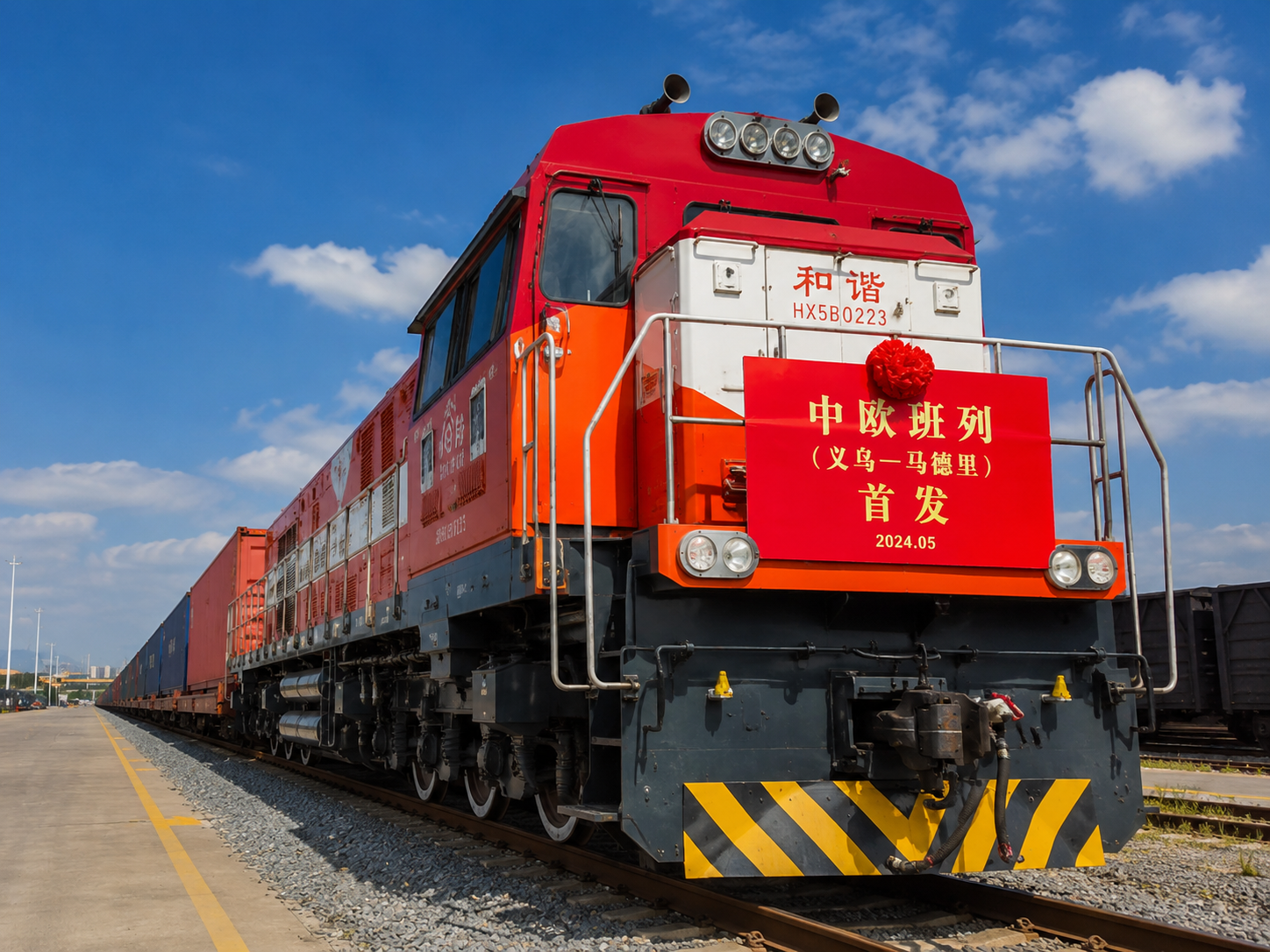
China has opened a new rail freight connection with Turkmenistan, strengthening overland logistics links between western China, Kazakhstan, Uzbekistan and the Caspian region.
The first container train departed from Xining, the capital of Qinghai Province, on June 28. The train carries 55 containers loaded with electrical goods, auto parts, clothing and everyday consumer products. Its final destination is the Balkan velayat of Turkmenistan, one of the country’s most important western regions and a gateway toward the Caspian Sea.
The route passes through China’s northwestern transport network, exits via the Khorgos crossing on the border with Kazakhstan, then continues through Kazakhstan and Uzbekistan before reaching Turkmenistan. The estimated transit time is 14–15 days.
For Central Asian logistics, the launch is significant because it adds another direct rail option between China and Turkmenistan. It also shows how Chinese provinces beyond the traditional coastal export hubs are building their own international freight corridors.
As K2Cargo News previously reported in Trans-Afghan Railway Project Estimated at $7 Billion, Central Asia is becoming one of the most active regions for new rail infrastructure and alternative trade routes.
Qinghai Gets a Direct Link to Central Asia
The new route is especially important for Qinghai Province.
Qinghai is located in western China and is not traditionally associated with the country’s main export gateways. Most international trade flows from China have historically been linked to coastal ports or large inland logistics centers such as Xi’an, Chengdu, Chongqing and Urumqi.
The launch of a direct rail service from Xining to Turkmenistan changes that picture. It gives Qinghai exporters a more structured route to Central Asia and allows the province to participate more actively in Eurasian rail logistics.
According to Chinese transport reports, the new line is designed to connect the Qinghai-Tibet Plateau with Central Asian markets. This is important because western Chinese provinces are trying to reduce dependence on long domestic pre-carriage to eastern seaports.
For shippers, rail can offer a middle ground between sea and air freight. It is slower than aviation but much cheaper, and it is faster than traditional sea routes for certain inland-to-inland destinations.
Why Turkmenistan Matters
Turkmenistan is an important destination for the new route because of its geography.
The country borders Kazakhstan, Uzbekistan, Iran and Afghanistan, and has access to the Caspian Sea through the port of Turkmenbashi. This makes it relevant for trade flows moving not only into Turkmenistan itself, but also toward the Caspian region, Iran, the South Caucasus and potentially the Middle East.
The Balkan velayat is particularly important because it is located in western Turkmenistan and is connected with the country’s Caspian transport infrastructure. A rail route reaching this region gives Chinese exporters another channel toward markets that are not easily served by standard maritime logistics.
The cargo on the first train also shows the nature of expected demand. Electrical goods, auto parts, clothing and daily consumer products are typical containerized goods that benefit from predictable delivery times and regular rail schedules.
If the service becomes regular, it could support both direct trade with Turkmenistan and broader distribution across nearby markets.
Kazakhstan and Uzbekistan Become Transit Links
The route also highlights the role of Kazakhstan and Uzbekistan as essential transit countries.
The train exits China through the Khorgos–Altynkol area, one of the key rail gateways between China and Kazakhstan. From there, cargo can move through Kazakhstan’s rail network and continue south toward Uzbekistan and Turkmenistan.
This underlines a broader trend: Central Asian logistics is becoming increasingly interconnected. A route launched by China and aimed at Turkmenistan still depends on Kazakhstan’s border capacity, rail infrastructure and transit efficiency. It also depends on Uzbekistan’s ability to handle cross-border flows smoothly.
For logistics companies, this means that the success of the route will not be determined only by the departure station in China or the destination in Turkmenistan. The full corridor must work as a single chain.
Border processing, wagon availability, customs documentation, tariff coordination and schedule reliability will all affect whether the new service can attract stable cargo volumes.
Rail Freight Is Becoming More Competitive
The expected 14–15 day transit time makes the route attractive for shippers moving goods between western China and Central Asia.
For many categories of consumer goods, delivery time matters, but not enough to justify the cost of air freight. Rail becomes useful when companies need faster delivery than sea transport, but still want to control logistics costs.
This is especially relevant for inland destinations. If goods are produced in western China and consumed in Central Asia, shipping them through seaports can be inefficient. Direct rail reduces unnecessary detours and can make supply chains more predictable.
The launch also fits China’s wider strategy of expanding international rail freight. Over the past decade, Chinese cities and provinces have actively promoted rail services to Europe, Central Asia and the Middle East. The goal is to create diversified export channels and support regional development inside China.
For Turkmenistan, the route supports the country’s ambition to strengthen its role in regional transport networks.
A Route With Caspian Potential
The destination in the Balkan region gives the new service a Caspian dimension.
Turkmenistan’s western logistics infrastructure can connect rail cargo with Caspian routes, including maritime links toward Azerbaijan and further routes to the South Caucasus, Türkiye and Europe. Although the new Xining route is first of all a China–Turkmenistan service, its long-term value may be wider.
If cargo volumes grow, the route could become part of a larger network connecting China with Central Asia, the Caspian Sea and western markets.
This does not mean it will immediately compete with the main Middle Corridor routes through Kazakhstan and the Caspian to Azerbaijan. But it adds another layer of flexibility to the region’s transport map.
For exporters and forwarders, flexibility is valuable. When one route is congested, expensive or politically complicated, alternative rail and multimodal options become more important.
What This Means for Regional Logistics
The new route comes at a time when rail freight between Kazakhstan and Turkmenistan is already growing. In 2025, rail transport between the two countries reportedly reached 1.9 million tonnes of cargo.
This provides a useful background for the Chinese service. If Kazakhstan–Turkmenistan rail volumes continue to grow, new container routes from China may find more support from existing infrastructure and operating experience.
For Kazakhstan, the route reinforces its role as a transit bridge between China and the rest of Central Asia. For Uzbekistan, it confirms the country’s position as a key connector between northern and southern parts of the region. For Turkmenistan, it brings another direct channel for imports and potentially for onward distribution.
For logistics operators, the main opportunity lies in building regularity. One inaugural train is important symbolically, but stable business requires predictable frequency, competitive tariffs and clear service standards.
Challenges Ahead
The route’s success will depend on several practical factors.
The first is frequency. A single test or inaugural train can prove that the corridor works, but shippers need regular departures to plan supply chains.
The second is cost. Rail must remain competitive with alternative road, sea and multimodal options. If tariffs are too high, cargo owners may use the route only for urgent or specific shipments.
The third is coordination across borders. The train crosses several countries, and every border can become a bottleneck if documentation, inspections or wagon handling are slow.
The fourth is cargo balance. For a route to become commercially sustainable, operators need not only export cargo from China to Turkmenistan, but also return loads or regional backhaul opportunities.
This may be difficult at the early stage, but it is essential for long-term economics.
Central Asia Gains Another Rail Corridor
China’s new Xining–Turkmenistan container route is more than a single freight launch.
It reflects the continuing shift of Eurasian logistics toward diversified inland corridors. Instead of relying only on seaports and a few major rail hubs, Chinese provinces and Central Asian countries are building more direct, specialized and regionally targeted connections.
For Turkmenistan, the route strengthens links with China and supports the country’s role in Central Asian transport. For Qinghai, it opens a direct international channel. For Kazakhstan and Uzbekistan, it creates additional transit activity.
The next step will determine whether this becomes a regular logistics product or remains a symbolic first train. If departures become stable and costs remain competitive, the route may become an important tool for trade between western China and Central Asia.
In any case, the launch confirms a larger trend: rail logistics across Central Asia is becoming denser, more flexible and more strategically important for Eurasian trade.
Read also: Trans-Afghan Railway Project Estimated at $7 Billion