

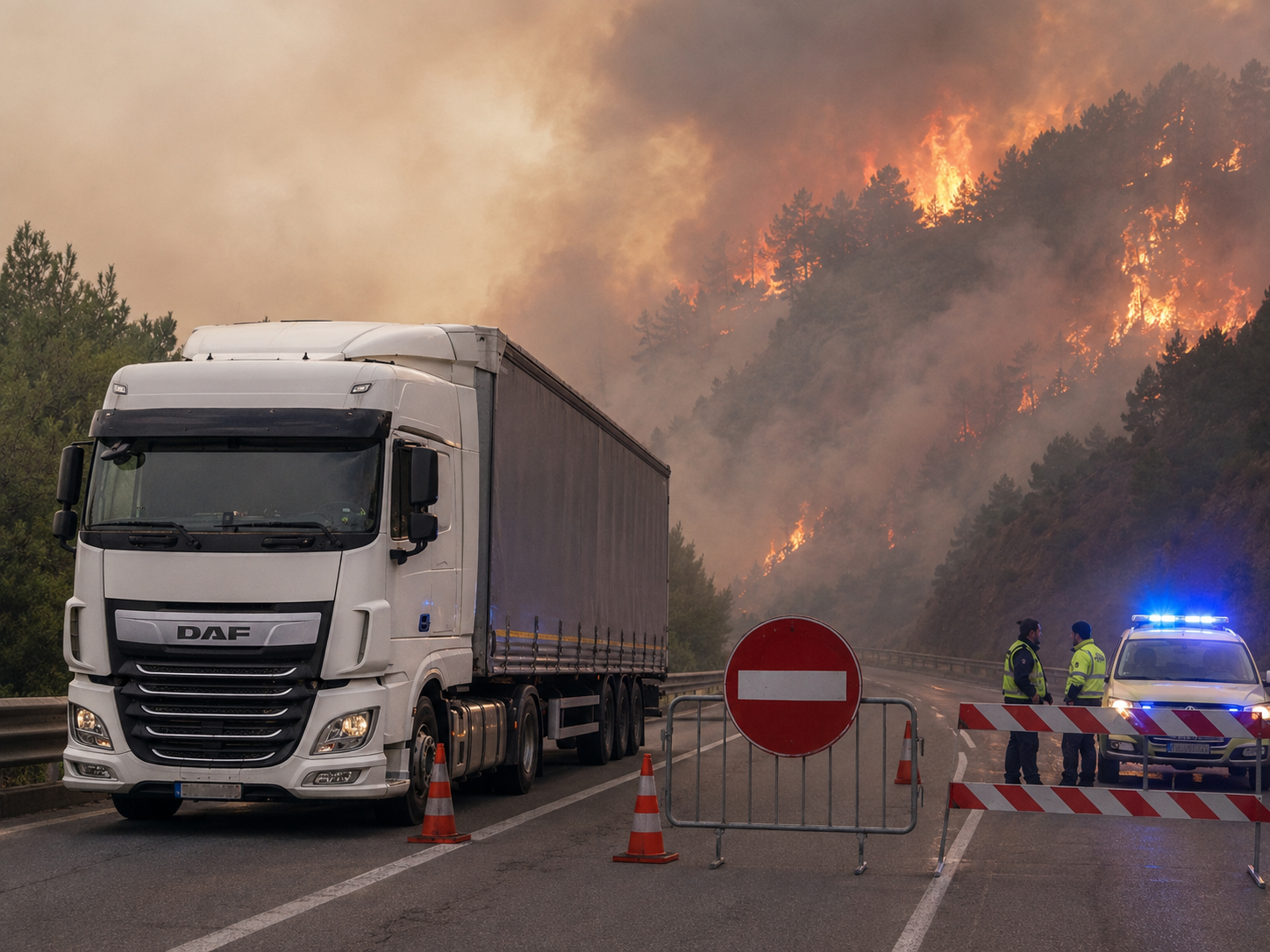
France Closes a Key Section of the A63
Major wildfires in southwestern France have severely disrupted traffic between Bordeaux, Bayonne and the Spanish border.
As fires spread across Gironde and Landes, authorities introduced extensive restrictions on the A63 motorway, one of the main Atlantic transport corridors used by international freight traffic between France and Spain.
In the Bayonne-to-Bordeaux direction, traffic is prohibited from the A63/A64 interchange to Exit 17 at Liposthey. Vehicles still on the motorway must leave at Liposthey.
All entry ramps between the A63/A64 junction and the Bordeaux ring road have also been closed. The motorway is completely shut between Liposthey and Exit 25.
In the opposite direction, from Bordeaux toward Bayonne, the A63 is closed between Exit 15 on the Bordeaux ring road and Exit 25.
Long-distance traffic is being advised to bypass the affected area via the A62, A65 and A64 through Langon and Pau.
Truck Routes Between France and Spain Are Being Rerouted
The closure is particularly important for road freight operators.
The A63 connects Bordeaux with Bayonne, Biarritz and the route toward San Sebastián in Spain. It forms part of a major freight corridor linking the Iberian Peninsula with France and northern European markets.
Diversions via the A62, A65 and A64 increase journey distances, fuel consumption and driving time.
For international carriers, the additional mileage can also affect compliance with drivers’ working and rest-time rules.
The disruption comes during the most difficult period of the summer road season. In addition to the fires, operators already have to take account of summer truck driving restrictions across Europe.
If a diversion sends a vehicle toward a route subject to a seasonal truck ban, delivery times can increase further.
Spain Has Closed 52 Road Sections
Road disruption is even more extensive in Spain.
As of 01:00 on July 28, a total of 52 road sections remained closed because of wildfires.
Ávila accounted for 18 local closures, while the Madrid region had 16. Eight roads remained affected in Castellón and six in Toledo, with four additional closures involving routes between different regions.
One of the most important affected roads is the N-403, which links Toledo, Ávila and Madrid.
Restrictions are also in place on the interregional M-540 and M-539 corridors.
Western Madrid Faces Extensive Restrictions
Wildfires have seriously affected roads west and southwest of the Spanish capital.
The M-501 remains among the routes affected by closures, along with sections of the M-507, M-510, M-512, M-521, M-531, M-533, M-537 and M-541.
For freight operators, these restrictions create problems for regional distribution.
Vehicles that would normally use local roads to reach warehouses, industrial facilities or retail locations may have to move onto larger routes.
That increases pressure on the remaining open network and can create congestion well beyond the immediate fire zone.
Toledo and Ávila Remain Heavily Affected
The number of closures in Toledo had fallen by the morning of July 28, but several routes remained unavailable.
Affected roads include the CM-5006, CM-5053, CM-543, TO-1385, TO-1451 and TO-1560.
Sections of the N-403 also remain closed between areas of Toledo, Ávila and Madrid.
Restrictions are more extensive in Ávila, where the AV-502, AV-503, AV-504, AV-512, AV-561, AV-562, AV-901 and AV-902 are among the affected roads.
The fires are disrupting transport around Cebreros, Navaluenga, Burgohondo and the Tiétar valley.
Eight Roads Remain Closed in Castellón
Wildfires are also affecting inland areas of Castellón province in the Valencian Community.
The CV-200 between Almedíjar and Aín, CV-203 between Ayódar and Caudiel, CV-205 between Tales and Fuentes de Ayódar, and CV-215 between Algimia de Almonacid and Alcudia de Veo remain among the affected routes.
Restrictions also apply to the CV-219, CV-223, CV-2261 and CV-230.
This area is important for freight because of its proximity to the Mediterranean transport corridor and the ports of Valencia and Castellón.
Even where the main motorways remain open, closures on regional access roads can complicate deliveries to inland warehouses, factories and distribution points.
Fires Are Also Disrupting Transport in Italy
Italy is simultaneously dealing with its own wave of wildfires.
Southern regions including Puglia, Basilicata, Calabria and Sicily have faced significant fire activity, with evacuations affecting residents and tourists.
Unlike Spain, where the most visible transport impact is the closure of dozens of roads, Italy has experienced repeated disruption to its railway network.
On July 26, rail traffic was suspended on the Messina–Catania line near Acireale because of a fire close to the tracks.
The same day, trains were halted between Fiumetorto and Termini Imerese on the Messina–Palermo route and between Termoli and Campomarino on the Pescara–Foggia line.
Fires also affected rail operations around Naples and on the Rome–Cassino corridor.
On July 27, services were temporarily suspended near Monza on the Milan–Chiasso route and between Parghelia and Briatico on the Rosarno–Eccellente line via Tropea.
Most of these restrictions were later lifted after firefighting operations, but the repeated incidents show the scale of the disruption.
Smoke Can Shut Italian Motorways as Well
Road freight also remains vulnerable.
On July 12, smoke from a fire outside the motorway forced a temporary closure of the A14 Bologna–Taranto between San Severo and Foggia in both directions.
Traffic was redirected via the SS16 Adriatica.
That restriction was temporary and is not part of the current July 28 closures, but it demonstrates that a wildfire does not have to reach a motorway directly to stop traffic.
Dense smoke can reduce visibility to unsafe levels and force authorities to close the road.
The situation is particularly sensitive because Italy is entering the peak summer holiday period, when passenger traffic increases sharply and additional seasonal restrictions apply to heavy goods vehicles.
Carriers Have to Replan Routes Continuously
For logistics companies, the greatest challenge is unpredictability.
A road that is open in the morning can be closed several hours later if wind direction changes or firefighting operations expand.
Route planning therefore needs to be checked immediately before departure and repeatedly during the journey.
This is especially important for services crossing southwestern France or central Spain.
Diversions increase mileage and fuel consumption and can also make it more difficult for drivers to complete a route before mandatory rest periods or seasonal driving restrictions begin.
For perishable and time-sensitive cargo, delays create additional risks involving temperature control and delivery deadlines.
Wildfires Add to the Summer Traffic Peak
Late July and early August are traditionally among the busiest periods on the roads of France, Spain and Italy.
Millions of European residents travel toward holiday destinations, sharply increasing passenger traffic.
Even under normal conditions, this produces congestion and additional restrictions for freight vehicles. Wildfires introduce another factor that cannot be reliably built into standard schedules.
If major corridors such as the A63 or N-403 remain closed for extended periods, traffic is forced onto alternative roads that were not designed for the same level of international transit.
Carriers are advised to avoid active fire zones, follow police and road authority instructions and not attempt to bypass official closures using local roads.
Read also: Spain Builds Covered Truck Parking for 383 Trucks