

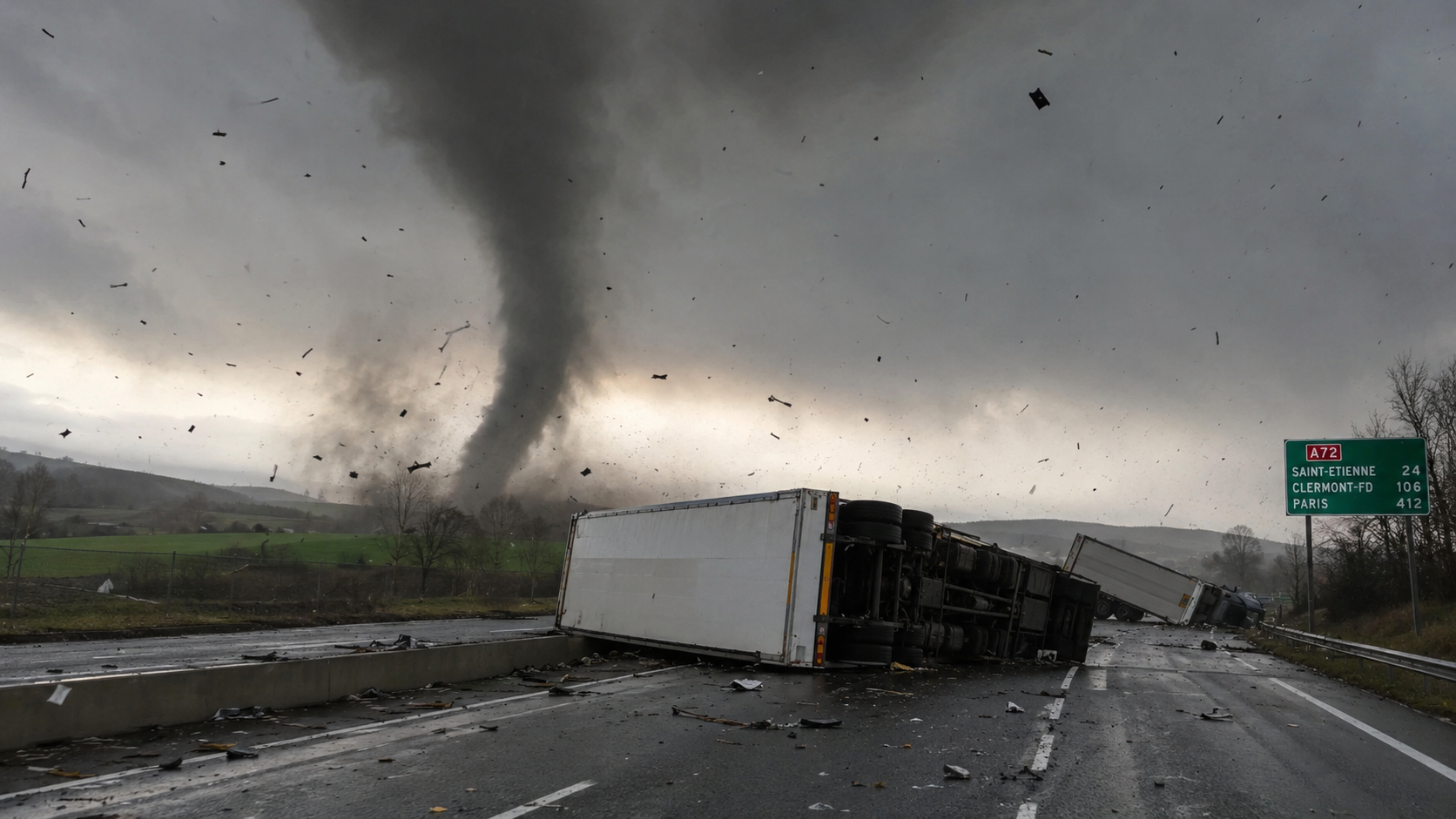
Two Trucks Overturned Near Saint-Étienne
A powerful storm that struck France on July 16 caused dangerous incidents on major roads and disrupted transport infrastructure.
One of the most dramatic events occurred when a tornado moved through an area north of Saint-Étienne. Winds overturned two articulated trucks on the A72 motorway.
The incident happened near the Ratarieux junction on the route from Saint-Étienne toward Clermont-Ferrand. Both trucks fell onto their right sides after the drivers had stopped on the emergency lane.
Neither driver was injured. The motorway was temporarily closed, and motorists were asked to avoid the area while emergency crews worked at the scene. Traffic resumed at approximately 9 p.m.
Stopping on the Shoulder Did Not Protect the Trucks
The A72 incident demonstrates that the usual advice to stop during rapidly deteriorating weather does not always eliminate the risk for heavy vehicles.
A tall semi-trailer has a large side surface. In a powerful crosswind, the body acts like a sail, generating enough force to overcome the vehicle’s stability.
Empty and partially loaded trailers are particularly vulnerable because they have less weight while retaining almost the same exposed side area. A sufficiently powerful gust can nevertheless overturn a fully loaded combination.
The drivers on the A72 had already stopped when their trucks fell over. A stationary vehicle therefore remains at risk when it is parked in an exposed location directly in the path of a tornado.
Where possible, drivers should seek a protected service area or a location shielded by substantial buildings or terrain. Parking beside trees, signs or power lines creates additional danger.
The Tornado Developed Inside a Powerful Storm
The storm intensified within a mass of very warm and humid air and developed supercell characteristics.
Strong winds, intense rainfall and large hail affected the Saint-Étienne area. A tornado crossed a commercial district north of the city and damaged vehicles, buildings and infrastructure.
French emergency services deployed hundreds of firefighters and a large number of vehicles. Rescue teams responded to hundreds of incidents involving fallen trees, damaged roofs, power outages and flooding.
The storm system also produced exceptionally high lightning activity. Tens of thousands of strikes were recorded across France, while hailstones several centimetres in diameter were reported in affected regions.
Other Incidents Resulted in Fatalities
The truck incident ended without injuries, but severe weather killed people elsewhere in France.
A fire broke out at a business in Dolomieu in the Isère department during the storm. The company’s 38-year-old owner died.
In Saint-Victurnien in Haute-Vienne, a 30-year-old woman was killed by a tree brought down by the wind.
French reports confirmed two deaths linked to the storms.
The incidents show that a severe thunderstorm creates several simultaneous hazards. The threat comes not only from tornadoes but also from falling trees, lightning, hail, flash flooding and damaged electrical infrastructure.
More Than 50,000 Customers Lost Electricity
The storms damaged distribution networks and caused widespread power outages.
More than 50,000 homes temporarily lost electricity. Fallen poles and damaged lines also complicated traffic and required additional emergency and repair teams.
Rail operations were affected as well. Some trains around Lyon were cancelled or delayed until Friday because of infrastructure damage, fallen trees and safety inspections.
For logistics operators, such disruption creates a chain reaction. A closed motorway diverts trucks onto lower-capacity regional roads, while interrupted rail services reduce alternative freight options.
Warehouses and factories may also suspend operations when electricity is lost or access routes are blocked.
Extreme Weather Is Becoming an Operational Risk
The tornado followed a period of extreme heat that created conditions for rapidly developing thunderstorms.
Sharp changes from heat to severe storms are becoming a major challenge for road freight operators. Companies must monitor not only temperature forecasts but also short-lived local hazards that can develop quickly.
K2Cargo.News previously reported that extreme heat is already disrupting European logistics, damaging roads, forcing railway speed restrictions and increasing pressure on heavy vehicles.
The risk does not end when temperatures begin to fall. Hot and humid air can produce severe thunderstorms, hail, damaging winds and localized tornadoes.
Weather monitoring therefore needs to continue throughout the journey rather than only before departure.
Poland Issued Severe Thunderstorm Warnings
After the storms in France, dangerous weather was also forecast for Poland.
The Polish Institute of Meteorology and Water Management issued thunderstorm warnings for a large part of the country on Sunday, July 19.
Second-level warnings covered the Opole, Silesian and Lesser Poland regions, along with parts of Lower Silesia, Greater Poland, Łódź and Świętokrzyskie.
Forecasters expected rainfall of 20–35 millimetres, wind gusts of up to 85 km/h and locally 100 km/h. Hail was also possible. In most affected areas, the warnings remained in force until 10 p.m.
Some forecasts indicated the possibility of particularly intense convective systems and localized rotating storms. A tornado cannot be reliably forecast for one specific road many hours in advance, so drivers need to follow real-time warnings.
Southern Poland Faced the Highest Risk
The most difficult conditions were expected in southern and southwestern Poland.
The Opole, Silesian and Lesser Poland regions are crossed by major international freight routes connecting Germany, Czechia, Slovakia, Ukraine and Poland’s industrial centres.
Wind gusts reaching 100 km/h can make truck operations dangerous even without a tornado. On exposed roads, bridges and viaducts, an articulated vehicle can be pushed unexpectedly into another lane.
Hail several centimetres in diameter can damage windscreens, mirrors, lights and truck bodywork. Refrigerated and curtain-sided trailers may also suffer roof or side damage.
Heavy rain sharply reduces visibility and increases the risk of aquaplaning. A heavy truck also needs far more distance to stop than a passenger car.
Summer Restrictions Could Concentrate Trucks on Motorways
The warning was particularly important because summer truck restrictions were in force.
Many heavy vehicles are required to wait until the Sunday driving ban ends. Once the restriction is lifted, large numbers of trucks may leave parking areas and enter motorways at the same time.
When the end of a driving ban coincides with a severe storm, heavy-vehicle traffic becomes concentrated during the most dangerous period.
Some categories are exempt, including trucks carrying perishable goods, livestock, fuel or other special cargo.
Drivers of exempt vehicles need to assess the conditions carefully. Legal permission to continue does not mean the journey remains safe.
Drivers Should Not Wait Out Storms in Random Locations
When strong-wind warnings are issued, drivers should identify suitable stopping places before conditions deteriorate.
An official parking or service area away from trees, light structures and advertising signs is preferable.
Stopping on the emergency lane should be a last resort. A truck remains exposed to wind and creates an additional hazard for other traffic.
Bridges, open high ground and terrain where wind may accelerate should be avoided.
When a truck is already experiencing powerful crosswinds, the driver should reduce speed gradually, avoid sudden steering and hold the wheel firmly. Abrupt braking or lane changes can lead to loss of control.
Dispatchers Need Real-Time Route Monitoring
The decision to stop during a storm should not rest entirely with the driver.
Transport companies need to use weather radar, road-authority alerts and navigation data. Dispatchers should inform drivers about approaching storms and recommend safe parking locations.
This is particularly important on international journeys. A driver may not understand local-language warnings or may receive them too late.
Companies should also allow delays without putting pressure on the driver. Demanding arrival at a warehouse slot regardless of weather may encourage unsafe decisions.
Shippers and consignees should treat delays caused by official weather warnings as a legitimate reason to change schedules.
Empty Trailers Require Particular Caution
The risk of overturning depends on both wind speed and vehicle configuration.
An empty semi-trailer is much lighter than a fully loaded one but has almost the same side surface. Powerful gusts can therefore lift its wheels more easily.
Tall box trailers, car transporters, container chassis and curtain-sided units may also be vulnerable.
With partial loads, cargo position becomes important. Poor weight distribution reduces stability and can make the effect of crosswinds more severe.
Before entering an area under a storm warning, carriers should check load securing and ensure that heavy items are positioned low and distributed evenly.
Hail Can Damage Both Vehicle and Cargo
Severe weather threatens more than vehicle stability.
Large hail can damage trailer roofs, ventilation components, refrigeration equipment and external sensors. Water may then enter the load compartment.
Electronics, paper products, furniture, pharmaceuticals and goods packed in cardboard are particularly sensitive.
After passing through heavy hail, the driver should inspect the trailer before continuing. Damage to the roof or seals may not be immediately visible but can allow water to enter over time.
Photographs and records of the time and location should be preserved for insurance claims.
Storms Disrupt the Wider Supply Chain
Even a short motorway closure can produce delays far beyond the affected area.
Trucks are diverted onto regional roads with less capacity. Congestion increases, fuel consumption rises and drivers may struggle to comply with working-time rules.
A missed unloading slot can move delivery to the following day and disrupt the truck’s next assignment.
Damage to rail and electricity infrastructure also limits the ability to shift cargo to alternative routes.
Just-in-time supply chains are particularly vulnerable. One delayed component shipment can stop a factory even when the production site is far from the storm zone.
Insurance Policies Will Face New Weather Risks
More frequent severe weather also affects freight insurance.
A standard motor policy may cover damage caused by hail, falling trees or wind, but the terms vary between contracts.
Cargo damage, delivery delay and vehicle recovery may require separate coverage.
When a driver continues despite an official warning or obvious danger, an insurer may examine whether reasonable preventive measures were taken.
Transport companies should therefore document dispatcher instructions, driver decisions and the warnings available at the time.
European Carriers Must Adapt Their Planning
The tornado in France and warnings in Poland demonstrate that extreme weather is becoming a regular factor in road freight.
Companies already plan around tolls, driving bans, rest periods and border delays. Weather risk now needs to become another standard routing parameter.
The shortest and cheapest route may no longer be acceptable when it crosses an area threatened by damaging winds, flooding or large hail.
Carriers need alternative parking areas, backup routes and additional transit time. Drivers should have clear authority to stop when conditions become unsafe.
The main lesson from the A72 incident is that a heavy truck is not protected from a tornado simply because it has stopped.
Timely warnings, a safe location and freedom from schedule pressure may be more important than saving several hours on a delivery.
Read also: Heatwave Disrupts European Logistics