

Two Separate Economic Agreements Are Moving Forward
Russia and India are accelerating work on the legal and logistics infrastructure needed to support further trade growth.
Two separate negotiating tracks are involved.
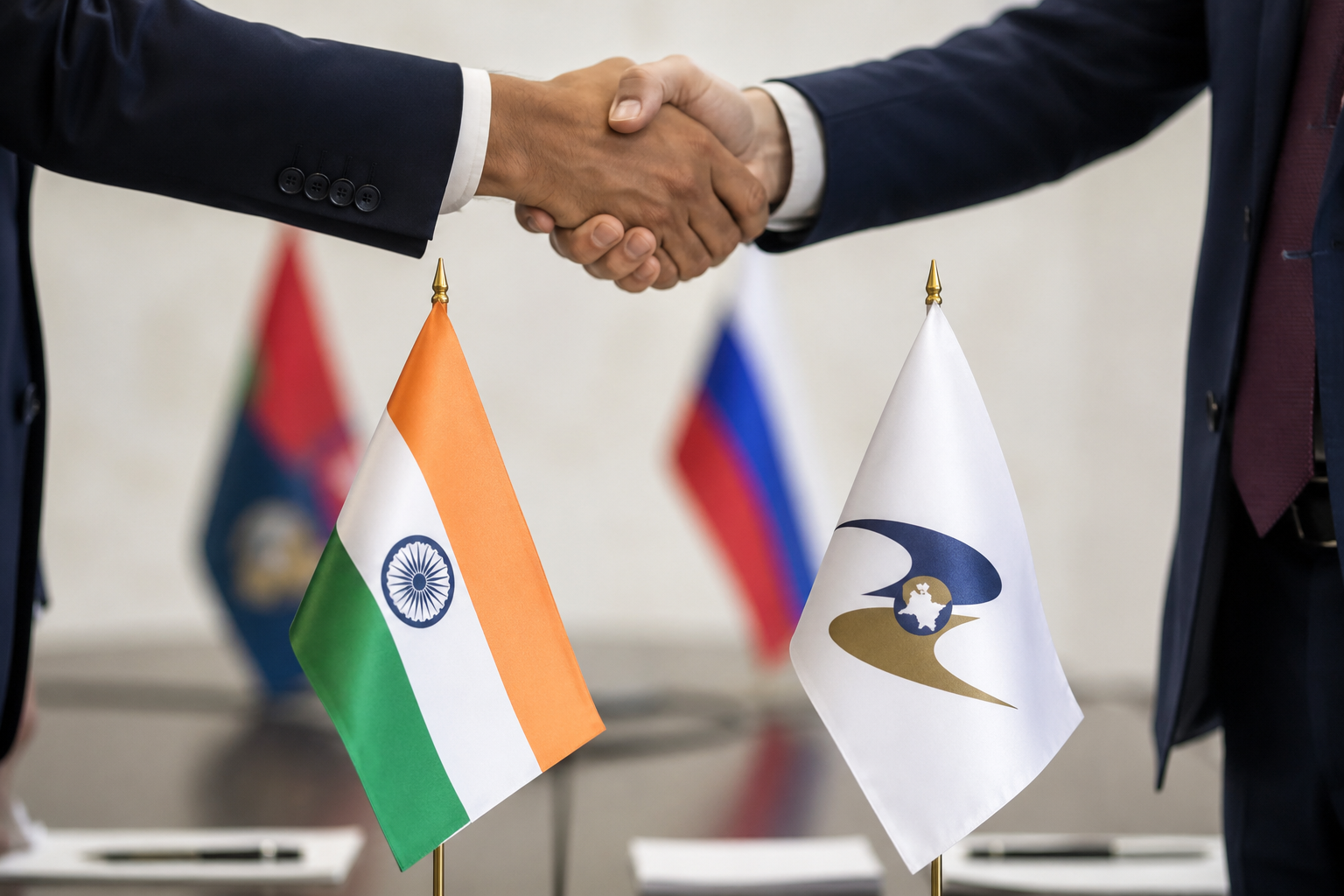
Moscow and New Delhi are discussing a bilateral investment protection agreement, while the proposed free trade area is being negotiated between India and the Eurasian Economic Union, whose members are Russia, Belarus, Kazakhstan, Armenia and Kyrgyzstan.
The FTA process has already moved into substantive negotiations.
The first round took place in New Delhi in November 2025, followed by a second round in Moscow on June 22–25, 2026.
The Moscow talks produced agreement on the general contours of tariff liberalisation for goods. Negotiators also discussed sanitary and phytosanitary measures, technical regulation, customs administration, intellectual property and competition.
For freight operators, these issues can be as important as tariffs themselves. Removing a customs duty does little to improve a supply chain if cargo continues to face lengthy certification, customs or product-compliance procedures.
The Target Is More Than $100 Billion in Trade
Russia and India have jointly set a target of increasing bilateral trade to more than $100 billion by 2030.
They have already moved significantly toward that figure.
Trade reached a record $68.7 billion in India’s 2024–25 financial year. The structure, however, remains highly unbalanced: Indian exports to Russia were worth around $4.9 billion, while imports from Russia amounted to approximately $63.8 billion.
Russia mainly supplies oil and petroleum products, vegetable oils, fertilisers, coking coal, precious stones and metals.
India exports pharmaceuticals, chemicals, iron and steel products, marine products and other manufactured goods.
The challenge is therefore no longer simply to increase total trade, but to create more balanced cargo flows.
For logistics companies, that matters directly. Better backhaul volumes improve equipment utilisation and can make regular shipping, container and rail services more economical.
The FTA Could Generate More Return Cargo From India
One objective of the future India–EAEU agreement will be to reduce barriers affecting Indian exports.
New Delhi is particularly interested in easier market access for agricultural and food products, marine products, pharmaceuticals and manufactured goods.
That could change the physical structure of Russia–India logistics.
At present, a large part of the value of bilateral trade is generated by Russian energy exports to India. If Indian shipments to Russia and other EAEU economies begin rising more quickly after trade liberalisation, carriers could build more balanced two-way services.
The FTA will not automatically eliminate every barrier.
Product lists, tariff cuts, exclusions and transition periods still need to be negotiated.
The free trade area should therefore be treated as an agreement under negotiation rather than an established trade regime.
The Investment Treaty Has a Different Role
Russia and India are separately negotiating an investment protection agreement.
It serves a different purpose from the EAEU FTA.
While the trade agreement deals primarily with market access, tariffs and trade procedures, an investment treaty is intended to establish clearer conditions and legal protections for companies investing in the other country.
That could have direct consequences for logistics.
Larger cargo flows require investment in ports, warehouses, terminals, rail infrastructure, shipping capacity and distribution centres.
The clearer the legal framework for protecting long-term capital, the easier it becomes for companies to assess infrastructure projects whose payback periods may extend over decades.
Vladivostok–Chennai Could Become a Larger Freight Route
Another part of the strategy involves the Eastern Maritime Corridor between Vladivostok and Chennai.
Russian Deputy Foreign Minister Andrey Rudenko says the two countries are examining options to intensify transport along the route.
For Russia, the corridor could help strengthen the cargo base of its Far Eastern ports. For India, it would provide an additional maritime connection with the Russian Far East.
Potential cargoes include energy commodities, coal, fertilisers, timber, metals, food products and eventually larger volumes of containerised freight.
Turning the corridor into a significant commercial service will, however, require more than political support.
Operators need sufficient two-way cargo, competitive freight rates, suitable vessels and coordinated port operations.
Northern Sea Route Is Another Option Under Discussion
Moscow and New Delhi are also exploring cooperation on the Northern Sea Route.
Russia sees the Arctic corridor as a potential alternative to routes through the Suez Canal for certain cargoes.
In December 2025, the two countries signed a memorandum on training specialists to work aboard vessels operating in polar waters. A separate memorandum on cooperation in cargo transportation along the Northern Sea Route is expected to follow.
The NSR should not yet be viewed as a universal replacement for Suez.
Commercial operations depend on ice conditions, ice-class tonnage, icebreaker support, insurance, Arctic port infrastructure and the economics of individual voyages.
Its importance for Indian trade is therefore likely to vary considerably by cargo type and season.
North–South Remains the Most Developed Land-Based Alternative
The International North–South Transport Corridor represents another major component of India–Russia connectivity.
It links Russia with the Caspian region, Iran and ports on the Indian Ocean, from where cargo can move to India.
The route combines rail, road and maritime sections and offers several possible configurations through the Caspian and Iran.
Infrastructure continues to expand along the wider corridor. For example, Kazakhstan is developing its own transport and logistics terminal at Iran’s Shahid Rajaee Port, creating additional infrastructure linked to North–South trade and access to Indian markets.
The central challenge is no longer whether a route physically exists, but whether it can provide predictable border transit, competitive tariffs and sufficient railway and port capacity.
Payment Infrastructure Is Part of the Logistics Strategy
The two countries are also working on payment mechanisms.
Rudenko says Moscow and New Delhi are developing financial and logistics channels that the Russian side describes as more resilient to sanctions pressure.
The payment discussion predates the latest statements.
The countries’ joint economic agenda already includes greater use of national currencies and digital financial instruments in bilateral settlements.
This matters directly to freight.
A transport corridor cannot scale if companies face difficulties paying for goods, freight, insurance, terminal handling or equipment.
The extreme trade imbalance creates an additional complication, because substantially more payment flows currently move toward Russian exporters than in the opposite direction.
Faster growth in Indian exports could help improve that balance.
Growing Trade Will Require More Than One Corridor
If bilateral trade exceeds $100 billion, the additional cargo is unlikely to move efficiently through a single route.
North–South can handle freight through Iran and the Caspian region.
Vladivostok–Chennai could provide a maritime connection between India and the Russian Far East.
The Northern Sea Route may develop as a more specialised option for selected commodities and seasonal flows.
Using several corridors provides shippers with more choice between cost, transit time and resilience.
The real test will be whether government agreements translate into regular commercial services.
The FTA Could Be the Main Freight Accelerator
Of all the initiatives currently under discussion, the India–EAEU free trade agreement could have the broadest impact on the structure of cargo flows.
Lower trade barriers increase the number of products for which cross-border shipments become economically attractive.
That is particularly important for Indian exporters, as Russia is seeking to reduce the very large imbalance in bilateral trade.
At the same time, an investment protection agreement could create clearer conditions for companies financing terminals, industrial facilities and logistics infrastructure.
Trade rules, investment protection, payments and transport corridors are therefore becoming parts of the same system.
If they develop in parallel, the $100 billion target would represent not only greater trade value but a significantly larger physical freight flow linking India, Russia and the wider EAEU market.
Read also: Kazakhstan to Build Logistics Terminal in Iran
