

DeCA Will Become Mandatory in Digital Form
Spain’s road freight sector is preparing for new administrative requirements. From October 5, 2026, the control document required for certain commercial road freight operations must be issued electronically as a DeCA, or Documento electrónico de Control Administrativo.
The requirement originates from Sustainable Mobility Law 9/2025. The law entered into force on December 5, 2025 and established a ten-month period before administrative control documents become obligatorily digital.
Technical requirements for DeCA were subsequently established by a June 5, 2026 resolution of Spain’s Directorate-General for Road and Rail Transport.
The change does not mean that every freight document used in Spain is moving to a single digital system. DeCA remains primarily an administrative document used for transport enforcement.
Domestic Transport and Cabotage Are Covered
DeCA applies to domestic road freight operations where both the origin and destination are located within Spain.
The requirement also covers cabotage operations carried out in Spain by foreign carriers. International transport companies performing domestic Spanish legs following an international delivery will therefore need to comply with the DeCA rules where applicable.
International transport whose route only passes partly through Spain is outside the scope of this requirement. Those operations will continue to use documentation required under applicable international agreements and transport rules.
This also means Spain is not making electronic CMR mandatory for all international freight movements from October 5. DeCA and e-CMR are separate documents serving different purposes.
Scanned Paper Documents Will Not Be Accepted
A DeCA must be a natively generated digital PDF created from structured information entered into a computer application.
Scanning an existing paper document or converting a digital image into PDF will not satisfy the requirement.
The file may not exceed 5 MB. Its metadata must record the date and time it was created and, where applicable, the date and time of subsequent modifications.
Crucially, the DeCA must be generated before the transport service actually begins. Companies therefore cannot wait until a roadside inspection to create the required administrative record.
Every DeCA Will Have Its Own URL and QR Code
Once generated, the DeCA must be stored in a digital repository and assigned a unique web address.
The URL must use HTTPS with TLS 1.2 or a higher standard and provide direct access to download the PDF.
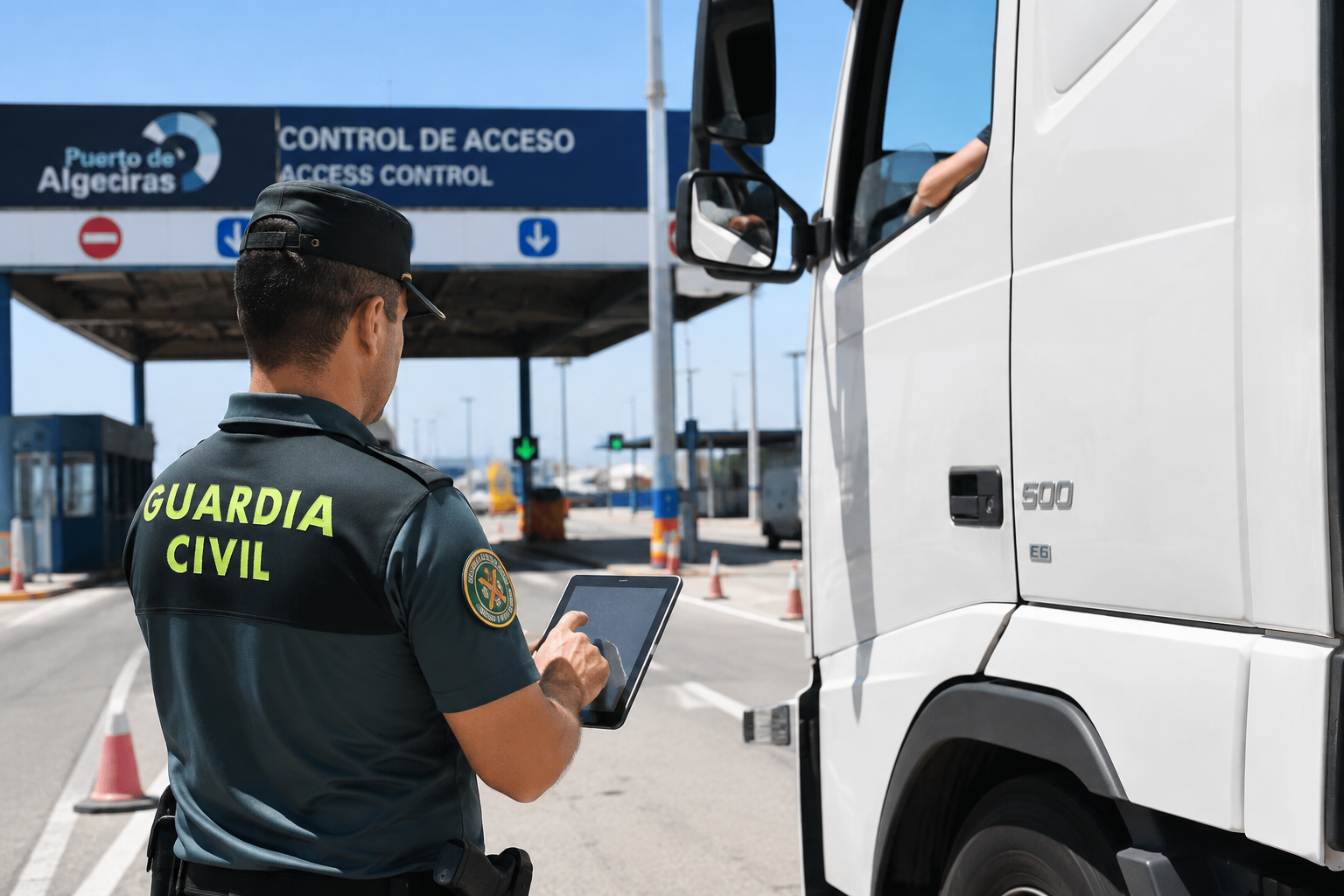
During a roadside inspection, officers must not be required to enter passwords, authenticate themselves, visit an intermediary webpage or click additional download buttons. Accessing the URL must directly enable the PDF file to be downloaded.
The unique address must also be embedded in the DeCA as a QR code so inspectors can scan it at the roadside.
The link must remain operational throughout the transport operation. Seven calendar days after the service has ended, the download option associated with that specific URL may be disabled.
Drivers Can Present Only the QR Code
Before the journey begins, the driver must receive a copy of the DeCA.
It may be carried electronically on a smartphone, tablet or another device. A printed paper copy is also permitted.
Drivers may additionally carry the QR code as a separate file. During an inspection, they can present either the complete DeCA containing the QR code or the QR code alone, allowing officers to retrieve the document.
Although a printed copy is acceptable, handwritten changes made to the paper version will not count as valid amendments to the DeCA. Any changes must be made through the electronic system.
Shipper and Carrier Share Responsibility
Responsibility for documenting the shipment falls on both the contractual shipper and the actual carrier.
Both parties do not have to generate separate copies independently. One party may create the DeCA provided that the other has the necessary access and can download the document.
The contractual shipper is responsible for information including its identification, the identity of the actual carrier, the origin and destination of the shipment, and the nature and weight of the goods.
The actual carrier is responsible for information covering special road authorizations where applicable, the transport date and the registration numbers of the vehicles used.
Both sides can be held responsible if the required control document is not created or if the necessary copy is not carried on board.
Electronic Files Must Be Retained for at Least One Year
The contractual shipper and actual carrier are required to retain DeCA files for at least one year and make them available to the road transport inspectorate when requested.
The two parties may use the same repository or maintain separate storage systems.
If one party generates the file, the other must be able to download it during the mandatory retention period.
The ability to deactivate the roadside download URL seven days after completion of the transport service therefore does not remove the obligation to retain the underlying file for one year.
Changes Must Remain Traceable
If information changes after the transport operation has started, the rules provide two ways to update the DeCA.
The first is to modify the existing PDF. New information and the reason for the amendment must be added, while the original details remain visible and are clearly identified as no longer valid. The same URL and QR code can then continue to be used.
The second option is to generate a completely new PDF. This results in a new URL and QR code, while the original file must be retained to preserve traceability.
In both cases, the updated version must be provided to the driver.
Several Shipments Can Be Grouped Into One DeCA
Spanish rules allow several freight services to be included in a single DeCA when the contractual shipper and actual carrier are the same for all shipments.
Each individual consignment must nevertheless be clearly identifiable. Its origin, destination, nature and weight must be specified, together with any other information that differs between shipments.
This can reduce administrative duplication when several services are performed between the same contracting parties.
CMR and ADR Documents Can Also Serve as DeCA
Companies do not necessarily need a separate dedicated DeCA template.
Spanish regulations allow other commonly used freight documents to perform the same function, including consignment notes, ADR transport documentation, waste-transfer documents and SANDACH documentation.
To qualify as a DeCA, however, the document must contain all required administrative data and meet the digital requirements, including native PDF generation and the appropriate QR code.
The contractual shipper and actual carrier must also be expressly and clearly identified.
Electronic Signature Is Not Mandatory for DeCA Itself
Because DeCA is an administrative document, it does not require a signature simply to be valid.
The situation is different where the same file also serves a contractual purpose and signatures are required for that use.
In such cases, at least an advanced electronic signature meeting the requirements of the EU eIDAS framework must be used. Qualified electronic signatures are also accepted.
eFTI Will Be the Next Stage
The system becoming mandatory on October 5 represents a transitional stage in the wider digitalization of freight documentation.
The initial model relies on native PDF files, digital repositories, direct URLs and QR codes.
The sector is ultimately expected to move toward structured data exchange under EU Regulation 2020/1056 on electronic freight transport information, known as eFTI.
When the required transport information is managed and presented through an eFTI-compliant platform, operators will no longer need to present DeCA in the PDF form established under Spain’s current resolution.
For carriers, the period before October will therefore be important for adapting software, digital storage and QR-based document access, as well as training drivers and administrative staff handling domestic and cabotage operations in Spain.
Read also: Spain May Restrict Truck Overtaking on Key Roads in 2026
