

Technology Is Becoming a New Export Engine
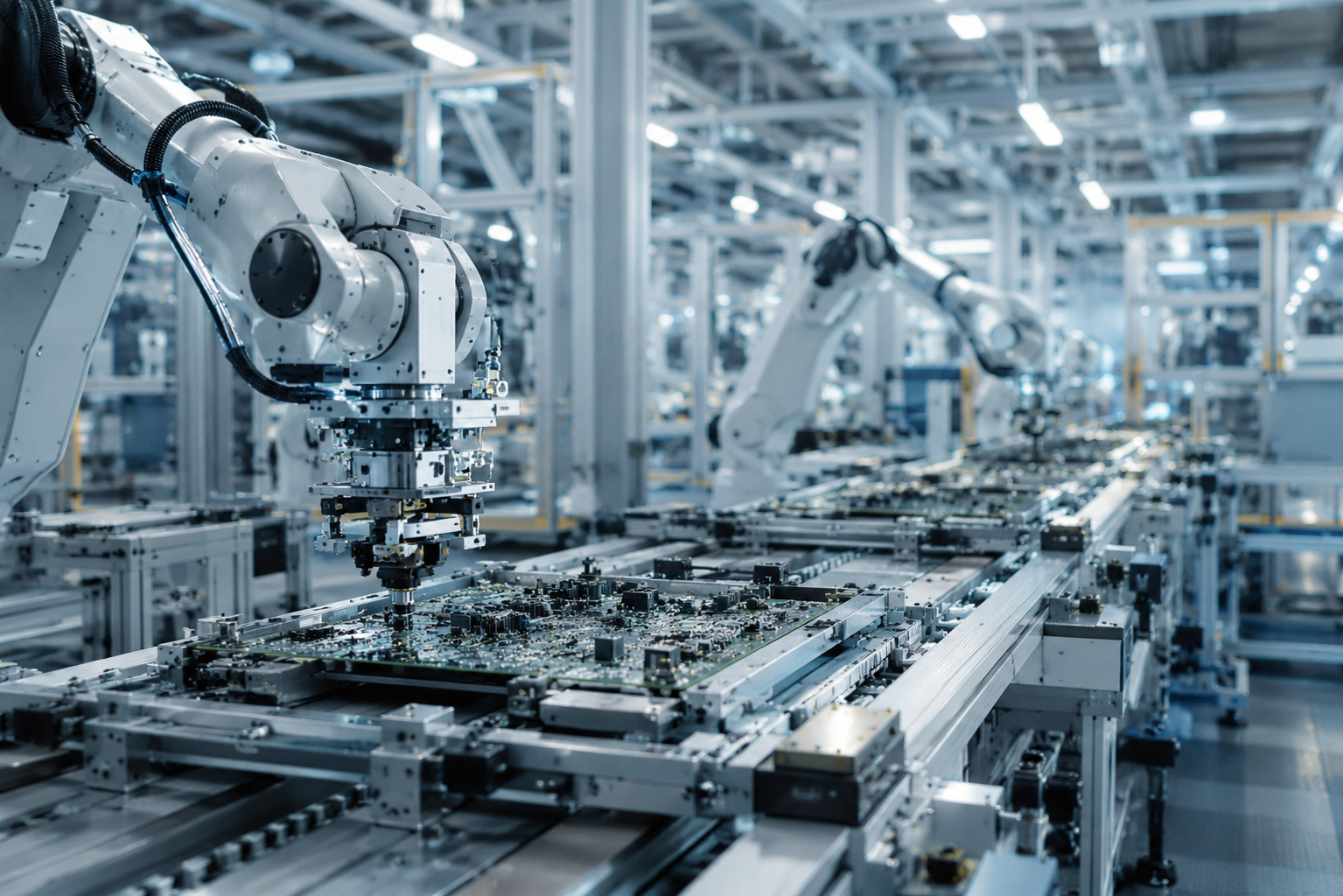
Mexico is experiencing another period of strong export growth, but its composition is changing. While the automotive industry has traditionally dominated the country’s manufacturing exports, computers, electronics, servers and other high-tech products are now delivering some of the fastest growth. FreightWaves highlighted the trend based on research from BBVA México.
According to BBVA Research, Mexico’s merchandise exports increased 7.6% in 2025 to $664.8 billion. Manufacturing exports rose 9.8% and accounted for 91.7% of total merchandise exports. Automotive exports declined 4.2%, while machinery and equipment for various industries expanded 64.1%.
Computing and electronics stood out even more sharply. Mexican exports from the sector to the United States increased 46.8% in 2025, while automotive shipments weakened. BBVA links the change both to rising demand for computing infrastructure and to the redistribution of U.S. sourcing away from China.
Chapter 84 Exports Are Approaching $200 Billion
Another indication of the scale of the shift is Mexico’s trade in products classified under Chapter 84 of the Harmonized System, which includes a broad range of machinery as well as computers and data-processing equipment.
BBVA estimates that exports in this category have roughly doubled in only a few years and are now approaching $200 billion on a trailing 12-month basis. Computers are responsible for a substantial share of the increase.
Mexico’s trade surplus in Chapter 84 is now effectively explained by computer exports, suggesting the country is developing a new comparative advantage beyond automobiles, household appliances and the traditional maquiladora industries that have long defined cross-border manufacturing.
AI Investment Is Supporting Demand
One factor behind the expansion is the U.S. investment cycle in artificial intelligence and data centers.
Major technology companies are increasing spending on servers, computing equipment and data-center infrastructure. BBVA finds a strong relationship between Mexican computer exports and U.S. private investment in information-processing equipment.
That creates an opportunity for Mexico to participate in the expanding North American technology supply chain not only as a final assembly location, but also as a producer of electronics, communications equipment, components and other products used in digital infrastructure.
The strongest technology clusters are concentrated in states including Chihuahua and Jalisco. BBVA reported export growth of almost 50% in Chihuahua and around 78% in Jalisco in 2025, with computing and electronics contributing heavily to that performance.
Mexico Supplies as Much as 17% of U.S. Imports
Geography remains one of Mexico’s strongest competitive advantages.
The country shares a land border with the world’s largest consumer market and already has deeply integrated road, rail and manufacturing networks with the United States.
BBVA estimates Mexico accounts for roughly 16% of U.S. imports, while the Economics Observatory puts its share at a record 17% in early 2026, compared with around 7.2% for China.
For logistics, this reinforces the importance of manufacturing and border hubs such as Ciudad Juárez, Tijuana and Monterrey, where cross-border trucking and intermodal networks connect Mexican factories with U.S. customers. FreightWaves notes that electronics growth could increase flows of higher-value components across these corridors.
USMCA Is Becoming Mexico’s Key Tariff Advantage
Proximity is no longer Mexico’s only advantage.
As trade barriers rise globally, the United States-Mexico-Canada Agreement has become increasingly important. USMCA entered into force in 2020, replacing NAFTA and preserving preferential market access for qualifying trade among the three North American economies.
Figures cited by FreightWaves indicate that Mexico faced an effective U.S. tariff rate of less than 5% by the end of 2025, compared with roughly 33% for China and around 10% for U.S. imports overall. About 88% of Mexican goods could enter the United States duty-free under USMCA when they met the agreement’s requirements.
As tariffs increase on competing manufacturing locations, that differential becomes more valuable.
For companies deciding whether to manufacture U.S.-bound products in China, elsewhere in Asia or in Mexico, the calculation increasingly includes not only labor costs but also tariffs, distance, delivery times, component origin and compliance with USMCA rules.
Nearshoring Is Moving Beyond Automotive Manufacturing
For decades, U.S.-Mexico industrial integration was associated mainly with cars, automotive components and large assembly plants.
The expansion of computer and electronics production suggests nearshoring is broadening into more technologically complex sectors.
BBVA describes computing and electronics as an important hub in Mexico’s production network, connecting traditional industries with higher-technology manufacturing. Proximity to the United States lowers logistics costs, while established industrial clusters and specialized labor support integration into U.S.-focused supply chains.
Production capacity, however, is already heavily utilized. Overall capacity utilization in computing and electronics exceeded 93% in 2025, while the computing segment was operating at close to 97.5%. That points to both strong demand and potential bottlenecks if the industry continues expanding quickly.
Export Growth Has Not Yet Produced a Full Investment Boom
Strong trade figures do not necessarily mean Mexico has already secured a large-scale wave of nearshoring investment.
Foreign direct investment in computing and electronics reached a decade-high of about $1.8 billion in 2024 before declining 36.3% in 2025.
This highlights the difference between increasing production at existing facilities and committing capital to new factories, warehouses and infrastructure.
For the export boom to translate into sustained industrial expansion, Mexico will need to address constraints involving electricity supply, transport infrastructure, digitalization and skilled labor. BBVA identifies these areas among the main challenges facing further development of the technology sector.
USMCA Uncertainty Remains the Biggest Risk
Mexico’s advantage also depends heavily on a trade agreement whose longer-term future has become less certain.
On July 1, 2026, the United States declined to extend USMCA for another 16 years in its existing form. The agreement was not terminated and remains in force, while negotiations continue. Without a later agreement to extend it, annual reviews can continue ahead of a potential expiration in 2036.
Washington is seeking changes including stronger rules of origin and greater North American content in industrial products. U.S.-Mexico talks in July covered automobiles, steel and aluminum, economic security, agriculture and other trade issues.
For manufacturers considering investments in Mexico with a lifespan of decades, the durability of those rules is critical. Strong current exports therefore do not automatically guarantee a comparable surge in long-term investment.
Technology Exports Could Reshape Cross-Border Logistics
For the transport sector, the changing composition of Mexican exports may matter almost as much as the increase in total trade.
Automotive supply chains revolve around large-scale, scheduled industrial flows. Electronics and technology equipment can place greater emphasis on speed, inventory precision, secure handling of high-value components and reliable border crossings.
As those shipments expand, the requirements placed on warehouses, trucking companies, customs brokers, intermodal terminals and cargo-tracking systems along major U.S.-Mexico corridors are likely to increase.
Mexico’s role in North American manufacturing is therefore becoming broader. It remains a major automotive production center, but its export base increasingly includes computers, servers, communications equipment and electrical products.
If the trend continues, the next stage of North American supply-chain integration will be shaped not only by moving conventional manufacturing closer to U.S. consumers, but also by competition for technology production and the logistics networks required to support high-value goods.
Read also: Expert Opinion: Why Kazakhstan and Georgia Are Becoming Key Hubs of Eurasia’s New Logistics Network