

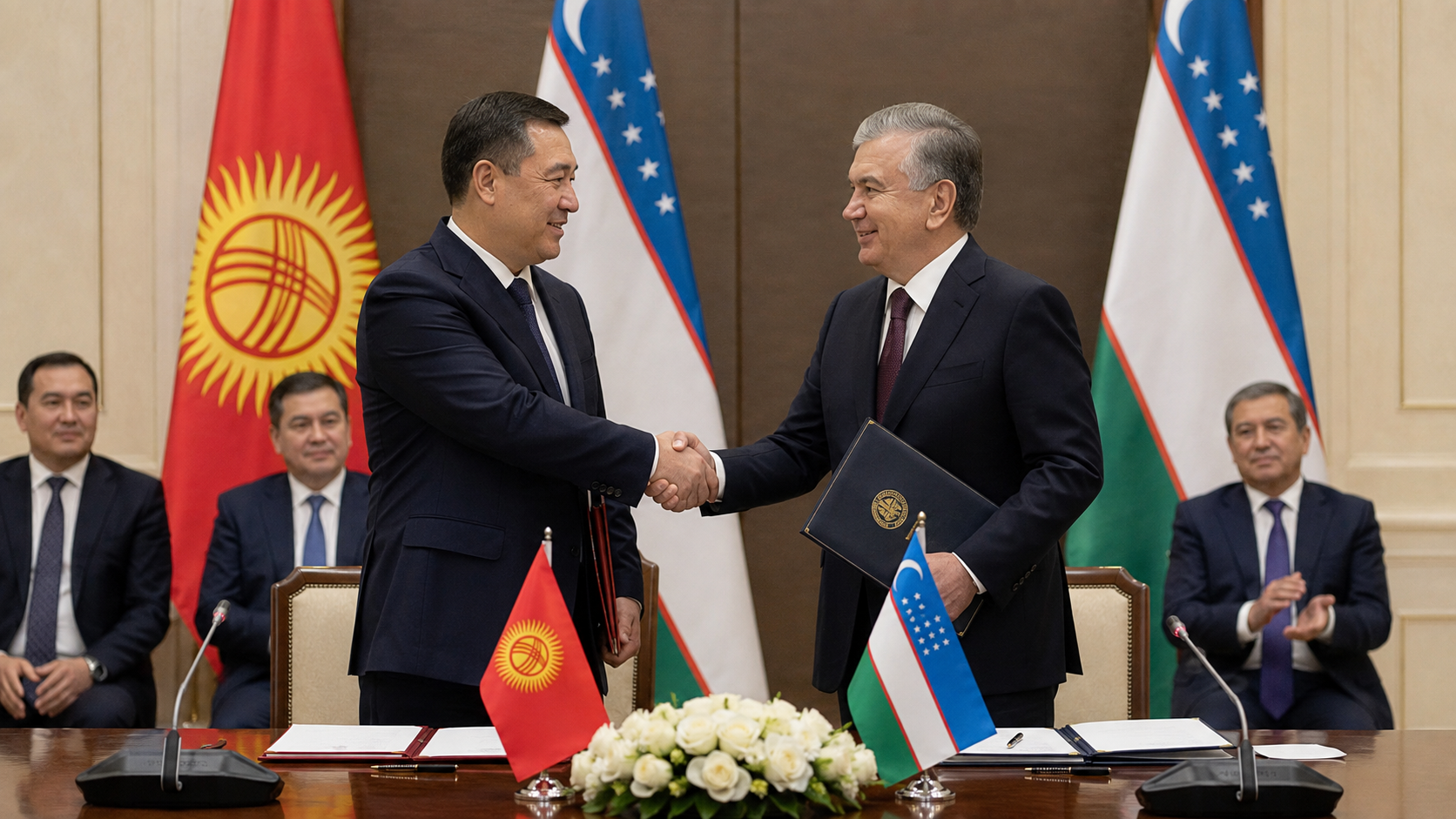
Relations Move to an Allied Level
Kyrgyz President Sadyr Japarov and Uzbek President Shavkat Mirziyoyev have signed a Treaty on Allied Relations between the two countries.
The ceremony took place in Cholpon-Ata on July 30, 2026, during the Uzbek leader’s state visit to Kyrgyzstan. The presidents held restricted and expanded talks at the Rukh Ordo cultural centre.
The treaty establishes a higher political and legal framework for bilateral relations. The two countries intend to deepen cooperation in trade, industry, energy, transport, agriculture, tourism, education and security.
Interstate Council Will Oversee Implementation
Kyrgyzstan and Uzbekistan will establish an Interstate Council chaired by the two presidents to implement the new agreements.
The body is expected to become the principal mechanism for setting long-term priorities and overseeing decisions adopted at the highest political level.
The leaders also agreed to maintain regular contacts between governments, parliaments, ministries, regional authorities and business communities. The first Kyrgyz-Uzbek regional forum in a new format is expected to take place before the end of 2026.
Countries Sign a Package of 12 Documents
The Treaty on Allied Relations formed the central part of a package of 12 bilateral documents.
Separate agreements address sections of the Kyrgyz-Uzbek state border and the joint use of the Chashma spring. The countries also signed an agreement on cooperation between their defence ministries.
The social policy package includes an agreement on state social insurance and pension provision. In education, the parties agreed to recognise academic credits issued by higher education institutions in both countries.
Additional protocols cover border checkpoints, mutual travel by citizens and Uzbek-owned recreational facilities located in Kyrgyzstan’s Issyk-Kul region.
Cooperation plans for culture and tourism cover 2026–2027, while the programme for deeper cooperation in the agricultural and industrial sector runs through 2026–2028.
Bilateral Trade Target Set at $3 Billion
Economic cooperation was one of the central subjects of the negotiations.
Trade between Kyrgyzstan and Uzbekistan reached approximately $1.2 billion in 2025. The figure has increased almost tenfold in recent years.
The two governments have now set a target of raising bilateral trade to $3 billion. Planned measures include expanding mutual supplies, supporting import substitution, creating new joint ventures and opening trade houses and representative offices in Bishkek and Tashkent.
Priority sectors include energy, logistics, agriculture, pharmaceuticals, textiles, electrical engineering, geology and critical minerals.
The Kyrgyz-Uzbek Development Fund will continue to be used to support joint investment and industrial projects.
Railway Will Link China and Uzbekistan Through Kyrgyzstan
The presidents paid particular attention to the China–Kyrgyzstan–Uzbekistan railway.
The project is intended to create a new land route between western China and Central Asia while improving access to markets in the Middle East, South Asia and Europe.
Kyrgyzstan and Uzbekistan agreed to jointly develop trade, logistics and border infrastructure along the future railway. They also plan to digitalise permit procedures and create more favourable conditions for road freight operators.
For transport companies, the project’s impact will depend not only on the railway itself but also on terminals, access roads, warehouses and border-crossing capacity.
Kambarata HPP-1 Remains a Strategic Project
The two countries also confirmed their interest in moving the Kambarata HPP-1 project toward practical implementation.
The hydropower project is being advanced by Kyrgyzstan, Kazakhstan and Uzbekistan. The planned facility is expected to increase electricity generation and support more coordinated management of regional water and energy resources.
During the talks, the leaders stressed the need to accelerate preparation of the relevant interstate agreement.
The separate agreement on the shared use of the Chashma spring also reflects efforts by Bishkek and Tashkent to resolve sensitive water issues through jointly agreed rules.
What the Agreements Mean for Carriers
The Treaty on Allied Relations does not automatically remove existing customs, border or permit requirements. The practical effect for transport companies will depend on the implementation of the signed agreements and subsequent decisions by government agencies.
However, the announced measures could improve operating conditions for carriers. Priorities include modernising border checkpoints, digitalising documents, developing logistics facilities and increasing bilateral trade.
Successful implementation could generate additional freight flows between Kyrgyzstan and Uzbekistan and strengthen both countries’ roles in regional corridors connecting China, Central Asia and South Asia.
Read also: Trans-Afghan Railway Project Estimated at $7 Billion