

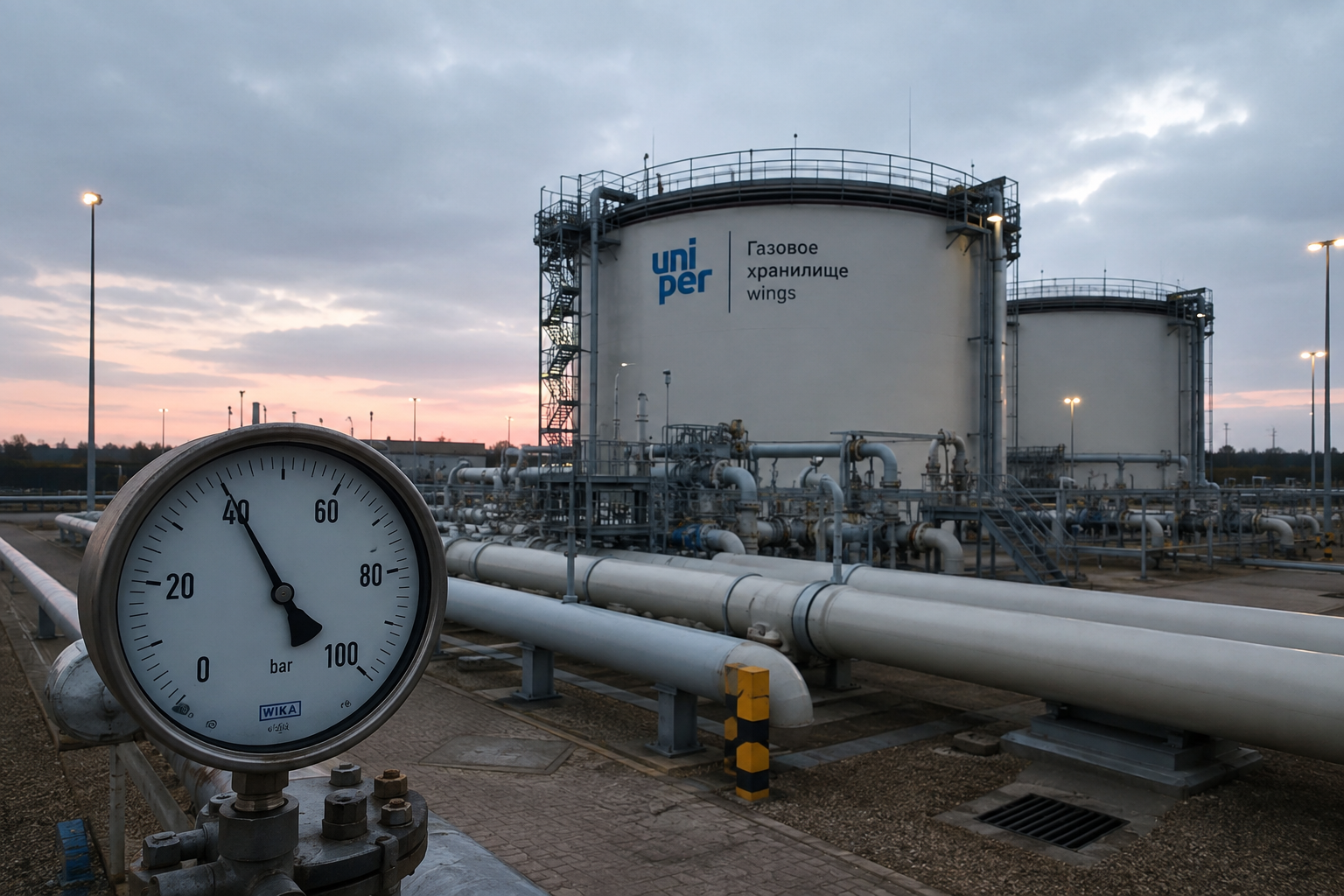
Germany Has Become a Key Concern for the EU Gas Market
Europe is approaching the 2026/2027 heating season with unusually low natural gas inventories. Germany is attracting particular attention because it is the EU’s largest gas consumer and holds more than one-fifth of the bloc’s underground storage capacity.
Figures cited by Politico put German storage at around 47% in early August, the lowest level recorded for this time of year. Across the EU, facilities were around 58% full on August 6. Reuters also reported that European inventories were at their lowest level for this point in the year since records began in 2011.
That is a major contrast with recent years. In 2024, for example, European storage had already exceeded 90% by August.
Germany Is Not Simply Refusing to Store Gas
The claim that Berlin is simply “refusing to stockpile gas” does not fully describe how the system works.
Commercial market participants are primarily responsible for filling German storage facilities. The current problem is that price conditions provide relatively weak incentives to purchase expensive gas during summer and hold it for sale during winter.
Germany’s gas storage association INES warned in July that an unfavorable summer-winter price spread had made injections commercially unattractive. German storage was only 41% full on July 1, its lowest level for that date since the 2021/2022 energy crisis.
The policy debate is therefore about whether market forces will deliver sufficient inventories or whether the government should intervene through incentives, guaranteed purchases or strategic reserves.
Berlin Is Relying on the Market and LNG Imports
Germany’s position is partly based on the fact that national gas security no longer depends solely on underground inventories.
Since the previous energy crisis, Germany has significantly expanded LNG import capacity while retaining major pipeline supplies from Norway. The government has previously argued that gas can continue arriving directly through pipelines and LNG terminals throughout the winter, meaning low storage does not automatically translate into a physical shortage.
However, this model increases Germany’s exposure to the global LNG market.
If European and Asian demand rise simultaneously during a cold winter, or global supply is disrupted again, European buyers may have to compete aggressively for additional cargoes.
Reuters notes that Europe’s shift from Russian pipeline supplies toward internationally traded LNG has diversified supply but also made the market more sensitive to global prices and cargo availability. European gas prices were around €53/MWh in early August, nearly twice pre-crisis levels.
There Is No Evidence Germany Will Run Out of Gas in September
Some reports have interpreted the current situation as meaning Germany could exhaust its gas supplies as early as September.
Current industry modelling does not support that conclusion.
INES says Germany remains technically capable of filling storage to approximately 76% by November 1, 2026. Its modelling indicates that such an inventory level should be sufficient in a normal or relatively mild winter.
The serious risk emerges in an exceptionally cold-weather scenario.
Using weather conditions comparable with the cold reference year of 2010, INES estimates that a 76% starting level could result in supply shortfalls of up to 9 TWh per month in February and March 2027, with individual daily deficits potentially reaching 2 TWh.
The more accurate conclusion is therefore that Germany faces increased winter supply risk, not that its gas is certain to run out in September.
Low German Inventories Matter to Neighboring Countries
Germany’s storage situation has implications across Europe because of the size of its market and the high degree of integration within the EU gas system.
Gas flows across national borders through interconnected pipelines, while member states have solidarity mechanisms designed to support one another during serious supply emergencies.
If Germany needs to purchase large additional volumes just before or during winter, it will be competing for pipeline gas and LNG with other European buyers. That can raise wholesale prices well beyond Germany itself.
The risk becomes particularly significant during an unusually cold winter, when high consumption coincides with rapid withdrawals from storage. INES says a 76% starting level remains manageable in average conditions but could become insufficient under extreme cold.
EU Storage Remains Below 60%
Germany is part of a wider European storage problem.
Gas Infrastructure Europe data showed EU storage at around 58.3% on August 6. The level is below that recorded at the same point during other difficult injection seasons, including 2018 and 2021. Gazprom cited those figures when describing current European inventories as a record low for early August.
The Russian company’s statement, however, should not be confused with an assessment that Europe is about to physically run out of gas.
Underground inventories are only one part of available supply. Europe continues to receive pipeline gas and LNG while storage is being filled and throughout the heating season.
The EU Agency for the Cooperation of Energy Regulators, ACER, estimated in July that Europe could reach around 80% storage before winter while maintaining LNG imports at approximately 2025 levels. Achieving 90% would require roughly 13% more LNG imports.
Russia Is Not the Only Reason Inventories Are Low
It would also be misleading to attribute the current storage problem entirely to Europe’s withdrawal from Russian gas.
The EU ended the previous heating season with heavily depleted inventories after stronger winter consumption. Replenishment was then complicated by higher prices and disruption to global LNG markets, including the Middle East crisis and restrictions affecting flows through the Strait of Hormuz.
High summer gas prices have also weakened the traditional economics of storage.
Normally, gas purchased during summer is cheaper than winter supply, giving traders an incentive to buy, pay storage costs and sell later. In 2026, that seasonal spread has narrowed sharply or turned negative at times.
Both INES and ACER have identified weak commercial incentives as an important reason for slower storage injections.
The EU Is Phasing Out Russian Gas, but Gradually
The Council of the EU formally approved the regulation for the gradual phase-out of Russian pipeline gas and LNG on January 26, 2026.
It is not an immediate blanket ban.
Existing contracts receive transition periods. The full prohibition on Russian LNG is due to take effect from the beginning of 2027, while the full pipeline gas ban applies from autumn 2027. In a declared emergency where security of supply is seriously threatened, the European Commission can temporarily suspend the import ban for up to four weeks.
The Council says Russia’s share of EU gas imports fell from around 45% in 2021 to approximately 13% in 2025.
It is therefore also an oversimplification to say that Europe has already abandoned all long-term Russian contracts and replaced them exclusively with short-term LNG purchases.
LNG Dependence Creates a Different Kind of Risk
Supply diversification has significantly reduced Europe’s dependence on a single external supplier, but it has introduced a different risk structure.
LNG can be sourced from the United States, Qatar, Nigeria and numerous other markets. At the same time, LNG is globally traded, meaning European buyers directly compete with Asian importers.
ACER estimates that the additional gas needed to refill storage under current conditions could add around €10–15 billion to Europe’s supply bill.
The Hormuz crisis has become another major variable in 2026. Qatar’s LNG exports depend almost entirely on access through the strait, so restrictions on shipping directly affect the volume of gas available to world markets.
European energy security is consequently becoming increasingly linked to international maritime logistics.
Germany Is Planning a Strategic Reserve — but Not for This Winter
Berlin has already acknowledged the need for an additional safety buffer.
Germany’s Economy Ministry is preparing a state-owned strategic reserve of approximately 24 TWh of gas, equivalent to just under 10% of the country’s total storage capacity.
The cost of developing the reserve, purchasing the gas and injecting it into storage has been estimated at around €1.2–1.5 billion.
However, the first filling is not expected until summer 2027, meaning the planned reserve cannot provide protection for the coming 2026/2027 winter.
That timing helps explain the current concern: the mechanism intended to strengthen Germany’s future security is not yet available, while existing commercial storage is unusually low.
Europe’s Biggest Risk May Be Price Rather Than Physical Shortage
Current assessments do not suggest that Europe is inevitably heading toward a complete loss of gas supply.
European energy authorities said earlier in the year that the bloc has enough import and regasification infrastructure to substantially increase LNG flows. In late May, the European Commission’s Gas Coordination Group said there was no immediate concern about security of supply for the coming winter at that time.
Low inventories nevertheless reduce the safety margin.
If the winter is cold and global LNG supply remains constrained, Europe may be forced to purchase much larger volumes on the spot market. The first consequence may therefore be a sharp increase in gas and electricity prices rather than immediate physical shortages.
For energy-intensive industries in Germany, Italy, the Netherlands and other major EU economies, such a scenario would increase production costs. The effect could then spread through chemicals, metals, fertilizers, transport and logistics supply chains.
Germany’s low storage level is therefore a genuine European risk. But the central question is not whether the country will “run out of gas in September.” It is how much inventory Germany and the EU can build before winter — and how much they will have to pay on the global market for the gas they still need.
Read also: Analytical Report: The Blockade of the Strait of Hormuz During the U.S.-Israeli War Against Iran