

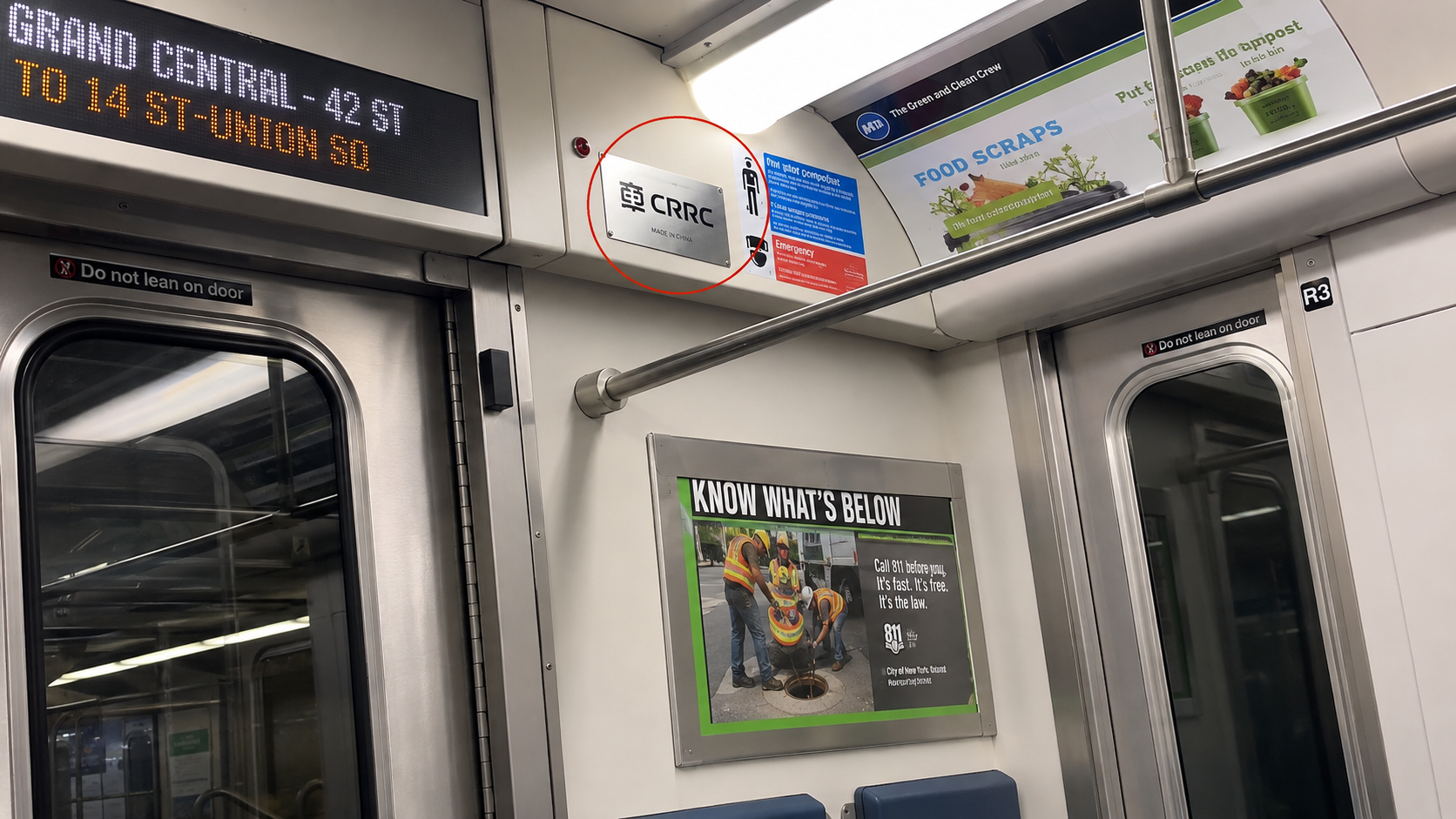
A Viral Story Claims China Retaliated Over Removed Logos
A story circulating online claims that China Railway Rolling Stock Corporation refused to repair Chicago Transit Authority trains after the American side modified the vehicles, removed CRRC branding and replaced it with U.S. markings.
The narrative adds a political element: the supposed rebranding is said to have been intended to portray Chinese-origin trains as U.S.-made equipment under Donald Trump’s campaign to restore American manufacturing.
As of August 11, 2026, however, there is no confirmed announcement from CTA, CRRC or CRRC Sifang America supporting that account. Available documentation instead shows that the manufacturer’s identity has remained public and that CRRC’s U.S. subsidiary continues to support warranty and after-sales work on CTA’s trains.
The Trains Are Made by CRRC — but Assembled in Chicago
There is a real fact behind the story.
Chicago’s new 7000 Series railcars are manufactured by CRRC Sifang America, the U.S. subsidiary of China’s state-owned rolling-stock giant CRRC.
CTA awarded the contract in March 2016. The base order covers 400 railcars worth approximately $632 million, while the original contract included options for another 446 vehicles, potentially bringing the total to 846.
Final assembly, however, does not take place in China.
CRRC invested about $100 million in a manufacturing facility in Chicago’s Hegewisch neighborhood. CTA described the project as bringing railcar production back to Chicago for the first time in more than half a century.
The trains are therefore more accurately described as a Chinese-owned, U.S.-localized manufacturing project than simply as Chinese trains relabeled after arrival.
CTA Has Never Hidden the Chinese Manufacturer
Chicago Transit Authority has consistently identified CRRC Sifang America as the manufacturer.
When the first 7000 Series cars began passenger testing on the Blue Line in April 2021, CTA explicitly stated that they were manufactured by CRRC Sifang America and assembled at the company’s new $100 million Chicago plant.
CTA budget documents, fleet plans and asset-management records have continued to identify the 7000 Series with CRRC.
The agency’s 2025 Transit Asset Management Plan, for example, lists its Series 7000 fleet as CRRC equipment.
There is therefore no evidence in CTA’s official documentation of an attempt to conceal the manufacturer and portray the trains as products of an unrelated American company.
Roughly 70% of Component Value Comes From U.S. Suppliers
At the same time, the project genuinely contains a substantial U.S. manufacturing component.
CRRC Sifang America says a pre-award audit found that approximately 70% of total railcar component costs were sourced from U.S. manufacturers. The company itself promotes the Chicago programme using phrases such as Built by Americans and Built for Americans.
U.S. suppliers provide numerous electrical, mechanical and other systems, while final assembly is performed by workers in Chicago.
CTA said in 2019 that the new facility was expected to support roughly 170 manufacturing, warehouse and professional jobs, in addition to jobs created during plant construction.
The result is a hybrid industrial model: the corporate parent is Chinese, parts of the design and supply chain are linked to China, much of the component value is sourced in the United States, and final assembly takes place in Chicago.
Localization Was Part of the Original Contract
This is why the claim that the United States later decided to transform Chinese trains into “Made in America” products does not fit the project timeline.
Localization was built into the programme from the beginning.
CTA announced construction of the CRRC Chicago manufacturing plant in March 2017, describing it as the return of railcar production to the city after more than 50 years.
CRRC Sifang America itself continues to state that the 7000 Series is manufactured on Chicago’s South Side and that its plant helped revive local railcar manufacturing.
This was not a later effort to disguise imported rolling stock. Local production was part of the original commercial structure.
The Contract Predates Trump’s Buy American Order
The chronology also matters politically.
CTA selected CRRC in March 2016.
Donald Trump signed his Buy American and Hire American executive order on April 18, 2017, more than a year after the Chicago contract was awarded. The order instructed federal agencies to maximize the use of U.S.-produced goods, products and materials in applicable federal procurement and financial-assistance programmes.
The decision to assemble the trains in Chicago and use a large U.S. supplier base therefore cannot have originated with that Trump initiative.
Those elements were already part of the project.
Trump’s second administration has again made domestic production and America First trade policy major priorities, but there is no public evidence linking a supposed removal of CRRC logos from Chicago’s 7000 Series to those policies.
There Is No Confirmed Evidence That CRRC Logos Were Removed
The central visual element of the viral claim is also unverified.
Official CTA photographs have shown 7000 Series trains in CTA’s own livery since the earliest testing period: stainless-steel bodies, distinctive blue front ends and CTA identification.
At the same time, CTA has continued to identify CRRC Sifang America as the manufacturer in accompanying documentation.
That distinction matters.
Municipal trains are normally branded for the transit operator rather than covered with large manufacturer logos. The fact that a CTA train carries CTA branding is not, by itself, evidence that its manufacturer has been deliberately concealed.
No reliable documentation found in the available sources establishes that CTA removed existing CRRC logos after delivery and replaced them specifically to create a false claim of U.S. manufacture.
Current After-Sales Activity Contradicts the Repair-Refusal Story
Perhaps the strongest contradiction comes from current after-sales activity.
A CRRC Sifang America job posting dated July 2026 sought a Field Representative specifically to support CTA7000 railcars at Chicago maintenance locations.
The job description covers ongoing troubleshooting, warranty projects and after-sales operations, including coordination between CRRC Sifang America and CTA for rapid fault resolution, warranty repairs, spare-parts management and return logistics.
A similar vacancy was publicly posted in May 2026.
This does not prove that CTA and CRRC have never had a commercial or technical disagreement.
It does, however, conflict directly with the broad claim that the Chinese manufacturer has simply refused to provide repair or technical support for Chicago’s trains.
CTA and CRRC Recently Updated Their Contract
There is also stronger official evidence of an ongoing commercial relationship.
In June 2025, the CTA board considered an amendment to its long-running contract with CRRC Sifang America. CTA officials said roughly 230 cars from the base order had already been received and deliveries were continuing.
The amendment addressed escalation formulas for future option cars, taxes and duties, performance guarantees and other contractual provisions.
CTA officials also said continuing under the agreement offered significant savings compared with launching a completely new procurement.
Rather than cutting ties with CRRC, CTA was therefore updating the framework for continued performance of the contract.
CTA Performs Maintenance Too
Another source of confusion is the division of responsibility for railcar maintenance.
Routine maintenance of a metro fleet is generally performed by the transit operator through its own depots and heavy-maintenance facilities.
The manufacturer typically remains involved in warranty issues, design-related defects, engineering assistance, spare parts and specialized technical support.
CTA’s own budget documents describe extensive preventive maintenance and repair programmes covering propulsion, HVAC, braking, traction and other major systems.
The phrase “China refused to repair Chicago’s subway” therefore oversimplifies how responsibility for these trains is structured.
The Real Industrial Paradox Is More Interesting
There is nevertheless a genuine paradox behind the project.
An American city purchased railcars from a subsidiary of a Chinese state-owned industrial giant. The Chinese company then invested in a U.S. factory, hired American workers and sourced a substantial share of the trains’ components from U.S. suppliers.
The finished product can therefore simultaneously be described as equipment produced by a Chinese corporate group and railcars assembled by American workers in Chicago.
This illustrates how difficult it can be to assign a single national identity to modern manufactured products.
CRRC itself has used the project’s U.S. content as a selling point, emphasizing local employment, domestic suppliers and Chicago assembly.
It therefore did not need CTA to secretly remove Chinese branding to create a narrative of American production.
U.S.-China Tensions Make the Claim Easy to Believe
The story spreads easily because it fits a genuine geopolitical backdrop.
Washington has increasingly sought to reduce dependence on Chinese suppliers in strategic industries, encourage domestic manufacturing and use tariffs and procurement rules to reshape supply chains. The Trump administration expanded those policies again in 2026 through a broad new tariff regime.
CRRC has also faced years of political scrutiny in the United States over the role of Chinese state-owned enterprises in critical transportation infrastructure.
But the Chicago project demonstrates that the real industrial relationship is more complicated than a simple China-versus-America narrative.
Chinese ownership and technology were combined with American labor, suppliers and local final assembly.
The Repair-Refusal Claim Should Not Be Reported as Established Fact
As of August 11, 2026, the defensible conclusion is that the story claiming CRRC refused to repair Chicago trains because Chinese logos had been removed remains unverified.
Official records show that CRRC Sifang America continues to be publicly identified as the manufacturer. Local assembly and U.S. component sourcing were part of the project from the start. The contract predates Trump’s first Buy American executive order, while recent public material shows CRRC Sifang America continuing to recruit personnel for warranty and after-sales support of the CTA7000 fleet.
The viral version is therefore better understood, at least on the evidence currently available, as an embellished interpretation of a real and politically sensitive U.S.-China rail contract rather than a confirmed dispute over removed logos.
