

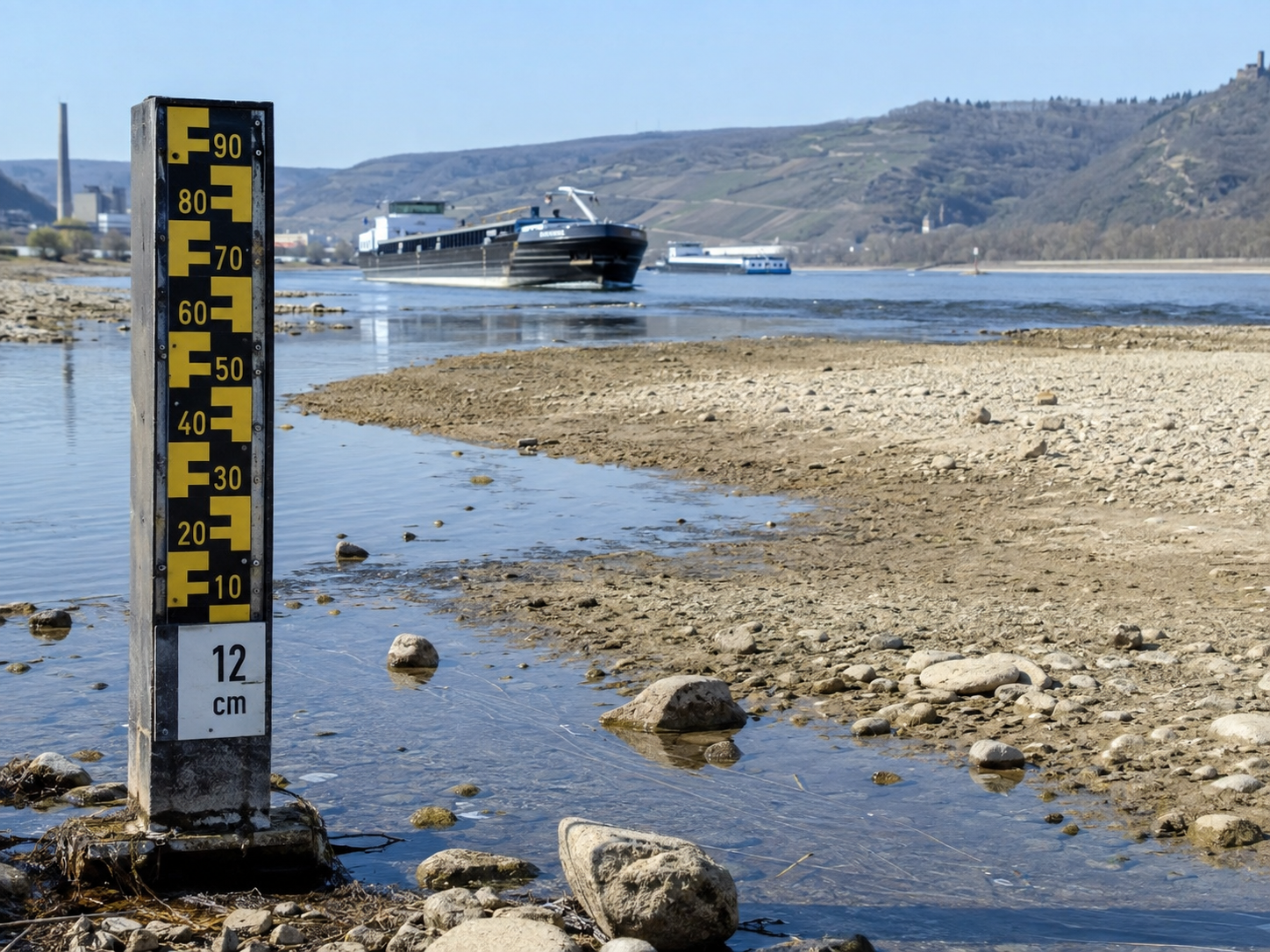
Critical Rhine Section Is Almost Closed
European river levels continue to fall following prolonged heat and limited rainfall. The most severe disruption is at Kaub in Germany, a critical Rhine bottleneck connecting southern industrial regions with the ports of Rotterdam, Amsterdam and Antwerp.
Germany’s Federal Waterways and Shipping Administration, or WSV, said the navigation reference reading at Kaub fell to 12 centimetres on August 12. This was below the previous record low of 25 centimetres registered in 2018.
The figure does not mean that the entire river is only 12 centimetres deep. The actual navigable channel is approximately one metre deeper than the reference reading. However, the available depth is no longer sufficient for most cargo vessels carrying commercial loads.
According to Reuters, northbound and southbound barge traffic through Kaub has effectively stopped. Some vessels have been stranded south of the bottleneck, while others are returning north to seek alternative work and routes.
Barges Carry Around 20% of Normal Loads
Navigation continues on northern sections of the Rhine, but many barges are operating at only around 20% of their normal capacity. Several vessels are therefore required to move a volume that would normally fit on a single barge.
In July, tanker barges could carry approximately 1,200 tonnes through Duisburg but only 460 tonnes at Kaub. Freight costs from Rotterdam to Karlsruhe increased from around €45 to €60–70 per tonne. Following the latest decline in water levels, some cargo bookings through Kaub are no longer available.
Operators reduce cargo volumes to lower vessel draught. However, crew, fuel and operating expenses remain largely unchanged even when a barge carries only a fraction of its standard load.
Carriers Introduce Low-Water Surcharges
Additional low-water charges are commercial freight surcharges rather than government fees. They compensate operators for lost capacity when vessels cannot be fully loaded.
There is no single mandatory water level at which all Rhine navigation automatically stops. The decision depends on vessel design, draught, local conditions and the captain’s assessment. At the current level, however, most commercial voyages through Kaub have become technically or economically unviable.
RheinCargo said daily coal and ore volumes transported from Rotterdam to Duisburg had fallen from approximately 24,000 tonnes to 14,500 tonnes. The company is adding three weekly freight train round trips, each capable of carrying around 2,000 tonnes.
Several German states have also relaxed weekend truck restrictions to help transfer cargo from inland waterways to road transport.
Danube Also Reaches Critical Levels
Low water has affected large sections of the Danube, although conditions differ by country and location. Record lows have been reported in Croatia and Serbia, while water levels in Romania fell to their lowest since 1996.
At the Romanian entry point, Danube flows dropped to approximately 1,700 cubic metres per second, compared with a normal July range of around 4,700 cubic metres. Several ferry services were suspended, while grain barges remained idle or operated with sharply reduced loads.
In Serbia, barges and tankers were limited to 30–40% of normal capacity. The country received only around a quarter of its planned fuel imports by river in July, forcing some cargo onto road and rail.
Barge freight rates between the Ukrainian Danube ports of Reni and Izmail and Romania’s Port of Constanța rose to approximately $28 per tonne. Industry estimates indicate that rates roughly doubled from the beginning of July.
Drought Hits Energy and Tourism
At Austria’s Greifenstein hydropower plant, Danube flows have fallen to approximately 700 cubic metres per second from a typical summer level of around 2,000. Verbund said its hydropower generation during the first half of 2026 was 32 percentage points below the long-term average.
Low water has also created cooling problems for nuclear power stations in Hungary and Romania. River cruise operators are changing embarkation points, arranging ship swaps and coach transfers, and cancelling a limited number of departures.
Cargo Shifts to Rail and Road
The Rhine and Danube carry fuel, grain, coal, ore, metals, fertilisers and chemical products. Falling river capacity is increasing demand for trains and trucks, but land-based transport networks cannot quickly absorb all the cargo normally moved by barges.
Cargo owners face higher freight rates, low-water surcharges, longer delivery times and the need to maintain larger inventories. If dry conditions persist, some European river sections could remain unavailable for commercial navigation until sustained rainfall restores water levels.