

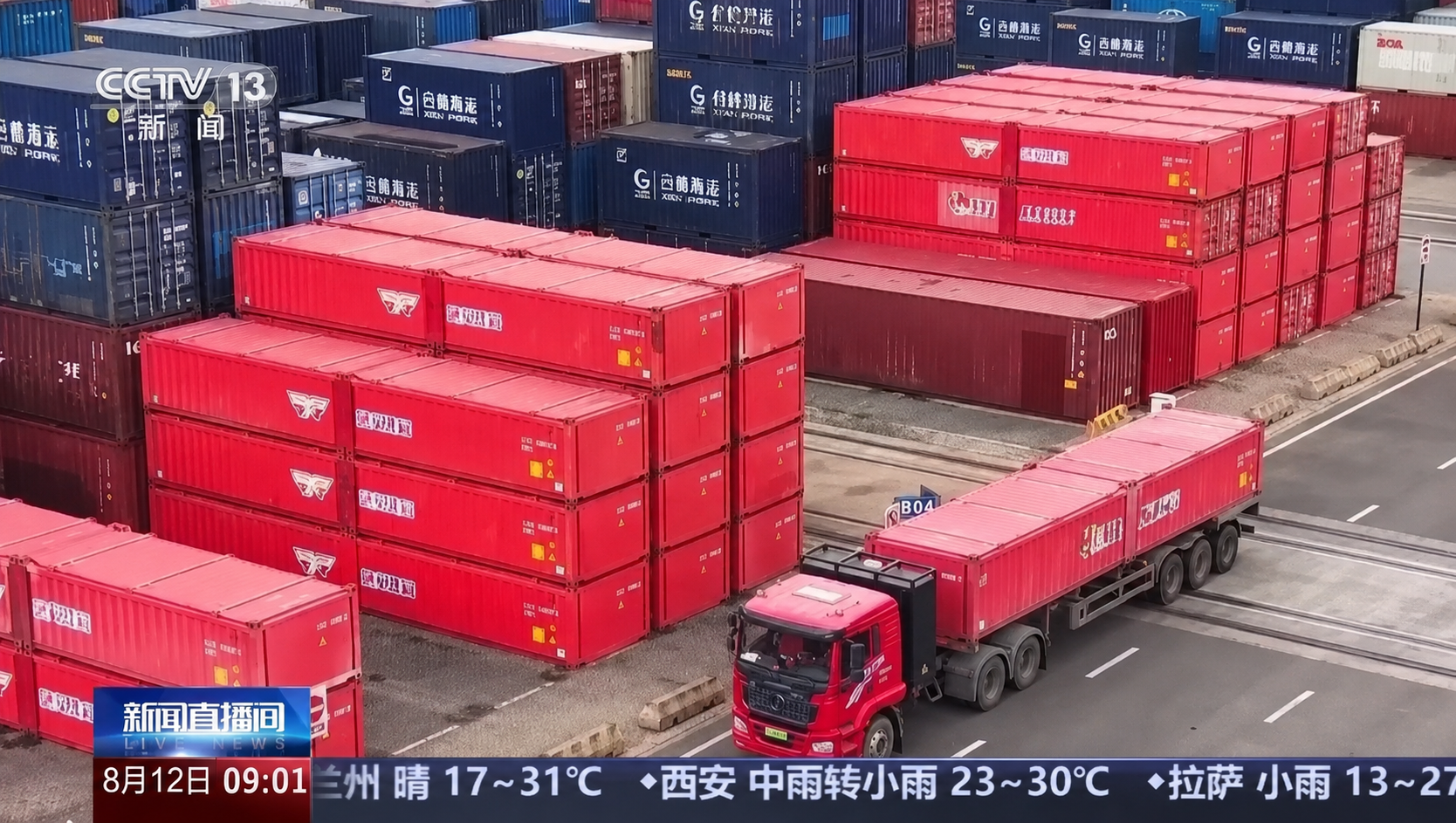
First Train Departed From Baotou for Huanghua Port
China has launched its first rail-sea service carrying bulk cargo in double-stacked low-profile containers. The train departed from Wanshuiquan South station in Baotou, Inner Mongolia, on August 12, 2026, bound for Huanghua Port in Hebei province.
According to CCTV, the train was loaded with coke. At the port, the containers can be transferred directly to a vessel without removing or repacking the cargo.
The system is expected to eliminate more than five intermediate handling stages. Its developers also claim that it can reduce unit transport costs by more than 25%.
Container Height Was Reduced to 1.7 Metres
A standard ISO container is approximately 2.6 metres high and cannot normally be double-stacked on a conventional railway wagon beneath electrified infrastructure. China therefore developed special containers with a height of 1.7 metres. Two units create a combined stack measuring 3.4 metres.
The figure of 4.6 metres cited in descriptions of the project refers to the available vertical railway loading clearance, not the track gauge. China uses the standard 1,435 mm railway gauge.
Reducing the height primarily lowers the container’s internal volume rather than necessarily reducing its permitted cargo weight. The system is therefore intended for dense and heavy commodities that would not fill a standard container to the roof. It is less suitable for lightweight, high-volume cargo.
A Road Combination Would Approach 4.5 Metres
Two 1.7-metre containers have a combined height of 3.4 metres. Once placed on a conventional container chassis, the total vehicle height could approach or exceed 4.5 metres.
This is the principal obstacle for most European routes. EU Directive 96/53/EC sets a maximum vehicle height of 4 metres and includes containers within the overall dimensions.
A specially designed low-deck semi-trailer could theoretically reduce the total height. However, it would still have to provide sufficient ground clearance, acceptable axle loads, tractor compatibility and secure attachment points for both containers.
Some European countries apply more permissive national limits. Finland, for example, allows vehicles up to 4.4 metres high. Even there, a double-stack configuration on a standard chassis could be too tall. Operations in Britain or Scandinavia would still require route-specific assessments covering bridges, tunnels, power lines and local restrictions.
Two Heavy Containers Could Exceed Weight Limits
Weight may become an even greater restriction than height. Low-profile containers are intended for dense cargo, meaning that two loaded units could exceed the authorised gross combination weight or axle limits for a conventional European articulated truck.
Railway wagons distribute weight differently and are designed to accommodate heavier cargo units. On the road, carrying two containers filled with dense commodities may be impossible even if the vehicle meets the applicable height limit.
A more realistic configuration could place a loaded container on the lower level and an empty or significantly lighter unit above it.
A Higher Centre of Gravity Requires Extensive Testing
The upper container raises the vehicle’s centre of gravity and increases its sensitivity to cornering, crosswinds and emergency manoeuvres. Road deployment would require additional locking systems, electronic stability control, speed restrictions and carefully managed load distribution.
A related concept was tested at Australia’s Port of Brisbane. A specialised vehicle carried up to eight empty 20-foot containers in two layers. However, the trial took place only within port facilities and on limited public port roads under a temporary permit. The combination underwent modelling and rollover-stability testing before entering service.
The Australian project is not a direct equivalent of the Chinese system. It is limited to empty standard containers and has an overall height of more than 7 metres.
Widespread European Adoption Is Unlikely Soon
Double-stacked container trucks are unlikely to become common on European motorways in the near future. Height and weight restrictions, the elevated centre of gravity and the need for infrastructure compatible with non-standard containers remain major barriers.
Initial applications would be more realistic within ports, industrial sites and logistics terminals or on short, specially approved routes. China’s concept has stronger immediate potential on railways, particularly for regular flows of heavy bulk commodities between production centres and seaports.
Read also: China-Kazakhstan Lianyungang Base Reaches 8,000 Trains
