

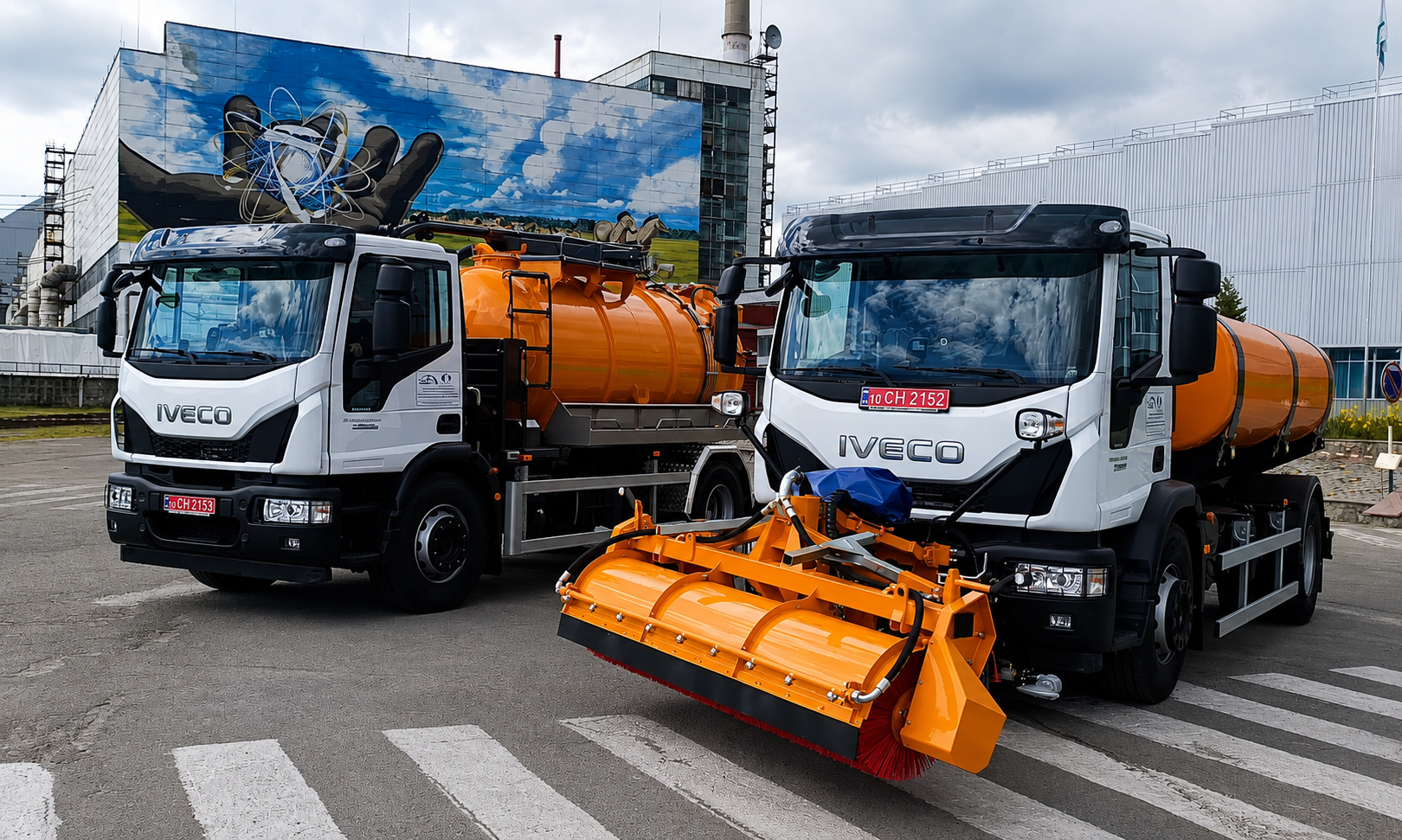
A new fleet has been delivered to Chornobyl
The year 2026 marks the 40th anniversary of the Chornobyl nuclear disaster. Electricity generation at the site ended long ago, with the last undamaged reactor being shut down in 2000. Nevertheless, the plant still requires constant supervision, technical maintenance and specialised transport.
The European Bank for Reconstruction and Development financed the purchase of ten Iveco vehicles to support these operations.
The new fleet will replace some of the vehicles and equipment lost following the start of the full-scale war and the occupation of the Chornobyl exclusion zone in spring 2022.
The vehicles will operate at the plant and across the surrounding exclusion zone. Their main duties will include transporting cargo and employees, maintaining internal roads, handling waste and supporting the site’s infrastructure.
The fleet includes Iveco Daily and Eurocargo models
The new fleet consists of several Iveco Daily and Iveco Eurocargo configurations.
Some of the vehicles are intended for passenger and general cargo transport. Others have been equipped with specialised bodies for technical and municipal operations.
One Iveco Eurocargo has a tanker body for carrying liquid waste. Another Eurocargo is fitted with a tank and road-sweeping equipment, allowing it to clean and maintain roads within the power plant complex.
The remaining vehicles will transport equipment, tools and materials and support everyday operational tasks.
Although they feature Iveco’s latest badges and exterior design, the vehicles use Euro 5 powertrains. A simpler specification may make maintenance and repairs easier at an isolated industrial site.
Trucks are still needed after the reactor shutdowns
The shutdown of all reactors did not turn Chornobyl into an inactive facility.
Work continues on dismantling equipment, storing and cooling spent nuclear fuel, monitoring radioactive materials and managing waste.
Specialists also supervise the destroyed fourth reactor and numerous facilities located throughout the exclusion zone.
These operations require continuous road transport. Trucks move construction materials, spare parts, technical equipment, waste and employees between remote sections of the complex.
Road maintenance is also essential. Emergency services, construction machinery and technical staff must be able to reach critical facilities without delay.
The vehicles will replace equipment lost during the occupation
The need to renew the fleet increased following the 35-day occupation of the Chornobyl zone in spring 2022.
Vehicles and other equipment were damaged, destroyed or removed during that period. After Ukraine regained control of the site, work began to restore its operational capabilities.
The delivery of ten Iveco vehicles is one part of that process. The new fleet will restore capacity for waste transport, site maintenance and infrastructure support.
At Chornobyl, road vehicles are not used only for routine operational purposes. The availability of reliable equipment also affects the speed of response to damage, fires and other emergencies.
International partners financed the purchase
The vehicles were funded through the International Chornobyl Cooperation Account managed by the European Bank for Reconstruction and Development.
Contributors include Ukraine, the European Union, the United States, the United Kingdom, Canada, China, Taiwan and Saudi Arabia.
Despite their differing geopolitical interests, the donors continue to cooperate on projects intended to protect nuclear safety at Chornobyl.
The funds are used not only for major construction projects but also for vehicles and equipment needed for the site’s daily operations.
The drone strike increased repair requirements
Additional pressure on the site emerged after a drone strike in February 2025.
The attack damaged the New Safe Confinement built over the destroyed fourth reactor.
The structure limits the spread of radioactive material and creates safer conditions for dismantling the old shelter and unstable reactor elements.
Restoring the damaged structure will require extensive engineering and construction work. Preliminary estimates place the cost at more than €500 million.
The new trucks may support the programme by transporting construction materials, specialised equipment and personnel involved in inspections and repairs.
The vehicles will work under special conditions
Operating vehicles at the Chornobyl plant is very different from conventional freight transport.
The trucks may travel between industrial sites, waste storage facilities, energy infrastructure and areas subject to different levels of radiation control.
After entering certain zones, vehicles undergo checks. Their bodies, wheels and equipment may be cleaned and decontaminated when necessary.
Reliability is particularly important. A breakdown at a remote or controlled location can disrupt operations and require additional personnel and equipment.
Relatively simple and repairable Iveco Daily and Eurocargo variants are therefore well suited to tasks where durability and ease of maintenance matter more than complex electronic equipment.
Lead-protected KrAZ trucks worked at Chornobyl 40 years ago
The modern Iveco vehicles are very different from the trucks deployed immediately after the 1986 disaster.
Some of the best-known vehicles used at the time were KrAZ dump trucks with cabs protected by lead plates.
They operated in heavily contaminated areas, transporting radioactive soil, construction debris and damaged structural materials.
To reduce radiation exposure, the cabs were reinforced with heavy shielding, while special windows could be as much as 7.5 centimetres thick.
These trucks were designed for short-term use in extremely high radiation conditions. Many could no longer be used for ordinary work after completing their duties.
Today, the role of the vehicle fleet has changed. Instead of emergency clean-up, trucks support long-term site management, dismantling, monitoring, repairs and waste handling.
International support remains essential
The Chornobyl plant has not generated electricity for more than a quarter of a century, but maintaining the site remains expensive.
Spent fuel storage facilities must be serviced, radioactive materials monitored, protective structures maintained and the large exclusion zone supervised.
The war has increased both the risks and the amount of work required. Damage to infrastructure and the loss of equipment mean that international partners must support immediate recovery as well as long-term projects.
The Iveco delivery demonstrates how ordinary-looking transport equipment contributes directly to nuclear safety.
Without trucks, the site cannot efficiently move materials, waste, equipment and personnel, maintain roads or respond quickly to damage.
Iveco will support the plant’s daily operations
Ten vehicles cannot solve every technical challenge at Chornobyl, but they will restore part of the plant’s lost operational capacity.
Iveco Daily vehicles will handle lighter cargo and passenger duties. The Eurocargo models will transport liquid waste, perform municipal work and carry heavier loads.
The new fleet will reduce dependence on ageing equipment and improve the reliability of daily operations.
Forty years after the disaster, transport at Chornobyl remains directly connected to safety. That work will now be supported by modern specialised Iveco vehicles.
Read also: Ukraine Considers War-Risk Protection for Infrastructure
