

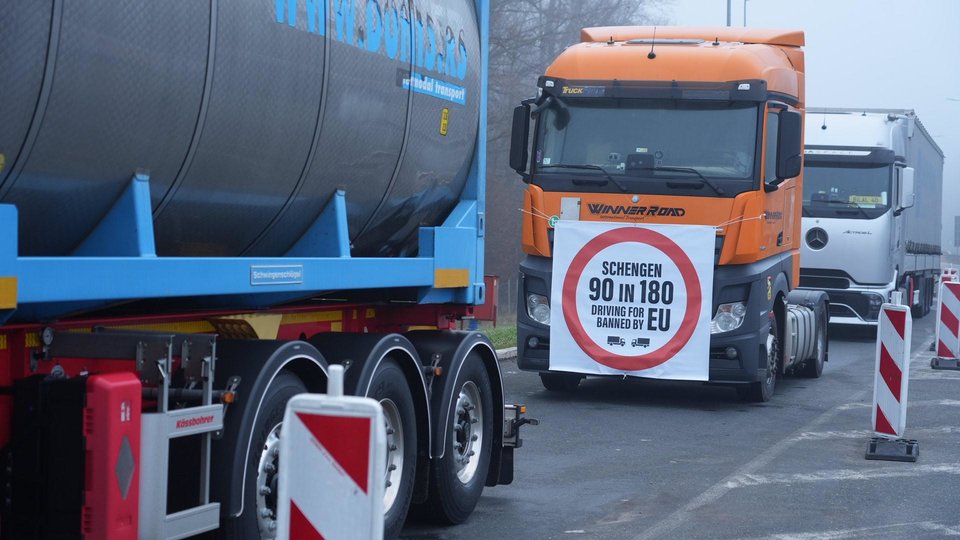
Hauliers Await Brussels Talks
Transport associations from Serbia, Bosnia and Herzegovina, Montenegro and North Macedonia have warned that protests at European Union borders could resume. The dispute concerns the rule limiting third-country nationals to 90 days in the Schengen Area during any rolling 180-day period.
According to the MIA news agency, the associations intend to wait for a meeting with European Commission representatives scheduled for September 1 in Brussels. If the talks fail to produce an acceptable solution, hauliers may return to blocking freight border crossings.
As of August 18, 2026, no final decision has been made. The dates and locations of any renewed protests have not been officially announced.
Why the 90/180 Rule Affects Drivers
Under the Schengen Borders Code, a third-country national’s short stay cannot exceed 90 days in any 180-day period. The restriction also applies to professional drivers unless they have another legal basis for a longer stay.
Hauliers argue that international drivers do not enter the Schengen Area as tourists but to deliver and collect cargo. However, both entry and exit dates are counted as days of stay, even when a driver spends only a few hours inside the area.
Transport associations are demanding consistent enforcement at all border crossings. They also want actual time spent in the Schengen Area to be taken into account. According to the industry, differing interpretations by border authorities complicate route planning and expose drivers to the risk of being refused entry.
EES Did Not Introduce the Restriction
The digital Entry/Exit System did not create the 90/180 rule. According to the official European Union portal, EES records third-country nationals crossing external borders and enables more accurate calculation of authorised stays.
The operational challenge therefore stems from automated enforcement of an existing requirement rather than a new immigration restriction. Transport companies must now monitor not only driving and rest periods but also the number of Schengen days remaining for each driver.
Industry associations estimate that approximately 17,000 professional drivers in North Macedonia and around 100,000 across the four Western Balkan countries are affected. These figures represent drivers working under the restriction, not the number already penalised or refused entry.
New Blockades Could Disrupt Freight Corridors
Drivers from the four Balkan countries previously blocked EU freight terminals in January 2026. At the time, Reuters reported that the protests affected major overland routes connecting the European Union with Türkiye and the Middle East.
Renewed blockades could generate long truck queues, delay deliveries and increase carrier costs. Industrial components, perishable products and consignments with fixed unloading slots would face the greatest exposure.
Moving part of long-distance freight to rail could reduce dependence on international road movements. K2Cargo.News has previously examined how combined transport can help European logistics address driver shortages. Nevertheless, trucking remains essential for most Western Balkan trade routes.
The outcome of the September 1 meeting will determine whether the parties can agree on a consistent approach to calculating professional drivers’ stays. Until then, border crossings remain open and renewed protests remain a possible but unconfirmed scenario.