

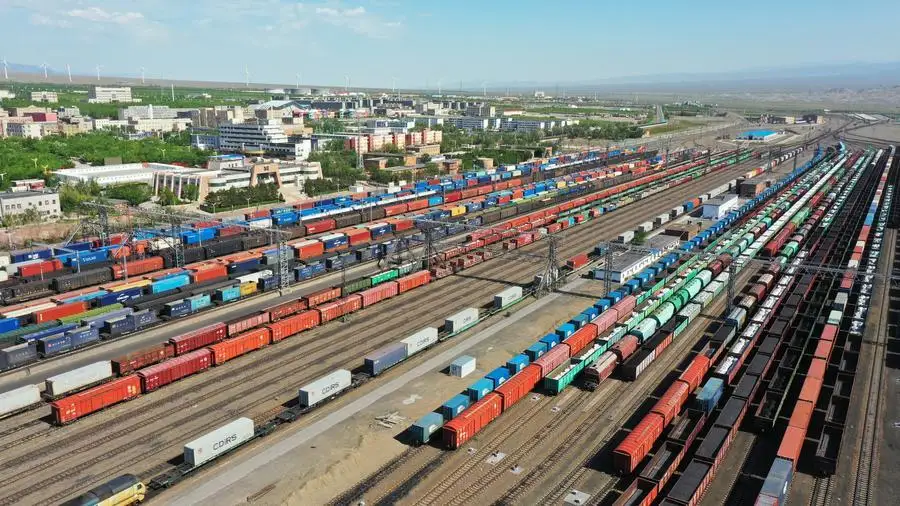
Cargo Volume Rises 14.1%
Alashankou railway port, also known as Alataw Pass, set a new cargo-handling record. The border hub processed 12.4 million tonnes between January and July 2026, an increase of 14.1% from the same period a year earlier.
According to the latest data on the port’s January–July operations, the increase in freight volume was accompanied by faster customs, border-control and transshipment procedures.
Alashankou is located in China’s Xinjiang Uygur Autonomous Region on the border with Kazakhstan. The connecting Dostyk railway station provides access to the wider Central Asian and European rail networks.
Clearance Takes Less Than Four Hours
Closer coordination between railway, customs and border authorities has been one of the main drivers of improved performance. The joint mechanism allows agencies to exchange cargo and train information in advance, coordinate inspections and accelerate the handover of freight services.
Customs clearance for outbound trains has consequently been reduced to less than four hours. Tailored logistics solutions have also been developed for 54 local companies, covering documentation, departure schedules, transshipment and onward transportation.
The measures have helped businesses reduce logistics costs and make delivery schedules more predictable.
These steps have significantly reduced waiting times at the port, customs officer Sofiya Umarjan said
According to the official report on the development of Alashankou railway port, intelligent inspection systems and image-recognition technology allow train inspections to begin immediately after arrival.
Up to 33 Train Handovers per Day
Alataw Pass can now complete up to 33 freight train handovers per day. Its network includes 129 China–Europe routes serving 21 countries and regions.
At the beginning of 2026, the network consisted of 128 routes. The latest figures therefore indicate that the port is continuing to expand its geographical coverage alongside its operational capacity.
Cargo moving through the hub includes automotive components, electronics, industrial machinery, medical equipment and consumer products. More than 200 categories of goods are transported through the border crossing.
Importance for Eurasian Trade
The increase in cargo volume demonstrates that China–Europe rail services remain an important complement to maritime shipping. Rail is particularly attractive for goods requiring shorter transit times and more predictable schedules.
For Central Asian countries, Alataw Pass provides a major railway gateway to the Chinese market. Kazakhstan benefits from additional transit traffic, while companies in Uzbekistan, Kyrgyzstan and other regional economies gain access to routes connecting them with Chinese industrial centers and European markets.
Further growth will depend on coordination between railway administrations, the availability of wagons and locomotives, transshipment terminal capacity and the speed of border procedures.
The January–July 2026 results show that digitalization, advance data exchange and interagency cooperation are allowing the port to handle more cargo without a proportional increase in waiting times.
Read also: China–Kazakhstan Lianyungang Base Reaches 8,000 Trains