

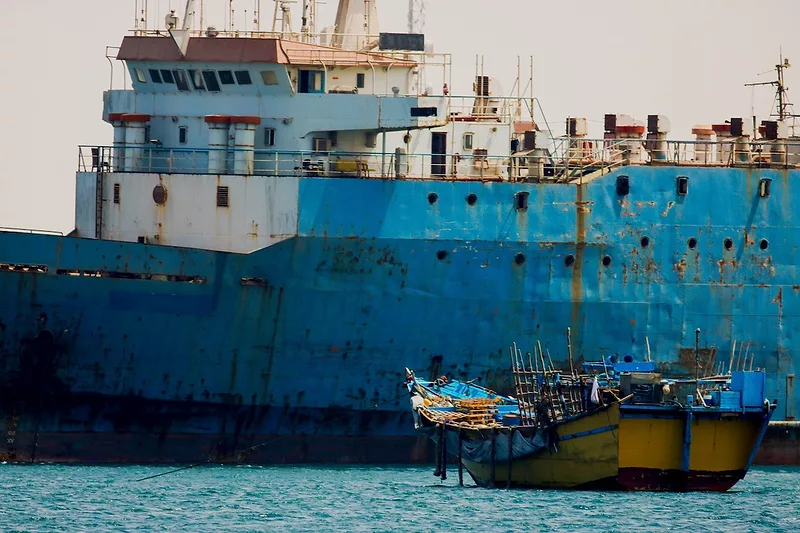
Two Ships Hijacked in Four Days
Somali pirates have carried out two new commercial vessel hijackings in the Gulf of Aden and off Somalia, increasing concerns over the return of a major security threat along one of the world’s most important shipping corridors.
On August 17, eight armed men boarded the Cameroon-flagged general cargo ship Lutuf approximately four nautical miles off Somalia. The attackers took control of the vessel and redirected it toward the Puntland coast. Preliminary updates from UK Maritime Trade Operations and the Maritime Security Centre — Indian Ocean indicated that the crew was safe, although the ship had not been reported released.
Three days later, six armed pirates hijacked the Eritrean-flagged oil products tanker Sibu 1. The incident occurred approximately 136 nautical miles east of al-Mukalla, Yemen, after which the tanker was taken toward Somalia’s Puntland region.
According to the Associated Press, Sibu 1 had 20 crew members aboard, including 16 Indian nationals. Lutuf carried ten people: six Indians, one Turkish national, one Georgian and two Serbian security guards.
Six Commercial Vessels Seized Since April
Sibu 1 became the sixth commercial vessel hijacked by Somali pirates since April 21, 2026. The previous ships were Honour 25, Sward, Eureka, Asana and Lutuf.
The widening geographical range of the attacks is particularly concerning. Lutuf was seized close to Somalia, while the attack on Sibu 1 took place much farther north, off Yemen. This indicates that pirate groups remain capable of operating across a significant part of the Gulf of Aden and western Indian Ocean.
In July, the International Maritime Organization reported 24 attempted and actual incidents of piracy and armed robbery in the Red Sea and Gulf of Aden over a three-month period. At the time, 44 seafarers remained captive aboard three hijacked vessels.
Competing Conflicts Are Stretching Naval Resources
The piracy resurgence is occurring as security conditions deteriorate across other Middle Eastern maritime corridors.
Yemen’s Houthis have declared a blockade targeting Saudi-linked shipping and demonstrated their willingness to attack merchant vessels in the southern Red Sea. At the same time, the conflict involving Iran has produced numerous incidents in and around the Persian Gulf and Strait of Hormuz.
In early August, the UKMTO Joint Maritime Information Center assessed the threat in the Strait of Hormuz as severe and the threat in the Gulf of Aden and Bab el-Mandeb area as substantial. The center had recorded 80 vessel incidents across the monitored region since March 1.
Cyrus Mody, director of ICC Commercial Crime Services and a senior International Maritime Bureau piracy expert, said other threats may be creating an opportunity for Somali groups.
“Other maritime security threats are taking precedence, due to which opportunity has potentially arisen for the Somali pirates,” Mody said
His comments were reported by Bloomberg and republished by Insurance Journal. The connection between competing regional conflicts and increased piracy therefore remains an expert assessment rather than proof that reduced patrols directly caused the new attacks.
Threat Remains Below the 2009–2010 Peak
Mody stressed that the current level of risk remains significantly lower than in 2009 and 2010, when Somali pirates regularly operated far into the Indian Ocean and targeted much larger tankers, bulk carriers and container ships.
The International Maritime Bureau recorded 38 piracy and armed robbery incidents worldwide during the first half of 2026, the lowest mid-year total since 1992. Nevertheless, 27 vessels were boarded, five were hijacked and 67 crew members were taken hostage. Somali pirates accounted for 94% of all seafarers taken hostage during the period.
“There is no room for complacency. Crew safety remains at risk,” IMB Director Michael Howlett warned
What the Resurgence Means for Shipping
The new hijackings create another layer of risk for operators continuing to use the Suez Canal, Red Sea, Bab el-Mandeb and Gulf of Aden route. Potential consequences include:
- higher insurance and security costs;
- changes to voyage plans and schedules;
- stronger access-control and surveillance measures;
- additional crew training;
- delays and higher freight costs.
UKMTO advises shipowners to conduct voyage-specific risk assessments, follow the Best Management Practices for Maritime Security, maintain enhanced watchkeeping and report suspicious activity promptly.
It is still too early to describe the situation as a return to the piracy crisis of fifteen years ago. However, two hijackings within four days demonstrate that Somali pirate groups retain the ability to identify vulnerable vessels and exploit pressure on the regional maritime security system.
Read also: Pirates Seize Lutuf off Somalia as Regional States Plan Joint Task Force
