

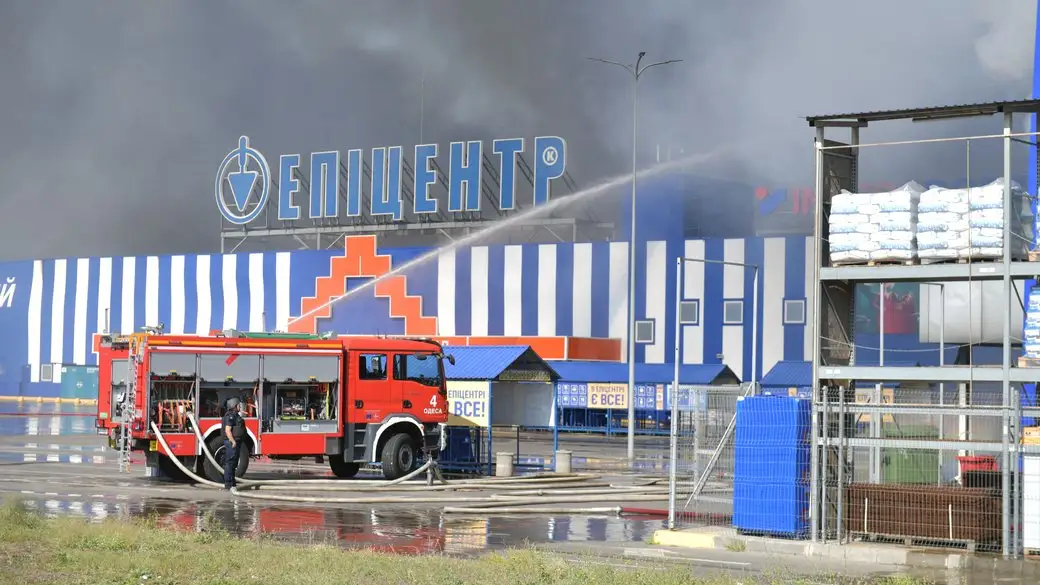
Two Epicentr Stores Were Hit in Odesa
Odesa and the surrounding region came under a major missile and drone attack on the morning of August 24, 2026. According to the Odesa Regional Military Administration, the main impacts affected food warehouses and energy infrastructure. Private homes were also damaged, and fires broke out at several locations.
Epicentr confirmed direct hits on two of its home-improvement hypermarkets. The affected facilities were reported in Odesa’s Peresypskyi district and near the seventh kilometre of the Ovidiopol road.
“Two Epicentr stores in Odesa were hit. Firefighting operations are continuing, and the consequences are being assessed,” company representative Yuliia Chudnovets told Ukrainska Pravda.
The State Emergency Service of Ukraine reported fires at energy and gas infrastructure sites as well as warehouse premises. Forty emergency workers and eight vehicles were deployed, supported by volunteer and local fire units.
According to an updated statement from the regional administration, five people were injured in strikes affecting warehouse facilities. Three were hospitalised in moderate condition. The full extent of the damage was still being assessed.
Four Ozon Logistics Centres Were Targeted the Same Day
A new wave of strikes simultaneously affected Russian e-commerce. According to Ozon, drones targeted four of the company’s logistics facilities in southern Russia on August 24.
Fires broke out at the Makhachkala hub and at a facility near Enem. Ozon said several people were preliminarily reported injured in Makhachkala, where operations were suspended. Workers were evacuated from warehouses in Adygeysk and Nevinnomyssk, although the company reported no damage at those two locations.
Together with earlier strikes in the Samara and Orenburg regions, six Ozon facilities have now been targeted since August 22. The company is temporarily closing damaged hubs to inbound deliveries, redirecting goods and adjusting product availability on its marketplace.
The attacks indicate that a campaign initially focused largely on Wildberries has expanded to Russia’s second-largest e-commerce operator.
The Wildberries Campaign Began on July 18
The first major wave occurred on July 18, when Wildberries facilities in Kotovsk, Tambov region, and Elektrostal, Moscow region, were attacked.
Seven night-shift workers were killed and 25 people were injured in Kotovsk, according to regional authorities. Twenty-four people were initially reported injured in Elektrostal, with one later dying in hospital.
Ukraine said the sites supported the storage and movement of drone-production components and navigation equipment. Russian authorities and Wildberries described them as civilian logistics facilities.
A major fire subsequently broke out at a Wildberries warehouse in the Vladimir region on August 3. Flames affected approximately 100,000 square metres of the 172,000-square-metre complex. Workers were evacuated, while inbound and outbound freight was redirected to alternative hubs.
The Koledino Facility Was Hit Again
On August 16, a strike hit the Wildberries complex in Koledino, approximately 45 kilometres south of Moscow. Covering more than 200,000 square metres, it is one of the company’s largest distribution centres.
Employees were evacuated, but the fire forced Wildberries to restructure its logistics chains and redirect deliveries. An 83-year-old man killed during the wider attack on Podolsk was not officially identified as a warehouse employee.
Another warehouse burned in Domodedovo the same night. Verified reporting did not identify it as a second Wildberries centre, however. Russian sources described it as a pharmaceutical warehouse.
According to Reuters, at least two dozen Wildberries warehouses were targeted between July 18 and August 19. The Russian government was subsequently instructed to develop a state-supported reconstruction programme.
The Full Value of the Losses Remains Unknown
Estimates of damaged floor space, destroyed inventory and lost processing capacity vary widely. They rely on statements from regional authorities, photographs, satellite imagery and private analytical platforms, but no comprehensive independently verified register has been published.
Claims about Wildberries’ importance to the Russian economy also require caution. Some reports incorrectly compare gross merchandise value, or GMV, with the company’s revenue or direct contribution to GDP.
GMV represents the full value of products sold by independent merchants. The marketplace itself primarily earns commissions, logistics fees, advertising and financial-service income.
A warehouse fire can therefore destroy substantial inventory and interrupt sales, but the total value of goods handled by the platform should not be treated as the operator’s own revenue or economic output.
Insurance May Exclude War-Related Damage
Insurance has become another major issue. Commercial property policies commonly exclude war, terrorism and drone-related damage or require expensive additional coverage.
Risk is therefore divided among the building owner, warehouse operator and merchants whose inventory was stored inside. Even where a marketplace promises compensation, payments depend on contractual terms, declared product values and the established cause of the loss.
Following the initial attacks, Sberbank introduced a restructuring programme for businesses that had lost stock at Wildberries facilities. By August 7, the bank had received approximately 2,000 applications.
This confirms a financial impact on marketplace sellers but does not prove predictions of an unavoidable banking crisis.
VTB Acquired 5% of WB Bank, Not the World Bank
One error in some versions of the story requires specific correction: VTB did not acquire a 5% stake in the World Bank.
In May 2026, VTB and RWB announced a strategic partnership under which the Russian state-controlled lender would acquire 5% of WB Bank, the financial subsidiary of the Wildberries group.
Estimates placing Wildberries’ total debt at RUB 1.2–1.3 trillion have appeared in analytical reports but have not been confirmed through detailed consolidated financial statements. The claim that VTB and Sberbank provided €13 billion in loans should therefore not be presented as an established fact.
The strikes may increase working-capital demand, trigger loan restructuring and force banks to raise provisions. Nevertheless, Wildberries’ digital platform, payment system and customer base remain operational, while part of the physical workload is being redirected.
The August 5 Attack Hit Multiple Ukrainian Distribution Networks
Ukrainian logistics has faced similar pressure for a much longer period and on a broader scale. Overnight into August 5, strikes on Kyiv and the surrounding region simultaneously affected warehouses, distribution centres and manufacturing facilities operated by several major companies.
The affected businesses included Rozetka, Nova Poshta, NOVUS, Fozzy Group, Silpo, Epicentr, INTERTOP, PUMA, Toyota Ukraine and LIQUI MOLY Ukraine.
Rozetka’s largest automated centre in Brovary, which could process more than 100,000 orders per day, was declared beyond repair. Epicentr lost logistics capacity and ceramic-tile production, while several grocery distribution centres temporarily stopped operating.
The immediate result was not the complete suspension of retail activity but an emergency redistribution of orders. Companies activated backup terminals, regional warehouses, retail stores, direct supplier deliveries and third-party logistics providers.
Dual-Use Goods Do Not Automatically Remove Civilian Protection
Ukraine has linked some strikes on Russian marketplaces to the alleged storage of drone components, fibre-optic cable, electronics, communications equipment and other potentially dual-use goods.
However, the availability of such products in an online catalogue does not by itself prove that every warehouse made an effective contribution to a specific military operation.
International humanitarian law requires parties to distinguish at all times between civilian objects and military objectives. A civilian facility loses protection only when its nature, location, purpose or actual use makes an effective contribution to military action and its destruction offers a definite military advantage.
The principles of proportionality and feasible precautions continue to apply even when an object qualifies as a military objective.
“Parties to an armed conflict must always distinguish between civilian objects and military objectives,” the International Committee of the Red Cross states.
What European Logistics Operators Should Learn
The events in Ukraine and Russia demonstrate the vulnerability of networks built around a small number of highly automated mega-hubs. These facilities lower normal processing costs but concentrate inventory, personnel and equipment at a single location.
More resilient logistics requires:
- distributing critical stock across several regions;
- maintaining backup sorting and IT systems;
- enabling orders to switch quickly between warehouses and stores;
- contracting alternative third-party logistics providers;
- dividing storage areas with effective fire barriers;
- providing protected spaces for employees;
- maintaining independent power and communications;
- reviewing war and terrorism exclusions in insurance policies;
- preparing freight-diversion routes in advance.
No conventional warehouse can be fully protected from a direct missile or drone strike. A distributed network can, however, prevent the loss of one facility from simultaneously stopping inbound deliveries, order fulfilment, returns and regional distribution.
The attacks of August 24 show that the issue is no longer limited to one marketplace or one country. Logistics infrastructure is becoming a separate front in the economic war, while supply-chain resilience is now a matter of both operational efficiency and physical security.
Read also: Russian Strike Hits 13 Ukrainian Businesses as Warehouses and Logistics Hubs Are Destroyed
