

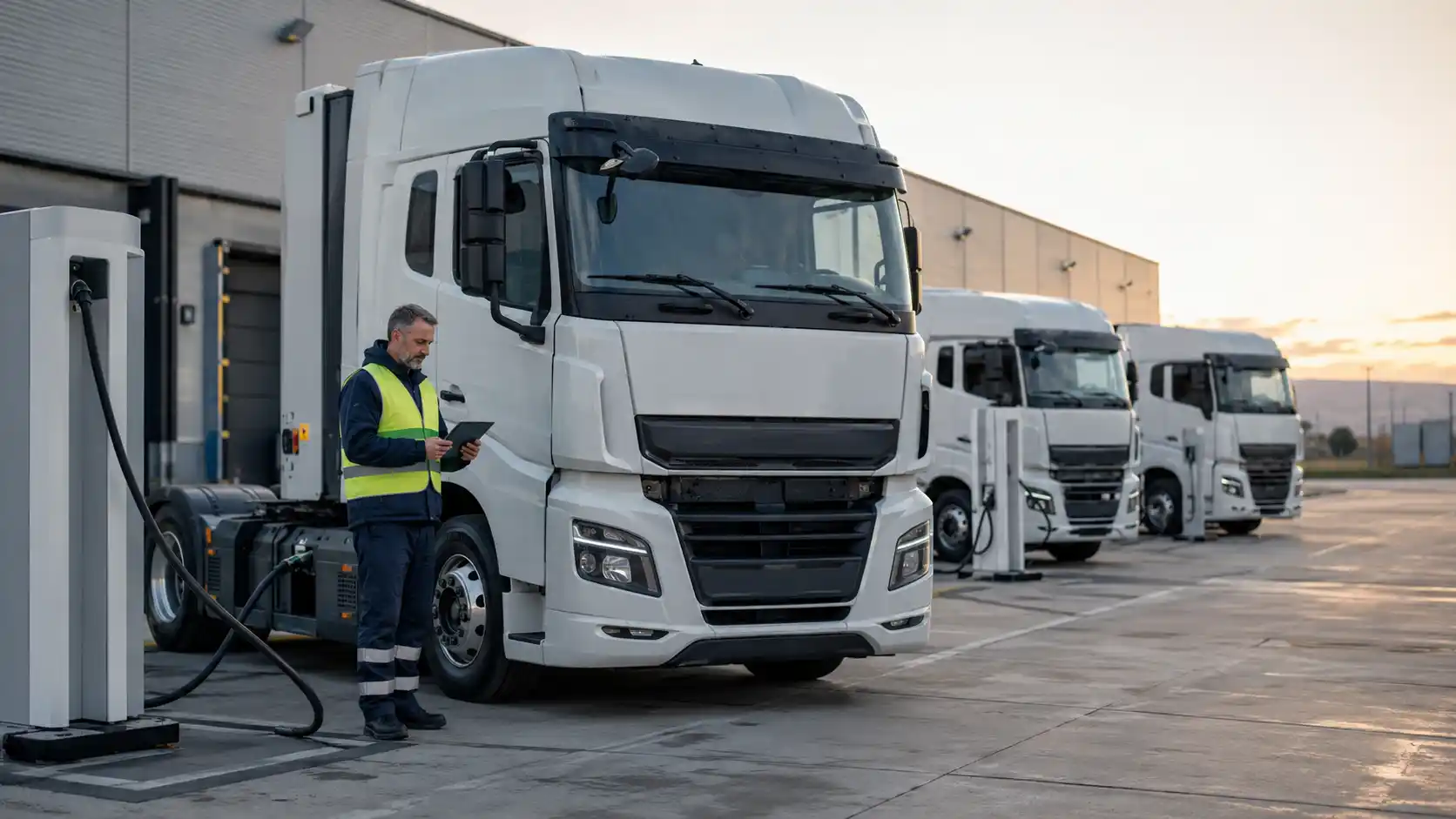
The survey of 57 transport companies found that battery-electric trucks already match or outperform comparable diesel vehicles in reliability, although purchase prices and grid connections remain the main barriers to fleet expansion
Survey Covers More Than 300 Electric Trucks
Around 93% of German transport companies already operating battery-electric trucks said they were satisfied or very satisfied with their performance, according to an Öko-Institut study conducted under the ELV-LIVE project.
The survey included 57 companies operating more than 300 electric trucks. In 56 cases, the vehicles had been in service for at least one year. Responses were collected between November 5, 2025, and January 22, 2026.
The participants were predominantly early adopters. About 70% employed more than 50 people, meaning the findings primarily reflect the experience of medium-sized and large businesses that have already invested in electrification rather than the entire German road freight market.
Electric Trucks Are Moving Into Long-Haul Operations
Battery-electric vehicles are no longer limited to urban distribution. Among the surveyed businesses, 70% use them in local transport, 79% in regional operations, 49% in domestic long-haul transport and 23% on international routes. Companies could report activity in more than one segment.
The participants acquired 110 new electric trucks during the previous 12 months. Around 35% of the companies purchased models offering a stated range of at least 500 kilometres.
These recently acquired long-range vehicles covered an average of 432 kilometres per day. They were also widely deployed beyond regional distribution, with 70% of the relevant operators using them in domestic long-haul transport.
The study’s figure of approximately 40% refers to the structure of companies’ overall heavy-truck fleets: at these businesses, up to two-fifths of vehicles above 18 tonnes travel more than 500 kilometres per day. It should not be interpreted as meaning that 40% of all electric trucks already cover that distance daily.
Reliability Is Comparable to Diesel Trucks
Around 32% of respondents said technical problems occurred just as frequently as with comparable diesel vehicles. Another 23% experienced problems less often, while 16% reported significantly fewer issues.
By comparison, 18% encountered problems more frequently and 7% significantly more frequently. When difficulties occurred, they were divided almost equally between vehicle faults and charging-related issues.
Operators generally praised vehicle reliability, quiet operation and driving comfort. Better working conditions also improved driver acceptance, an important advantage for a freight industry facing a persistent shortage of professional drivers.
The experience became more positive over time for 42% of respondents, while 51% said their assessment remained unchanged. Only 2% reported that their view of electric trucks had deteriorated.
Depot Charging Supports Lower Operating Costs
Companies identified cost savings, road-toll exemptions, affordable electricity at their own depots and customer climate requirements as major reasons for deploying battery-electric trucks.
Depot charging remains the main source of energy for the surveyed fleets. Around two-thirds of the businesses generate at least part of the electricity used by their trucks, including through on-site solar installations.
Public charging currently plays a much smaller role. Operators cited high electricity prices, too few suitable locations, insufficient space for articulated trucks and the absence of reliable charger reservation systems.
Purchase Prices and Grid Capacity Remain Barriers
The high initial cost of electric trucks continues to be one of the most important obstacles. Operators also face lengthy and expensive procedures when installing chargers or requesting additional grid capacity for larger fleets.
“High purchase prices and barriers to expanding depot charging and grid connections remain the main challenges,” project manager Florian Hacker said.
Electrifying a large fleet may require new transformers, upgraded cables, energy-management systems and several megawatts of additional capacity. Grid-connection projects can therefore take considerably longer than the delivery of the vehicles themselves.
72% Plan to Purchase More Electric Trucks
Despite the financial and infrastructure challenges, 72% of respondents intend to acquire additional electric trucks. Among businesses that recently purchased long-range models, 80% were satisfied with their performance.
Expectations for 2030 have also strengthened. Approximately 93% of early adopters believe battery-electric trucks will account for a major share of their fleet or become the standard technology by the end of the decade. The corresponding figure in the 2025 survey was 82%.
According to the official Öko-Institut announcement, further market growth will depend on more than vehicle performance. Operators need predictable toll incentives, affordable electricity, faster grid connections and public charging sites designed for heavy articulated vehicles.
Read also: European Truck Sales Rise 9.3% as Heavy Electric Registrations Jump 80%
