

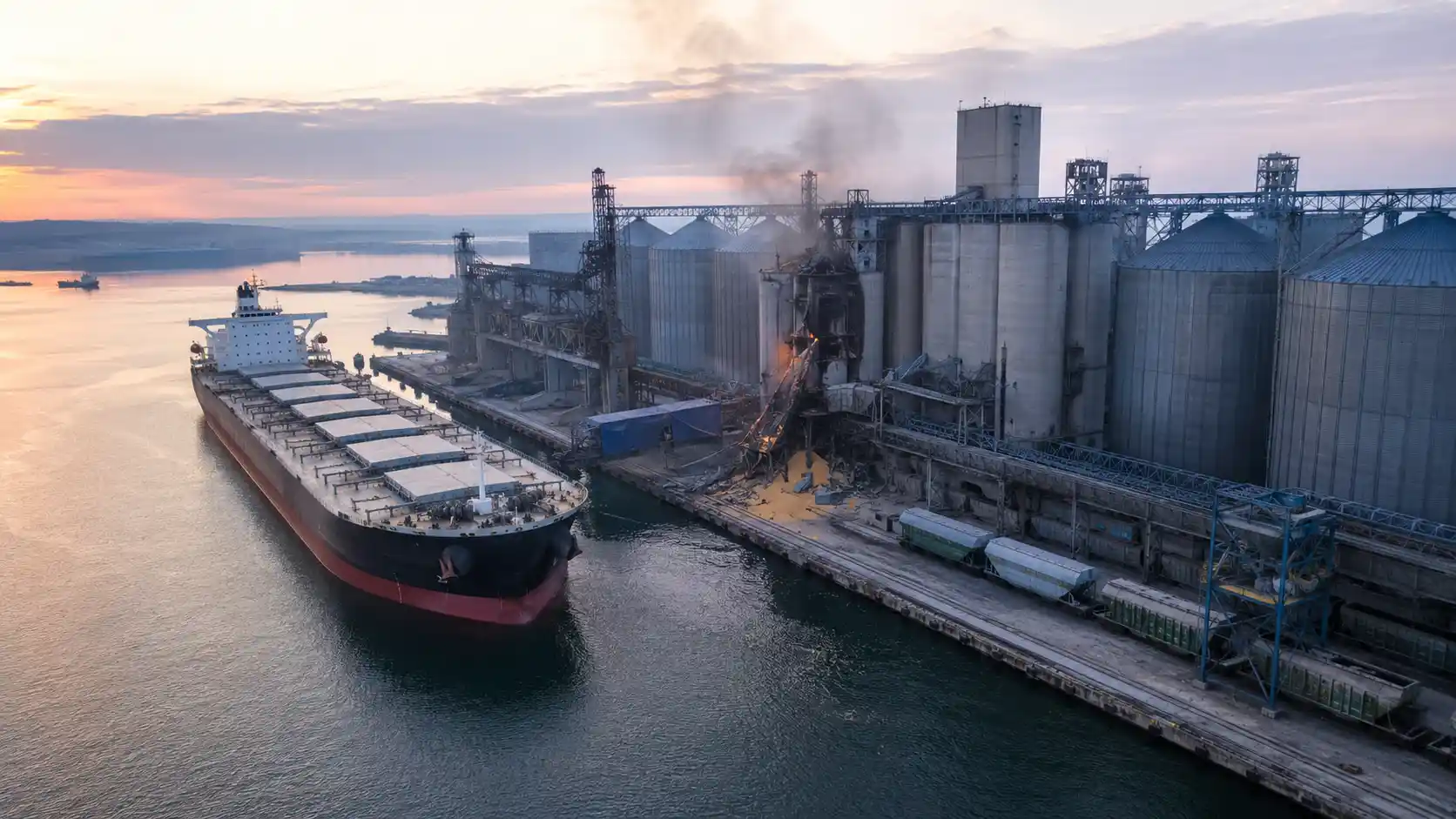
Importers are seeking more expensive wheat from Australia, the United States and Argentina after dozens of Black Sea shipments were delayed or cancelled
Importers Face a Shortage of Available Cargo
Major wheat importers are preparing for tighter supplies after escalating attacks on vessels, grain terminals and other port infrastructure in the Black Sea. Countries across Asia, the Middle East and North Africa are particularly exposed because of their dependence on Russian and Ukrainian wheat.
According to Reuters, benchmark Chicago wheat futures have risen by more than 17% since the beginning of July. Physical prices have also increased among alternative exporters, including Australia, Argentina and the United States.
The problem does not yet represent the disappearance of grain from the global market. Instead, it reflects a reduction in volumes that can be loaded and delivered on schedule. Wheat stored at an inland elevator is effectively unavailable to an importer if there is no operating terminal, willing shipowner or affordable insurance coverage.
Asian Buyers Await Up to 2.5 Million Tonnes
Asian flour mills contracted between 2 million and 2.5 million tonnes of Black Sea wheat for delivery between July and September. These cargoes represent approximately 30%–50% of the import requirements of some buyers.
Arrivals were expected to begin in mid-August, but a number of vessels were unable to enter ports for loading. Shippers have consequently delayed or cancelled dozens of cargoes during the peak new-crop export season.
“By the end of August, the market will have to find solutions,” Argus Media grain analyst Maxence Devillers said
Buyers are considering replacement cargoes from Australia, North America, Argentina, Bulgaria and Romania. Available export supplies are limited, however, and a large shift in demand could place additional pressure on prices.
The FAO Agricultural Market Information System has also identified Black Sea logistics disruptions as a factor supporting wheat prices alongside weaker production expectations in several exporting countries.
Egypt Is Highly Dependent on Black Sea Wheat
Egypt is among the most exposed buyers. Russia and Ukraine supplied more than 82% of the country’s wheat imports during the first half of 2026.
Record procurement of domestic wheat has provided the government with a temporary buffer. Private flour mills are in a more difficult position because they account for more than half of Egypt’s wheat import requirements and generally hold smaller inventories than government agencies.
Shipowner reluctance creates an additional risk. Higher war-risk insurance premiums, the possibility of vessel damage and uncertain loading times make previously agreed contracts less reliable.
In August, a vessel due to load grain for an Egyptian buyer was attacked while approaching Novorossiysk. Reuters sources identified it as Xin Hai Tong 66. The vessel was empty at the time, and no injuries were reported.
The threat to food supplies has also been discussed by Ukrainian President Volodymyr Zelenskiy and Egyptian President Abdel Fattah al-Sisi.
Indonesia May Need Replacement Cargoes
Indonesian buyers contracted approximately 600,000 tonnes of wheat from former Soviet exporters for shipment between July and September.
Existing stocks are sufficient to cover immediate food-processing requirements, but the country does not have a large surplus. If Black Sea cargoes fail to arrive on schedule, flour mills may need to purchase grain from Australia, Argentina, Romania or Bulgaria.
Algeria, Bangladesh, Jordan, Thailand, Tunisia and Vietnam face similar exposure. Jordan cancelled two wheat and two barley tenders in August after receiving a limited number of high-priced offers. Tunisia has warned suppliers against automatically invoking force majeure.
Alternative Wheat Costs Up to $60 More per Tonne
Black Sea wheat remains considerably cheaper than most alternatives, with cargoes priced at approximately $260–280 per tonne.
The least expensive U.S. wheat is offered at around $305 per tonne, while Australian Premium White wheat delivered to Asia costs approximately $315–320.
Changing origins could therefore add between $25 and $60 per tonne. For a conventional 50,000-tonne cargo, the additional procurement cost would range from $1.25 million to $3 million before higher insurance, financing and storage expenses are considered.
More distant sourcing also changes delivery schedules. Importers may need to contract earlier, hold larger safety stocks and allocate more working capital to grain procurement.
Ukraine Recorded 124 Attacks in July
According to the Ukrainian Ministry for Development of Communities and Territories, Russian forces carried out:
- 67 attacks on Ukrainian seaport infrastructure;
- 35 attacks on civilian vessels inside ports;
- 22 attacks on ships operating in the Ukrainian Maritime Corridor.
Only 14 comparable attacks were recorded during the whole of 2025. These figures refer specifically to Russian strikes on Ukrainian targets and do not include Ukrainian attacks on Russian ports, vessels, military facilities and energy infrastructure.
The exchange of attacks has extended risk to both sides of the Black Sea. Terminal closures and operating restrictions in Ukraine and Russia are reducing available export capacity just as the new harvest reaches the market.
Food-Security Impact Depends on Duration
Improved harvests in parts of the Middle East and North Africa have so far limited the immediate impact. Egypt has purchased record domestic volumes, while favourable rainfall has improved production prospects in Morocco and Tunisia.
Domestic crops are not sufficient to replace imports entirely. If disruption continues, Egypt, Indonesia and other buyers will compete for limited cargoes from Australia, the United States, Argentina and the European Union.
Even without a complete halt to Black Sea exports, this could raise grain, flour and bread prices. The most serious consequences would be felt in countries combining heavy import dependence with limited foreign-currency reserves and extensive food-subsidy programmes.
Read also: 57 Ships Hit Since June 20 as Attacks Reshape Black Sea Logistics