

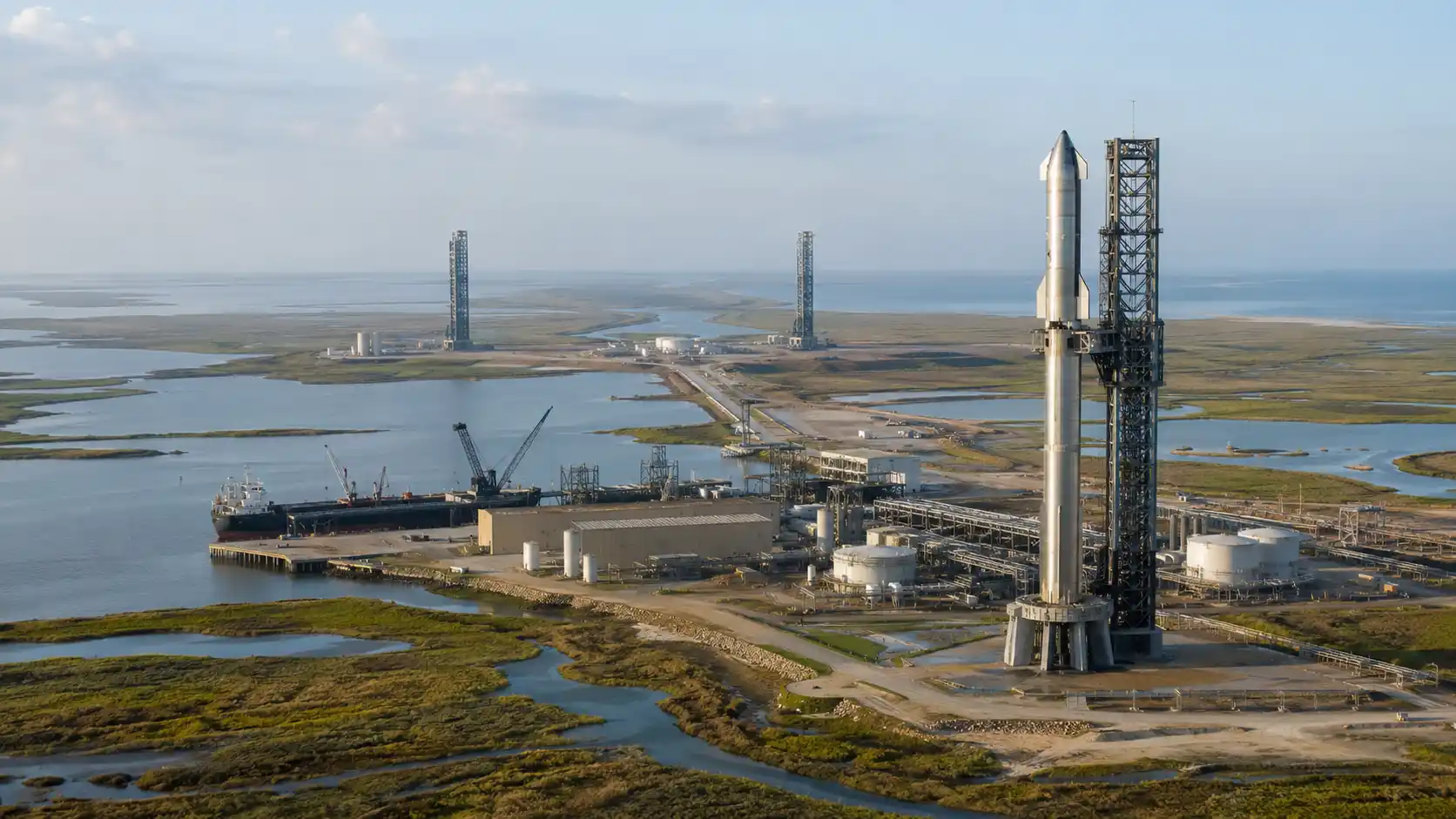
The 125,000-acre spaceport is targeting its first launch in 2029, although more than 10,000 annual flights remain Elon Musk’s long-term ambition rather than an approved operating capacity
Louisiana Will Host SpaceX’s Largest Facility
SpaceX has reached an agreement with the authorities in the U.S. state of Louisiana to develop Starbase Louisiana on the Gulf Coast. The company intends to invest $100 billion and turn the site into its largest launch complex.
According to SpaceX’s official project description, the spaceport will be located near Pecan Island in Vermilion Parish. It will cover approximately 125,000 acres, or 50,585 hectares, along a coastal strip extending for around 29 kilometres.
Starbase Louisiana will become the company’s fourth U.S. launch location and its second campus carrying the Starbase name after the existing facility in South Texas.
The scale of the project reflects SpaceX’s financial and operational expansion. K2Cargo.News previously reported that SpaceX’s quarterly revenue increased by 92% to $7.8 billion.
The Initial Plan Includes 10 Launch Pads
According to the official announcement from Louisiana Economic Development, the completed initial development will include five launch complexes. Each will have two Starship pads and its own propellant farm.
The confirmed first-stage plan therefore covers 10 launch pads. Elon Musk has also described a longer-term possibility of operating more than 12 launch towers in Louisiana, although no timetable has been published for that expansion.
The development is also expected to include:
- on-site propellant production;
- independent power generation;
- spacecraft processing and maintenance facilities;
- deep-water shipping capabilities;
- housing for employees and their families;
- a possible private airport.
Starbase Louisiana should not, however, be described as a completely autonomous manufacturing centre. The current plan focuses on launching, landing, fuelling and processing Starship vehicles rather than producing the rockets themselves.
Natural Gas Will Support Starship Operations
SpaceX considers access to Louisiana’s natural-gas resources one of the site’s principal advantages. The company intends to use local gas for power generation and as a feedstock for producing methane required by Starship’s Raptor engines.
On-site propellant production could reduce dependence on continuous deliveries of cryogenic fuel by road or sea. The facility will nevertheless require extensive systems for producing, cooling, storing and transferring liquid methane and oxygen.
Deep-water infrastructure will allow Starship vehicles and Super Heavy boosters to be delivered by sea, including from SpaceX’s production facilities in Texas. Maritime transportation is particularly important because the size of the fully assembled vehicles makes conventional road transport difficult.
More Than 10,000 Launches Remain a Long-Term Goal
Official announcements from SpaceX and Louisiana refer to the ability to support thousands of flights annually. The higher figure emerged after Musk said that more than 12 launch towers could eventually enable over 30 Starship flights per day.
If sustained throughout a full year, that rate would mathematically exceed 10,950 launches. It remains a long-term ambition, however, rather than a confirmed schedule or an approved operating limit.
Reaching it would require full reuse of both Starship stages, rapid inspections and maintenance, continuous propellant production and close coordination with aviation and maritime authorities.
Each mission will also require restrictions in defined areas of airspace and surrounding waters. Actual capacity will therefore depend on licensing, safety requirements, weather and the ability of regional transport infrastructure to support operations.
The First Launch Is Targeted for 2029
Construction is expected to begin in 2027, with the first Starship flight from Louisiana targeted for no earlier than 2029. This does not mean that the complex will immediately handle thousands of missions each year.
Official project documents do not confirm claims that SpaceX will have 15 operational pads and conduct more than 1,000 missions as soon as the facility opens. The initial Louisiana plan covers 10 pads, with flight frequency expected to increase gradually.
The principal condition remains the readiness of Starship itself. The vehicle is still undergoing flight testing and must demonstrate that both stages can be recovered, inspected and relaunched safely at short intervals.
A Falcon 9 Booster Has Completed Its 37th Mission
SpaceX continues to extend the operating life of its existing reusable launch system. During the Starlink Group 10-49 mission, the Falcon 9 first-stage booster completed its 37th flight, setting a new reuse benchmark.
Starship is intended to take that model considerably further. During its 13th test flight on July 24, 2026, the upper stage completed its first sufficiently gentle Indian Ocean splashdown to remain afloat. The spacecraft was later towed to Christmas Island for examination.
A successful splashdown does not yet demonstrate routine reuse. SpaceX must still return the vehicle to a launch site, inspect it rapidly, refuel it and launch it again without extensive repairs.
Starship Could Transform Orbital Cargo Transport
Starship is designed to deliver more than 100 metric tonnes to orbit in a fully reusable configuration. A high launch frequency would allow SpaceX to deploy large satellite constellations, conduct orbital refuelling and transport equipment for lunar and deep-space missions.
Demand for such capacity is growing as governments and companies expand their satellite programmes. For example, Europe’s IRIS² constellation is set to grow to 348 satellites, with initial launches planned for 2029.
For the logistics industry, Starbase Louisiana will bring maritime transport, energy production, cryogenic storage, vehicle servicing and orbital cargo delivery together at one site. The model resembles a large integrated transport and industrial hub rather than a conventional launch pad.
The Project Could Create More Than 11,000 Jobs
SpaceX expects to create 3,000 direct jobs over ten years, with an average annual salary of approximately $92,600. Louisiana officials estimate that the project could generate more than 8,100 additional indirect jobs.
The total employment effect could therefore exceed 11,100 positions. In addition to aerospace specialists, the complex will require workers in port operations, energy production, construction, maintenance and ground logistics.
Environmental Approval Remains a Major Condition
Pecan Island is located within coastal wetlands that provide habitat for migratory birds and protect inland communities from storms. SpaceX says that large portions of the acquired property will remain undeveloped.
The company plans to cooperate with Louisiana environmental agencies, support shoreline restoration and mitigate potential effects on wetlands and wildlife.
The final scale and launch frequency will depend on environmental reviews, construction permits and federal launch licences. Starbase Louisiana should therefore be viewed as a long-term infrastructure programme rather than a fully approved spaceport guaranteed to conduct 10,000 flights annually.
Read also: China Successfully Launches Gravity-1 Rocket Carrying Nine Satellites from a Sea-Based Platform