

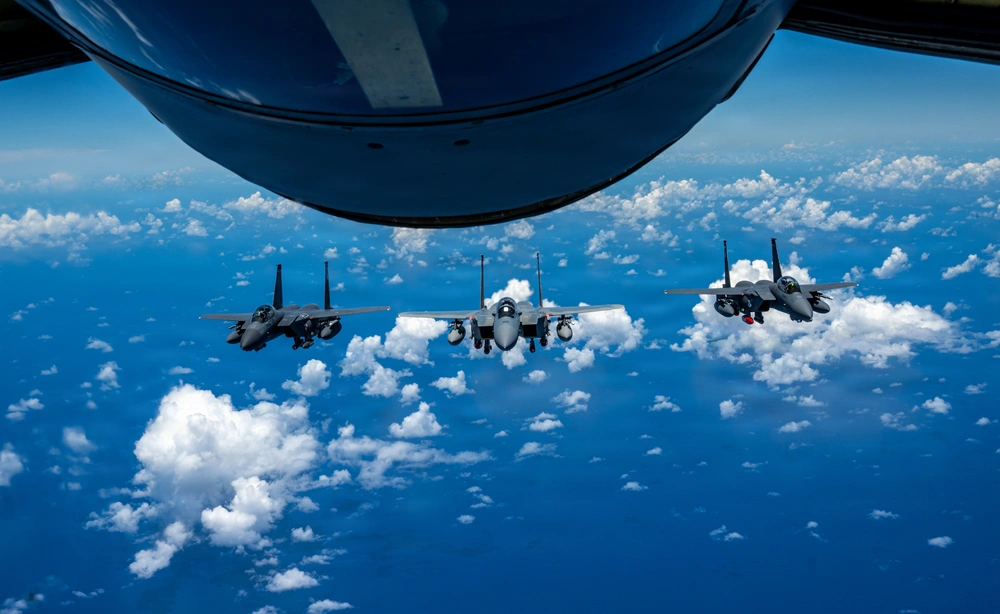
The agreement covers aircraft production, modernization and sustainment through 2037, but its stated value is a maximum ceiling rather than a guaranteed payment
Contract Extends Into the Next Decade
The U.S. Air Force has awarded Boeing a ceiling-value contract of $131.23 billion for the F-15 Eagle Crest program. The agreement is structured as an indefinite-delivery/indefinite-quantity contract, allowing aircraft, equipment and services to be ordered separately as requirements and funding become available.
According to the official U.S. defense contract announcement, the work will primarily be performed at Boeing’s facility in St. Louis, Missouri. Completion is expected by August 2037.
The initial ordering period runs until August 24, 2031, with an option to extend it through August 24, 2036.
“The contract provides for aircraft production, systems integration, modernization, upgrades, retrofits and sustainment,” the department said
The agreement was awarded through a sole-source acquisition. The Air Force Life Cycle Management Center at Wright-Patterson Air Force Base in Ohio is the contracting authority. The contract number is FA8634-26-D-B001.
$131.23 Billion Is Not an Immediate Payment
The announced value represents the maximum amount that may be ordered under the contractual framework. It is not a guaranteed procurement commitment and does not mean Boeing has already received, or will necessarily receive, the entire $131.23 billion.
At the time of the award, the Air Force obligated only $343,740 in fiscal 2026 research, development, testing and evaluation funding.
Future spending will depend on individual task orders, congressional appropriations, U.S. military requirements and requests from foreign customers. The final value of the program may therefore remain substantially below the contract ceiling.
The IDIQ structure allows the Air Force to place aircraft production, modernization and long-term support requirements under a single contractual mechanism.
Seven Countries Are Covered by Foreign Military Sales
The framework includes potential Foreign Military Sales activity for:
- Japan;
- Israel;
- Saudi Arabia;
- South Korea;
- Singapore;
- Indonesia;
- Poland.
A country’s inclusion in the contract does not automatically confirm an order for new fighter aircraft. The mechanism may cover aircraft production, equipment deliveries, upgrades to existing fleets, systems integration and maintenance support.
This distinction is particularly important in Poland’s case, as the contract notice does not announce a separate Polish purchase of F-15 aircraft.
Boeing Will Support Depot Maintenance Capacity
The scope includes aircraft production, integration of new systems, modernization, upgrades, retrofits and long-term sustainment.
Boeing is also expected to help establish organic depot maintenance capabilities. These facilities would enable customers to conduct major inspections, overhauls and modernization work without routinely sending aircraft back to the manufacturer’s main production site.
For F-15 operators, local or national depot capacity could reduce maintenance times, improve aircraft availability and lower dependence on cross-border transport of major components. The program will also create long-term demand for spare parts, engines, electronic systems, testing equipment and specialized aviation logistics.
F-15 Remains Part of U.S. Airpower Planning
The contract demonstrates that the United States intends to continue operating and developing the F-15 family alongside newer low-observable combat aircraft.
By combining requirements from the U.S. Air Force, Air National Guard and international customers, the framework could help Boeing sustain its St. Louis production line and the wider F-15 component supply chain into the next decade.
However, actual production volumes will be determined by individual orders rather than the headline contract ceiling.
U.S. Also Targets More Than 1,000 Space Launches a Year
Separately from the F-15 program, the administration has announced plans to accelerate the development of U.S. space transportation infrastructure. Under the White House space transportation initiative, the country is expected to support more than 1,000 launches and spacecraft reentries annually by 2030.
Federal agencies have been directed to accelerate launch-site development, modernize airspace corridors, cooperate with private companies and streamline permitting procedures.
The initiative is not financially or operationally connected to the Boeing F-15 contract. Together, however, the two programs illustrate Washington’s broader effort to expand aerospace production, maintenance infrastructure and strategic equipment supply chains.
Read also: MSC Air Cargo Orders Five Boeing 777-8 Freighters