

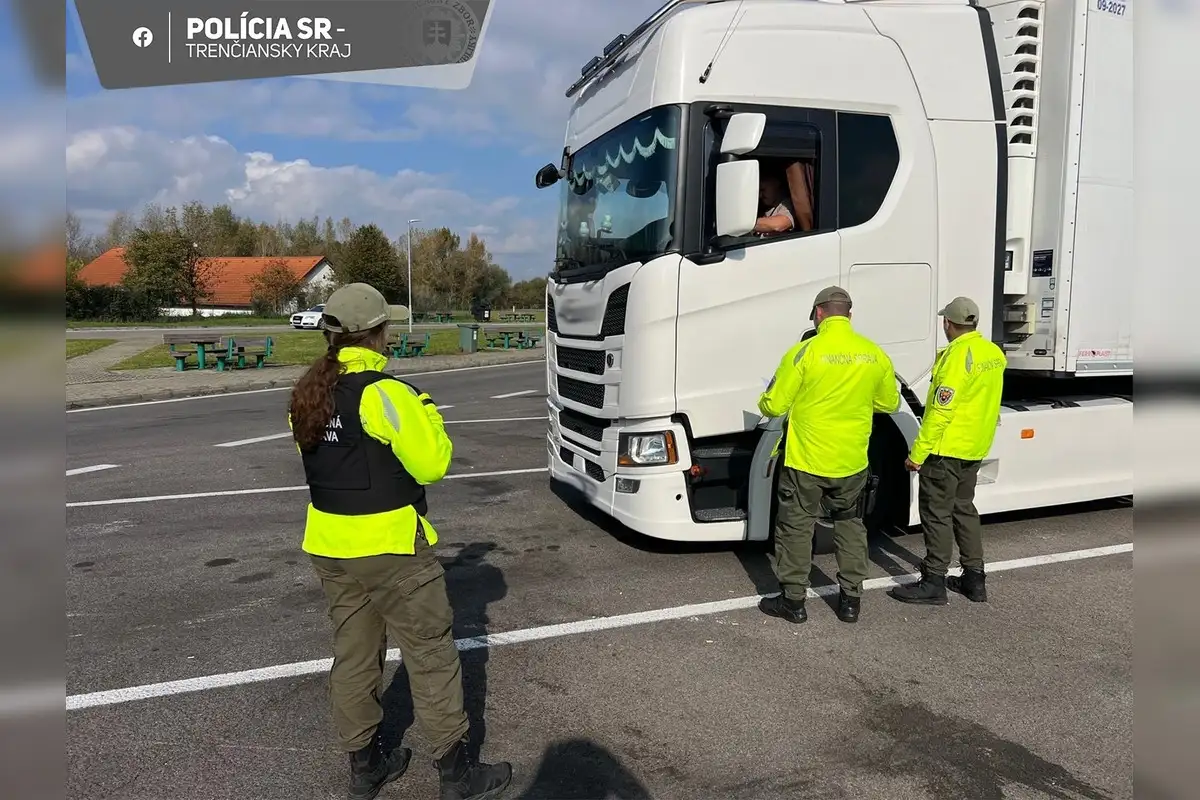
From 1 September 2026, international hauliers must comply with new overload criteria, stronger enforcement powers and revised weekend driving restrictions
Slovakia introduced a package of road traffic changes on 1 September 2026 under Act No. 131/2026. The legislation amends Act No. 8/2009 on road traffic and applies to both Slovak and foreign transport operators.
The reform relaxes certain time restrictions for heavy goods vehicles while increasing liability for overloading, excessive speeding and violations of weekend and public holiday truck bans.
One of the principal changes concerns the classification of overloaded vehicles. Exceeding the maximum permitted weight of a vehicle, combination, trailer or semi-trailer—or the applicable axle-load limit—by at least 10% is now treated as a serious offence.
The threshold is not a legal tolerance. Operators must continue to comply with all applicable weight and axle-load limits. For a vehicle combination authorised to operate at 40 tonnes, for example, a weight of 44 tonnes reaches the threshold at which the offence is classified as serious.
If an overload fine imposed during a roadside inspection is not paid immediately, police may retain the vehicle’s registration certificate and number plates. The measure also applies to vehicles registered outside Slovakia, potentially preventing a truck from continuing its journey until the matter is resolved.
The reform introduces tougher penalties for the most serious speeding offences. A violation falls into this category when the applicable limit is exceeded by more than 50 km/h in a built-up area or by more than 60 km/h outside a built-up area.
The administrative fine now ranges from €800 to €1,300, compared with the previous €500–1,000 range. For fines handled directly during roadside proceedings, the amount has increased from €250–800 to €500–1,000.
For international hauliers, these penalties create both financial and operational risks. In addition to the fine itself, a roadside inspection can delay delivery and disrupt booked loading or unloading slots at terminals and warehouses.
The changes affect vehicles with a maximum authorised weight above 7.5 tonnes, as well as vehicles above 3.5 tonnes towing a trailer or semi-trailer. Breaching the applicable weekend or public holiday ban is now included among serious road traffic offences.
At the same time, some operating periods have been shortened. On Sundays and on the final day of a public holiday, the ban now applies from 06:00 until 22:00. Previously, it began at midnight, giving carriers an additional six-hour window to complete journeys or transit Slovakia before the restriction starts.
The summer schedule has also been revised. Between 1 July and 31 August, on the first non-working day and on a Saturday following a working day, the restriction will operate from 09:00 to 19:00 instead of starting at 07:00. Since the legislation entered into force after the 2026 summer season, hauliers will encounter this change for the first time in summer 2027.
As K2Cargo.News previously reported, seasonal truck restrictions also apply across other European countries and require advance adjustments to international transport schedules.
The amended rules expand the list of exemptions from weekend and public holiday restrictions. These include vehicles used for regular municipal waste collection and transport supplying continuously operating production facilities in Slovakia.
Of particular importance to international operators is an exemption covering vehicles returning to Slovakia before continuing their journey. Certain exemptions for agricultural products and cargo connected with railway infrastructure have also been broadened.
Before relying on an exemption, operators should verify that the specific journey meets the statutory conditions and ensure that the driver carries documents confirming the type of cargo and purpose of the trip.
Vehicle-owner liability has been extended to several offences that can be recorded without stopping the vehicle. These include failure to maintain a safe distance, use of a mobile phone or a similar device while driving, and failure of a front-seat passenger to wear a seat belt.
The fixed penalties are €99 for failing to maintain a safe distance, €249 for using a phone while driving and €78 for a front passenger’s seat-belt violation.
Evidence may be collected not only by police equipment but also by systems operated by road authorities and railway infrastructure organisations. The resulting data will be forwarded to the police for processing under the prescribed procedure.
Following the entry into force of the amendments, transport companies should strengthen checks on the actual weight of vehicle combinations and the distribution of loads across individual axles. The 10% threshold must not be treated as a permitted margin: it only determines when an overload becomes a serious offence.
Operators planning journeys through Slovakia should also update schedules to reflect the revised weekend hours, verify whether an exemption applies and inform drivers about the consequences of failing to pay an overload fine at the roadside. Expanded automated enforcement means that more violations can be recorded without the truck being stopped.
Read also: 57 Ships Hit Since June 20 as Attacks Reshape Black Sea Logistics
