

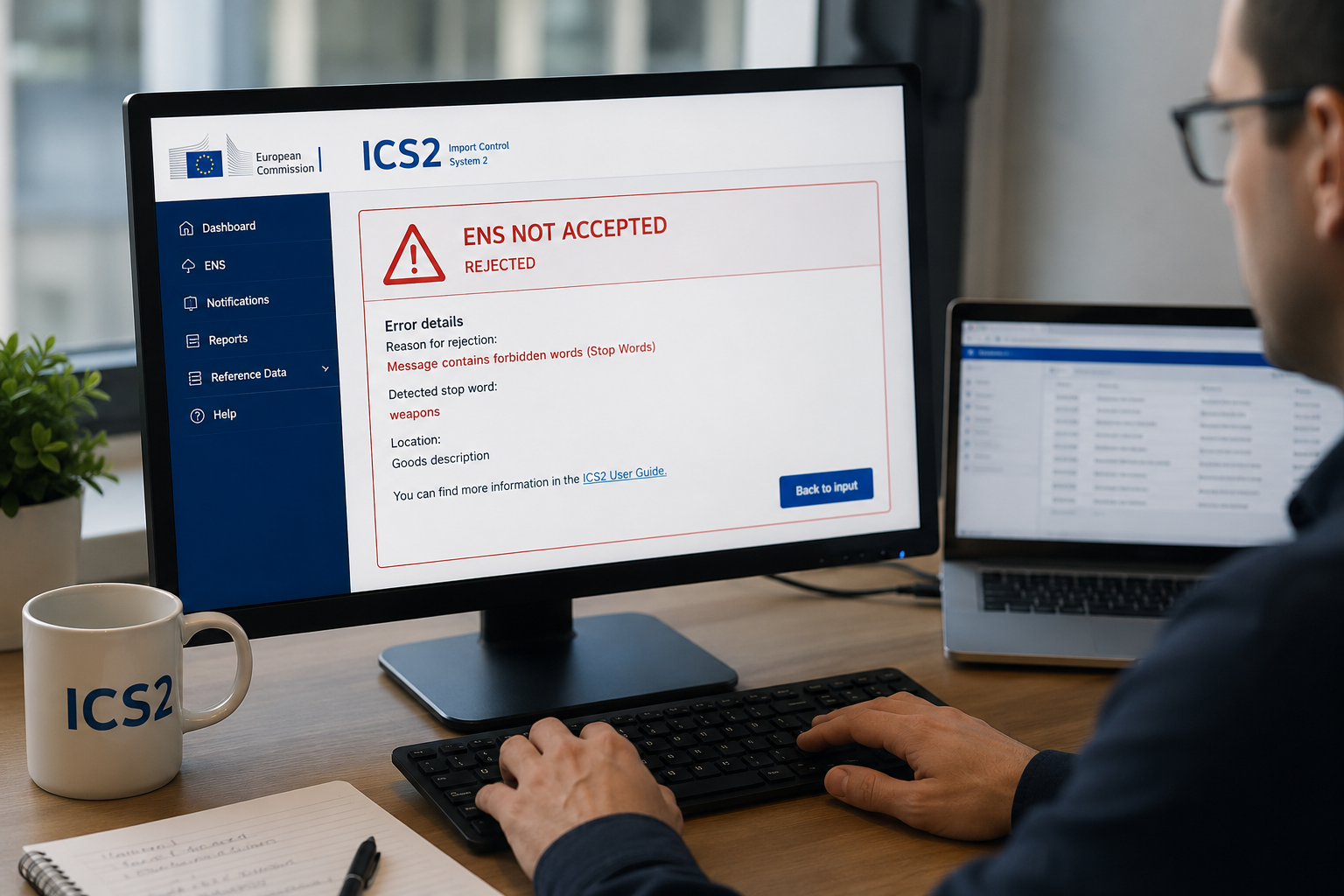
The Updated Rules Take Effect on August 3
The European Commission has published an updated Stop-Words List for the Import Control System 2, or ICS2.
The revised list will apply from August 3, 2026, and must be taken into account when preparing Entry Summary Declarations, commonly known as ENS filings.
ICS2 uses ENS data to perform security and safety risk analysis before goods arrive at the external border of the European Union. Cargo descriptions must therefore allow customs authorities to understand what is being transported without relying on an invoice, packing list or another document.
Generic and uninformative descriptions may cause the filing to be rejected automatically. The declarant will then need to correct the information and submit the ENS again.
Which Descriptions May Be Rejected
Stop words are general terms that do not identify the actual contents of a shipment.
Examples include:
Goods
Parts
Spare parts
General cargo
Equipment
Electronics
Clothing
Food
Chemicals
Machinery
Various goods
See invoice
Unknown
N/A
The presence of one of these words does not necessarily mean that any longer description containing it will be rejected. The main risk arises when the generic term is used as the only description or when the remaining text still fails to identify the product.
For example, spare parts for machinery remains too broad because it does not explain what the parts are made from or which machine they are intended for.
How Goods Should Be Described
The description should identify the product and, where relevant, its material, purpose, type or technical characteristics.
Instead of Parts, use:
Steel brake pads for passenger cars
Instead of Electronics, use:
48-port Ethernet network switches
Instead of Clothing, use:
Men’s knitted cotton T-shirts
Instead of Food, use:
Dry wheat pasta in retail packages
Instead of Chemicals, use:
Sodium hydroxide, CAS 1310-73-2
Instead of Machinery, use:
Hydraulic pumps for agricultural tractors
Instead of Spare parts, use:
Aluminium transmission housings for commercial vehicles
A useful test is whether a customs officer can understand the nature of the shipment from the ENS description alone.
A Commodity Code Does Not Replace the Description
Providing an HS or Combined Nomenclature code does not remove the requirement for an adequate goods description.
The code and the written description perform related but separate functions. The commodity code places the product within a tariff category, while the description explains the actual contents of the consignment.
Companies should ensure that the description matches the commodity code. A declaration containing a detailed description but an inconsistent tariff classification may still attract additional scrutiny.
The same product description should also be used consistently in the ENS, commercial invoice, packing list, transport order and customs documentation.
What Happens When an ENS Is Rejected
When ICS2 identifies an unacceptable description, the ENS may not receive the status required for further processing.
The filing party will have to correct the data and transmit it again. Depending on the transport mode and the stage at which the error is discovered, the consequences may include:
- a delay at the terminal or border;
- a missed vessel or flight;
- a loading prohibition;
- truck or container demurrage;
- additional customs questions;
- a physical inspection;
- storage and rebooking costs.
For time-sensitive cargo, even a technical rejection can disrupt the entire delivery schedule.
An incomplete ENS may also affect several parties at once. A carrier may be unable to load the shipment, while the freight forwarder, shipper and consignee wait for the corrected data to be accepted.
There Is No Single EU-Wide Fixed Fine
The European Union has not established one fixed monetary penalty specifically for using a stop word.
An inadequate description will primarily create an operational problem: rejection of the ENS, a request for correction or additional customs intervention.
Financial penalties may nevertheless apply under the national legislation of the EU member state handling the violation.
Under Article 42 of the Union Customs Code, member states must provide penalties for breaches of customs legislation that are effective, proportionate and dissuasive.
Depending on the country and circumstances, measures may include:
- an administrative fine;
- increased customs supervision;
- temporary suspension of an authorization;
- amendment of authorization conditions;
- revocation of a customs authorization;
- penalties for providing incomplete or inaccurate information.
The amount may depend on whether the error was accidental, repeated or deliberate and whether it interfered with customs risk analysis.
Companies should therefore not expect a universal penalty table covering all EU countries.
The Declarant Remains Responsible for Submitted Data
Responsibility for submitting an ENS may rest with a carrier, freight forwarder, courier operator, postal service or another party involved in bringing goods into the European Union.
ICS2 also allows multiple filing, under which different parties provide different parts of the required dataset.
However, operational responsibility does not begin only when the ENS is transmitted. The quality of the declaration depends on information supplied earlier by the exporter, manufacturer or shipper.
If the shipper provides only parts, goods or equipment, the carrier may be unable to prepare a compliant declaration without requesting clarification.
Transport companies should therefore make detailed cargo descriptions a mandatory field in bookings and transport orders.
Minimum Information to Request from Customers
Before accepting a shipment, the carrier or forwarder should obtain:
- the precise product name;
- the material or composition;
- the intended purpose;
- the product type or model;
- the HS code, when available;
- the number of items or packaging type;
- the chemical name and CAS number, where applicable.
Descriptions should be available before the ENS submission deadline, not after the vehicle has arrived at a port, airport or border crossing.
Companies should also prevent users from entering phrases such as see invoice or as per attached documents into mandatory cargo-description fields.
Automated Data Transfers Must Be Reviewed
Many ENS filings are generated automatically from transport management, enterprise resource planning or booking systems.
This creates a risk that old descriptions will continue to enter ICS2 even after employees have been informed about the updated rules.
Companies should review:
- product master data;
- customer booking templates;
- EDI messages;
- API integrations;
- invoice-to-ENS data transfers;
- house and master consignment records;
- customs-broker interfaces;
- saved descriptions used for regular shipments.
A warning should appear before submission when a description contains a prohibited generic term or is shorter than the company’s minimum quality standard.
The validation should operate at the source of the data. Correcting descriptions manually immediately before filing is slower and creates a greater risk of inconsistency between documents.
House-Level Data Is Particularly Important
For consolidated freight, a master description such as general cargo cannot adequately describe the individual consignments inside the container, trailer or airfreight unit.
Each house-level shipment should contain a sufficiently precise description.
For example, a consolidated load may include:
Cotton bed linen
Stainless-steel kitchen sinks
LED vehicle headlamps
Plastic children’s toys
Combining them under various goods deprives customs authorities of the information needed for risk assessment.
Forwarders should ensure that each shipper supplies compliant data before the consolidation is closed.
Changes Are Needed in Contracts and Instructions
Transport and forwarding agreements should clearly state that the customer must provide accurate and sufficiently detailed cargo information.
The contract may also specify who bears costs resulting from incorrect data, including storage, rebooking, demurrage, customs inspections and additional document processing.
Standard operating procedures should explain:
- who checks the description;
- when the check takes place;
- who contacts the customer for clarification;
- who approves the corrected wording;
- how changes are synchronized across documents;
- how evidence of customer instructions is retained.
This is especially important when several companies participate in a multiple-filing process.
Some Common Corrections Are Still Not Specific Enough
Replacing one vague word with a slightly longer phrase may not solve the problem.
Vehicle parts remains broad.
A better description is disc brake calipers for heavy trucks.
Industrial equipment remains broad.
A better description is electric centrifugal pumps for water-treatment systems.
Plastic products remains broad.
A better description is polypropylene food-storage containers.
Metal articles remains broad.
A better description is galvanized steel mounting brackets for solar panels.
Medical supplies remains broad.
A better description is single-use nitrile examination gloves.
The description should distinguish the goods from other products that might fall within the same general category.
Chemical and Dangerous Goods Require Extra Precision
Descriptions of chemical products should include the exact substance or commercial formulation whenever possible.
Instead of chemicals, the ENS should state, for example:
Acetone, CAS 67-64-1
Water-based acrylic paint
Lithium-ion battery electrolyte
Calcium ammonium nitrate fertilizer
For dangerous goods, the ENS description should also remain consistent with the transport documents and applicable ADR, RID, IMDG or ICAO requirements.
A discrepancy between the customs description and the dangerous-goods declaration may lead to additional checks.
Corrections Should Be Made Before August 3
Companies should not wait until the updated list becomes active.
Before August 3, 2026, carriers, forwarders and customs representatives should test their most frequently used descriptions against the new requirements.
Priority should be given to regular shipments for which the same wording is copied automatically every day.
The implementation plan should include employee training, customer notifications, software updates and test ENS filings.
Companies using an external customs or ICS2 service provider should confirm that the provider has installed the updated list and will apply it from the correct date.
The Main Risk Is Delay, Not Only a Fine
The most immediate consequence of a poor description is not necessarily a financial penalty. It is the possibility that the shipment cannot continue as planned.
A rejected ENS can result in a missed departure, truck waiting time, container storage and the loss of a delivery slot.
Those commercial costs may exceed any administrative fine.
For this reason, cargo descriptions should be treated as operational data rather than a minor customs formality.
From August 3, descriptions such as goods, parts, general cargo, equipment or see invoice should not be used as standalone entries in ICS2 filings.
The safest approach is to identify the precise product, its material and its function before the booking is accepted and ensure that the same wording reaches every party responsible for the ENS.
Read also: Ukraine Customs Launches a Digital Service for Analysing the Customs Value of Goods
