

Central Asia Is Becoming a Priority for Georgia
Georgia intends to continue strengthening its relations with Central Asian countries, viewing the region not only as an important political partner but also as a major source of future transit cargo.
Prime Minister Irakli Kobakhidze said the previous two months had been particularly active for Georgian foreign policy in Central Asia. High-level visits were made to Kazakhstan, Kyrgyzstan and Tajikistan, while Georgia hosted the presidents of Uzbekistan and Turkmenistan.
According to the Prime Minister, the government will make every effort to deepen both political and trade-economic relations with the region.
For Georgia, these ties are closely connected with transport policy. Tbilisi wants to strengthen its position as the western link between Central Asia, the Caspian Sea, the South Caucasus and European markets.
Kobakhidze Points to Seven Landlocked Countries
Kobakhidze highlighted Georgia’s geography, saying the country connects seven landlocked states with the Black Sea and, through it, Western markets.
The statement should not be interpreted as referring to seven Central Asian countries. In earlier remarks, the Prime Minister described seven landlocked states across the broader Caucasus, Caspian and Central Asian region.
Tbilisi is attempting to turn that geography into an economic advantage.
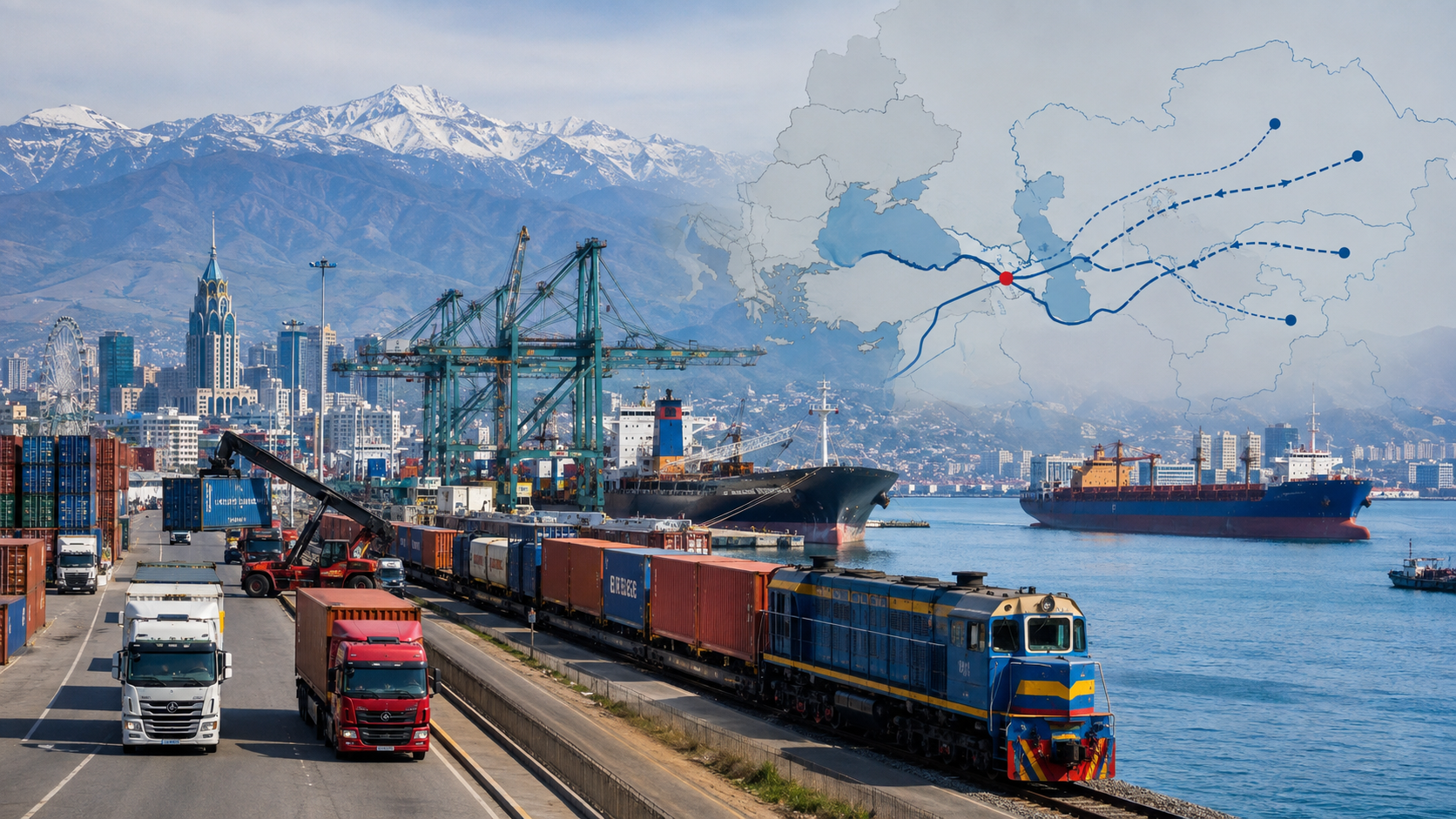
Central Asian cargo can cross the Caspian Sea, move through Azerbaijan and Georgia, and then continue either through Georgian Black Sea ports or overland through Türkiye toward Europe.
This is the basic geography of the Trans-Caspian International Transport Route, better known as the Middle Corridor.
Kazakhstan and Uzbekistan Become Strategic Partners
The strengthening of relations is already extending beyond political statements.
On June 29, Georgia and Kazakhstan signed a joint declaration elevating bilateral relations to a strategic partnership. Transport, logistics, trade and new joint projects were among the areas discussed.
A similar Strategic Partnership Declaration was signed with Uzbekistan on July 3.
The broader package included agreements on customs cooperation, digitalization, finance and other sectors. One of the documents covered implementation of the E-Permit electronic transport-permit exchange system.
These arrangements matter directly to freight transport. Corridor performance depends not only on railways and terminals but also on permit processing, customs clearance and cross-border data exchange.
Kobakhidze has explicitly linked stronger cooperation with Uzbekistan to higher regional trade flows, stronger transport corridors and wider economic integration.
Turkmenistan Is Also Looking Toward Georgian Ports
Transport was also a major part of Turkmen President Serdar Berdimuhamedow’s state visit to Georgia in July.
The two sides discussed trade, investment, energy, transport and logistics, as well as more effective use of the Middle Corridor.
Particular attention was given to stronger transit connectivity involving Georgian Black Sea ports and the future Anaklia Deep Sea Port.
For Turkmenistan, this could provide a stronger westbound logistics option across the Caspian. For Georgia, additional Central Asian volumes could increase demand for railways, roads and port terminals.
Poti Is Already Expanding Cargo Capacity
Diplomatic outreach is being accompanied by infrastructure investment.
The Port of Poti has started the second phase of an expansion project involving another $40 million in investment, bringing total investment to $93 million. The development is expected to increase the relevant terminal’s annual handling capacity to 3 million tonnes.
As K2Cargo.News previously reported, Georgia is expanding the Port of Poti to strengthen the Middle Corridor. Freight traffic on the Middle Corridor increased 21% during the first five months of 2026, while vessel traffic through Georgian ports rose 19%.
Increasing transit volumes mean rail approaches, terminals, highways and border infrastructure will also need to expand in parallel.
Georgia Is Committing Billions to Transport Infrastructure
The government increasingly describes transport and logistics as a foundation of the country’s economic strategy.
In February, Kobakhidze said Georgia had committed around $7 billion to a broad modernization of its transport infrastructure. According to the Prime Minister, modernization of the core railway network has already doubled capacity and reduced transit times across the country.
The network is complemented by the Baku–Tbilisi–Kars railway, which links the Caspian region through Georgia with Türkiye, as well as the East-West Highway.
Another major project is Anaklia Deep Sea Port. Tbilisi expects the port to accommodate larger container vessels and expand Georgia’s ability to handle growing Eurasian freight volumes.
Georgia’s Central Asia policy is therefore directly connected to its infrastructure investment program.
The Middle Corridor Sits at the Center of the Strategy
The Middle Corridor remains the main transport mechanism behind the growing partnership.
The route connects China and Central Asia with Caspian ports, crosses the sea to Azerbaijan and then continues through Georgia toward the Black Sea or Türkiye.
K2Cargo.News previously examined its prospects in “Can the Middle Corridor Become Eurasia’s Main Alternative?”.
World Bank projections cited in that analysis indicate that freight flows through the Caspian section of the Middle Corridor could nearly triple to around 11 million tonnes annually by 2030 if planned infrastructure investment and operational reforms are implemented.
Physical infrastructure alone will not be sufficient. Coordinated tariffs, digital customs procedures, faster border controls and stronger cooperation between Kazakhstan, Azerbaijan and Georgia are also required.
Georgia Offers Central Asia Another Western Gateway
Central Asian economies lack direct access to open-ocean trade routes, making the efficiency of transit through neighboring countries an important factor in their foreign trade costs.
Georgia offers access through the Black Sea toward Romania, Bulgaria and other European markets, as well as an overland continuation through Türkiye.
The Middle Corridor is not large enough to replace every other Eurasian trade route. Multiple transshipments can also increase cost and operational complexity.
Its strategic value is instead in diversification. An additional westbound corridor gives exporters and freight operators more options when geopolitical or commercial conditions change elsewhere.
This is why Georgia’s ties with Kazakhstan, Uzbekistan, Turkmenistan, Kyrgyzstan and Tajikistan are increasingly centered on connectivity.
Diplomacy Now Has to Translate Into Freight Flows
The recent series of visits and strategic agreements shows that Tbilisi is trying to institutionalize its relationship with Central Asia.
The next stage will be practical implementation: increasing corridor capacity, simplifying customs processes, digitalizing transport permits and improving predictability for freight operators.
Georgia’s objective is not simply to remain territory through which cargo passes. It wants to capture more value from ports, railway transport, road transit, warehousing and related logistics services.
As K2Cargo.News has previously noted, Kazakhstan and Georgia are increasingly emerging as key hubs in Eurasia’s new logistics network.
If closer political ties with Central Asia are followed by measurable reductions in transit time and transport costs, Georgia’s role as the eastern gateway to the Black Sea could strengthen considerably.
Read also: Expert Opinion: Why Kazakhstan and Georgia Are Becoming Key Hubs of Eurasia’s New Logistics Network
