

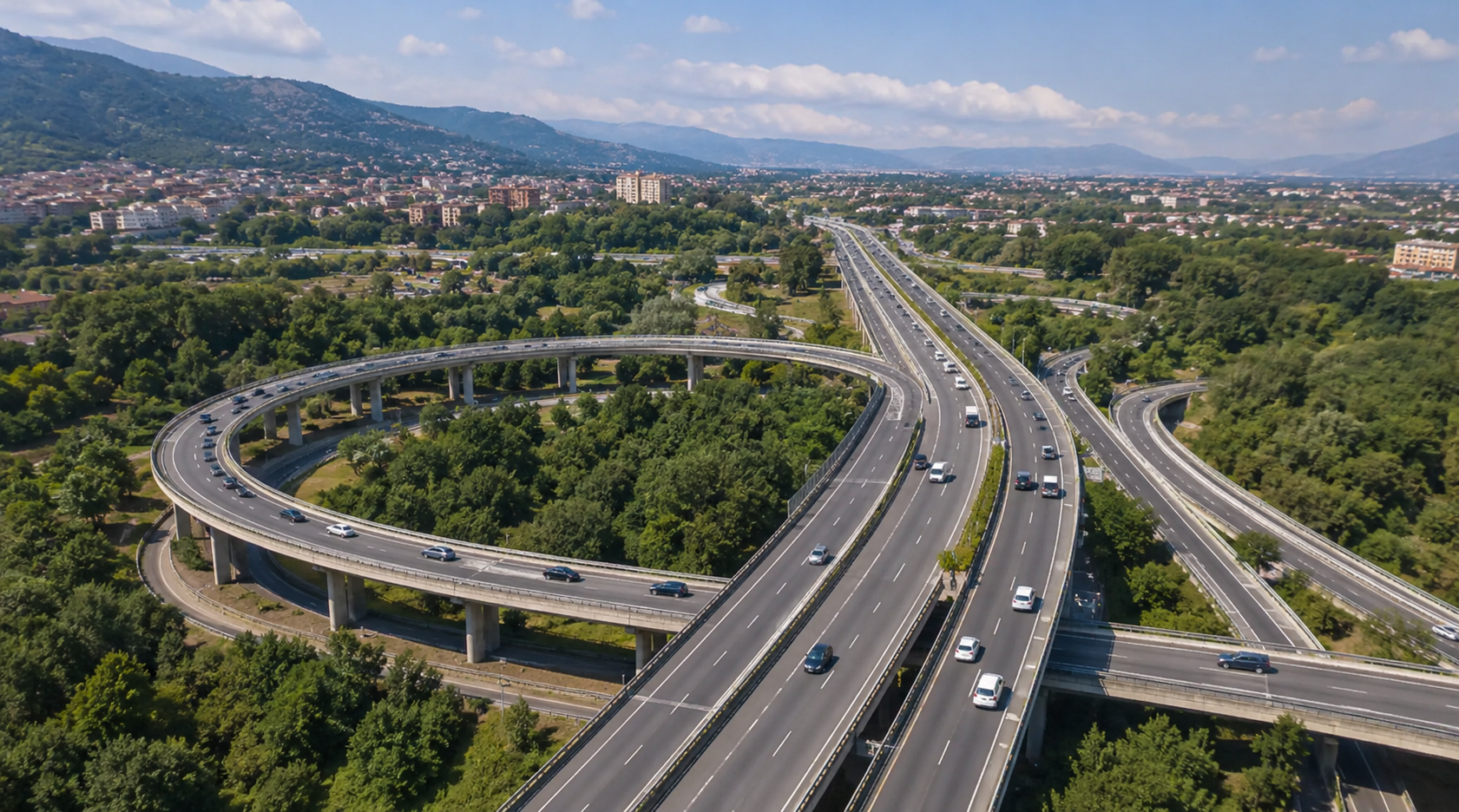
While the concept of “smart roads” was once viewed primarily as a promising area for pilot projects, it is now evolving into a fully operational transportation model capable of significantly improving road safety, efficiency, and sustainability.
A major milestone for the European transportation sector has been the official recognition of the Tangenziale di Napoli motorway as Italy’s first certified smart road. The Italian Ministry of Infrastructure and Transport (MIT) confirmed that the motorway complies with the country’s new standards for digital and cooperative road infrastructure, marking a new chapter in the development of intelligent mobility.
The certification is the result of a multi-year initiative carried out in collaboration with the Ministry of Infrastructure and Transport, the National Center for Sustainable Mobility (MOST), and technology company Movyon. The project demonstrates how modern digital technologies can transform a conventional motorway into a high-tech platform for data exchange between road infrastructure, vehicles, and traffic operators.
From Roadway to Digital Ecosystem
Modern transportation corridors are no longer limited to pavement, road signs, and lighting systems. Today, they are becoming part of a unified digital environment where information is just as important as physical infrastructure.
The Tangenziale di Napoli motorway has been equipped with an advanced network of intelligent monitoring systems that provide real-time visibility into traffic conditions and infrastructure performance.
As part of the project, 217 intelligent cameras have been installed to continuously monitor traffic flows and rapidly detect accidents, congestion, and other incidents. These are complemented by 15 dedicated monitoring portals that collect data on vehicle movements and road conditions.
Special attention has also been given to weather monitoring, as environmental conditions have a significant impact on traffic safety. Eight modern weather stations have been deployed along the motorway to track temperature, humidity, precipitation, and other meteorological factors in real time.
Communication Between Road and Vehicle
One of the most innovative aspects of the project is the implementation of Vehicle-to-Infrastructure (V2I) technology, enabling direct communication between the motorway and connected vehicles.
To support this capability, 40 dedicated communication antennas have been installed along the route. As a result, vehicles equipped with compatible systems can receive critical traffic information almost instantly.
Drivers can be alerted to congestion, roadworks, accidents, changing weather conditions, and other factors that may affect road safety. This allows motorists to make informed decisions well in advance, reducing the likelihood of dangerous situations.
In the future, such technologies will become a crucial component of autonomous mobility, which relies heavily on continuous data exchange between vehicles and surrounding infrastructure.
Real-Time Data as a Strategic Asset
One of the most significant advantages of a smart motorway is its ability to process and utilize vast amounts of data in real time.
Information is collected simultaneously from cameras, road sensors, weather stations, and connected vehicles. Advanced analytics platforms then aggregate and process this data to create a comprehensive overview of motorway operations.
This approach allows traffic operators not only to respond more quickly to incidents but also to anticipate potential problems before they occur. For example, the system can identify areas at risk of congestion or warn of adverse weather conditions before they begin to impact traffic flow.
The shift from reactive traffic management to predictive operations is becoming one of the defining benefits of intelligent transportation infrastructure.
Enhancing Road Safety
Safety remains the primary objective of smart mobility initiatives.
The use of intelligent cameras and traffic analysis systems enables authorities to detect road incidents more rapidly and dispatch emergency services more efficiently. Faster response times help reduce the severity of accidents and minimize the risk of secondary collisions.
At the same time, continuous monitoring of road surfaces allows maintenance teams to identify deterioration early and schedule repairs before serious issues emerge.
Through digital technologies, infrastructure operators can move from responding to problems after they occur to proactively preventing them.
Supporting Sustainable Mobility
The deployment of smart roads also contributes to broader environmental goals.
More efficient traffic management helps reduce congestion and minimizes the amount of time vehicles spend idling. This leads to lower fuel consumption and reduced carbon emissions.
Additional environmental benefits come from route optimization and improved traffic predictability, which are particularly valuable for freight transport and logistics operators.
As governments and industries face increasing pressure to reduce transportation-related emissions, intelligent infrastructure is emerging as an important tool for achieving national and European sustainability targets.
The Future of Intelligent Highways
The certification of Tangenziale di Napoli demonstrates that the concept of a smart road is rapidly moving beyond the experimental stage and becoming a new benchmark for transportation infrastructure development.
The integration of digital technologies, monitoring systems, analytics platforms, and vehicle-to-infrastructure communications is creating a new model of traffic management. In this model, data serves as the foundation for improving safety, efficiency, and sustainability across the transportation network.
Italy’s experience may provide a roadmap for many countries that view infrastructure digitalization as a critical element of future mobility strategies. In the coming years, intelligent highways are expected to play an increasingly important role in building a connected mobility ecosystem—one that seamlessly links vehicles, infrastructure, and digital services through real-time data exchange.
Read also: https://k2cargo.news/tunnel-renovation-to-reshape-traffic-flow-in-munich/