

Spain Converts Freight Corridors From 1,668 mm to Europe’s 1,435 mm Standard
Third-rail installations, Mediterranean Corridor upgrades and 25 kV electrification could remove Spain’s technical separation from the EU network, although freight routes remain fragmented
Iberian Gauge Has Restricted European Connectivity for Almost Two Centuries
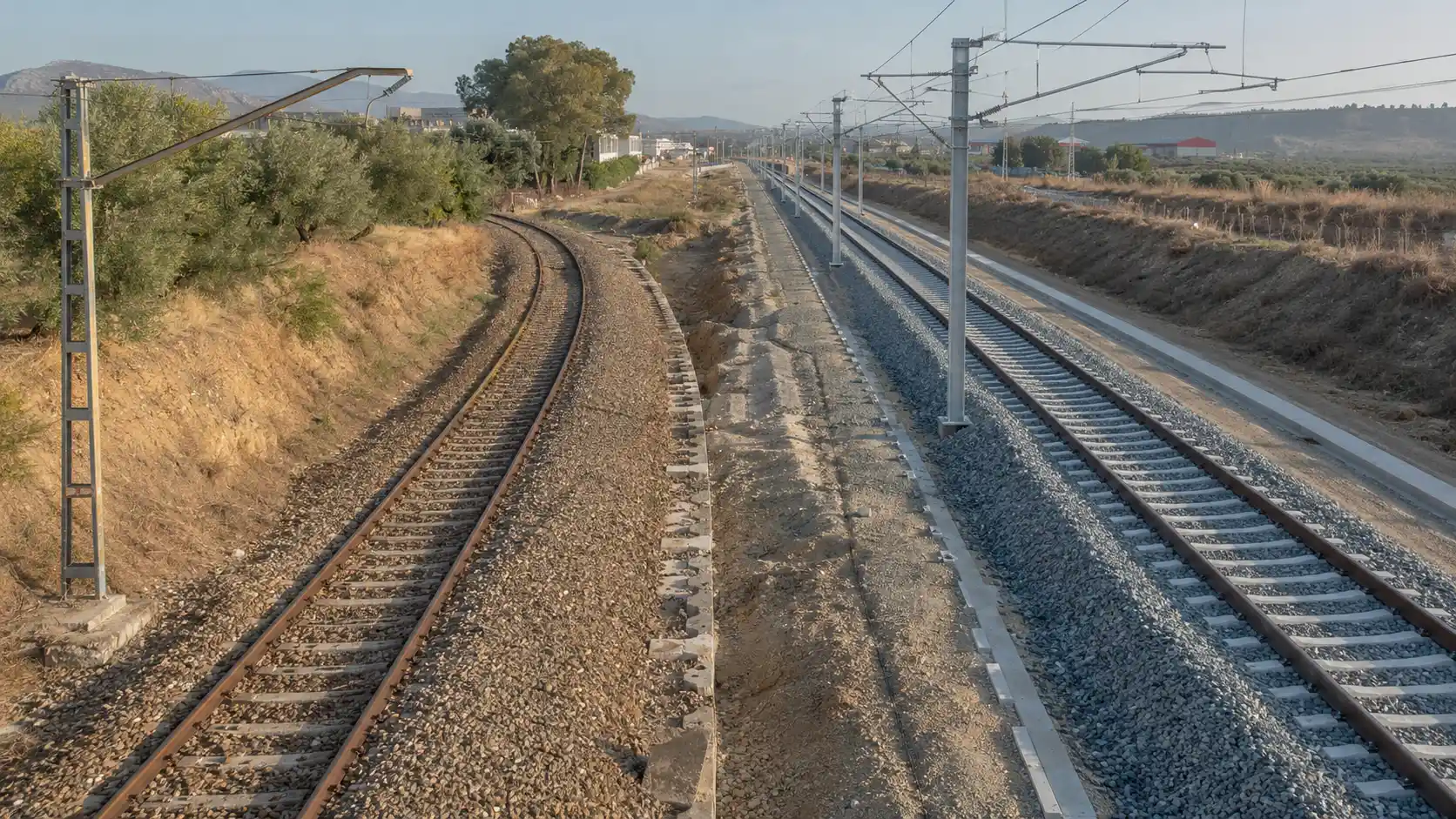
Spain’s different track gauge remains one of the main infrastructure barriers to full integration with Europe’s rail freight network. Most conventional lines use the 1,668 mm Iberian gauge, while Central and Western Europe predominantly operate on the 1,435 mm standard gauge.
The frequently repeated claim that the wider gauge was adopted solely to prevent a military invasion is not supported by the original technical record. Spain’s 1844 Subercase Report primarily linked the decision to the country’s difficult terrain and the belief that wider tracks would accommodate larger and more powerful locomotives. The background is examined in research published by the University of Barcelona.
The decision subsequently created a permanent technical barrier at the French border. Freight operators had to transfer cargo, exchange bogies or use specialized rolling stock.
Variable-gauge systems developed for Talgo and CAF trains partly addressed the problem for passenger services. They are used on both international and domestic routes connecting Spain’s standard-gauge high-speed lines with the Iberian-gauge network. However, the technology has not become a universal commercial solution for heavy freight.
High-Speed Rail Led the Conversion
Spain made a strategic change when it built the Madrid–Seville high-speed line, which opened in 1992. The route adopted the European 1,435 mm gauge and 25 kV AC electrification instead of the 3 kV DC system traditionally used on the conventional network.
Spain’s high-speed network now extends for more than 3,400 kilometres and is interoperable with the European standard gauge, according to the European Commission’s Atlantic Corridor overview.
Freight trains, however, still rely mainly on conventional infrastructure. A large standard-gauge passenger network therefore does not automatically remove the bottlenecks affecting cargo operations.
Freight Needs Continuous Routes
The central challenge is not simply the number of converted kilometres but whether those sections form continuous routes. An isolated standard-gauge segment offers limited value when trains must transfer cargo or change equipment farther along the corridor.
Adif is using several migration methods:
- third-rail installations accommodating both gauges;
- polyvalent sleepers that can support a later gauge change;
- complete reconstruction of existing sections;
- construction of new standard-gauge lines.
The revised TEN-T Regulation reinforces the EU’s interoperability objectives. Spain is not converting its entire conventional network on a single date, however. Migration is proceeding corridor by corridor and project by project, taking account of traffic requirements, construction constraints and available funding.
The Mediterranean Corridor Is the Main Freight Project
The largest programme is under way along the Mediterranean Corridor, connecting the French border with industrial areas, ports and logistics hubs on Spain’s eastern and southern coasts.
In November 2025, Adif began standard-gauge testing between the Castellbisbal junction, Martorell and the SEAT plant. The third rail enables 1,668 mm and 1,435 mm trains to use the same infrastructure. According to Adif, the project is intended to provide industrial customers with direct rail access to France and the wider EU market.
Earlier work at the northern Castellbisbal junction renewed 8.1 kilometres of track, installed 13,600 sleepers and added 23 mixed-gauge turnouts. The infrastructure is expected to support freight services linking the Martorell industrial area, the Port of Barcelona and the European network.
Farther south, the La Encina–Alicante project includes third-rail installation and infrastructure capable of handling 750-metre freight trains. It is intended to support future standard-gauge continuity toward Valencia, Catalonia, Murcia and Andalusia.
Until the individual projects form an uninterrupted network, their benefits for freight operators will remain limited. Carriers must still account for locomotive availability, compatible rolling stock, terminals and transshipment facilities.
The 25 kV Transition Is Also Gradual
Spain is simultaneously modernizing railway power systems. New lines predominantly use 25 kV AC, which is better suited to high loads and intensive services, while much of the conventional network remains electrified at 3 kV DC.
Official projects do not currently confirm a complete conversion of every railway line in Galicia. Instead, the transition covers selected corridors.
One of the largest projects is the 117-kilometre Ourense–Monforte de Lemos–Lugo route. The existing Ourense–Monforte section is being converted from 3 kV DC to 25 kV AC, while the previously non-electrified Monforte–Lugo section is receiving the same voltage. According to Adif, the programme also includes facilities at Puerto Seco for 750-metre freight trains.
During the transition, operators may require dual-voltage locomotives or traction changes at the boundaries between electrical systems. In the longer term, harmonization should reduce energy consumption, improve capacity and make heavy freight operations more efficient.
Connectivity Will Matter More Than Converted Track Length
Spain has already developed Europe’s largest standard-gauge high-speed network and is gradually extending European technical parameters to freight corridors. The competitiveness of rail logistics, however, will depend on continuous links between the French border, industrial areas, inland terminals and seaports.
Third rail preserves existing services and enables both gauges to operate during migration, but it increases infrastructure complexity. Full conversion offers long-term interoperability, although it requires substantial investment and may cause lengthy traffic restrictions.
The success of the programme will therefore be measured not simply by kilometres converted, but by whether freight trains can complete international journeys without cargo transfers, bogie changes or prolonged technical stops.
Read also: Austria Commits €19.5 Billion to Rail Infrastructure Through 2032