

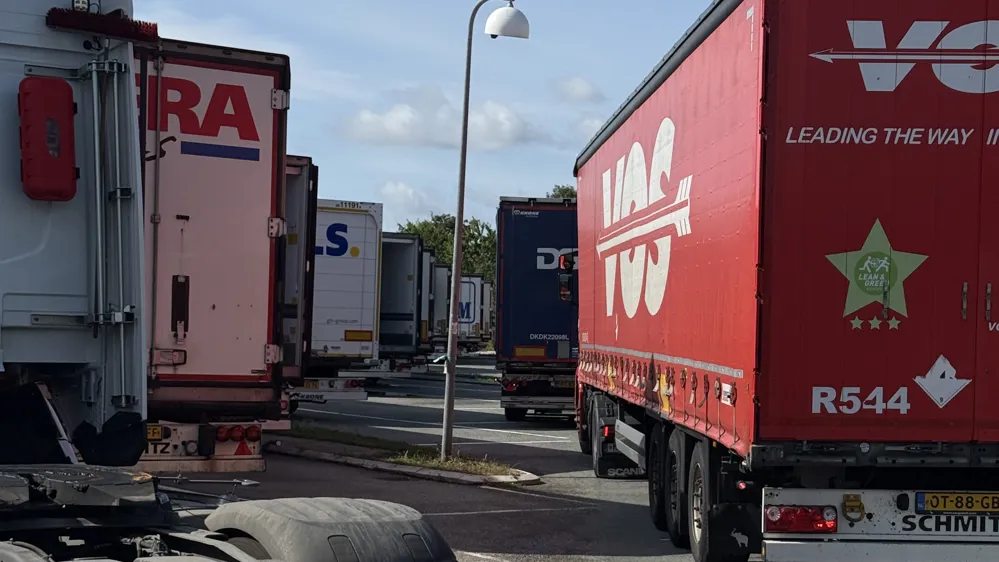
Overcrowded rest areas along the E45 and E20 are forcing drivers to risk fines, leave their routes and spend the final minutes of their permitted driving time searching for somewhere to stop
A shortage of parking spaces for heavy goods vehicles remains one of Denmark’s most serious road infrastructure problems. For drivers, the issue is no longer simply about convenience: overcrowded rest areas make it harder to comply with driving and rest-time rules and force them to search for a stopping place during the final hours of the working day.
A new survey by the Danish Transport and Logistics Association found that seven out of ten haulage companies regularly experience difficulties finding truck parking at motorway rest areas. Another two-thirds of respondents reported a shortage of spaces in and around major cities.
The difficulties are not limited to a small number of congested sites. Carriers describe a structural lack of parking along the country’s principal freight corridors, including the E45 and E20 motorways.
Conditions are most difficult during the late afternoon and evening, when most designated spaces are already occupied. Drivers therefore have to begin looking for parking well in advance, reducing the time available for driving and lowering the productivity of each trip.
When no legal parking space is available, drivers face several unfavorable options. They can continue driving and risk exceeding their permitted hours, make a long detour from the planned route or stop in a location where truck parking is prohibited.
Carriers report trucks being left on access roads, exit lanes, road shoulders and other unsuitable areas. Such parking can obstruct traffic and increase accident risks, but drivers approaching the end of their permitted driving time may have no other lawful alternative.
According to DTL, expanding individual rest areas has not always resolved the problem. Skærup Vest, for example, received 52 additional truck spaces in 2023, but carriers continue to report congestion and vehicles parking outside designated bays.
Parking is particularly difficult near Copenhagen, Aarhus, Odense and Køge, as well as at popular rest areas along the E45 in Jutland and the E20 on Funen. The closure of some parking facilities and the removal of spaces available to heavy vehicles are adding further pressure.
Carrier John Andersen from Vordingborg has described how the shortage affects drivers in practice. He said drivers must begin searching for a place well before the end of their shift because popular rest areas are almost completely full by evening.
During one trip, Andersen was close to exhausting his permitted driving time when he found that no legal spaces were available. He stopped his truck on an exit from the rest area, where several other vehicles had already parked.
Police officers said the trucks were parked in violation of the rules and warned that fines could be issued. Andersen described the situation as contradictory: drivers are required to stop on time, while the authorities do not provide enough legal spaces where that mandatory rest can be taken.
He said he would be prepared to challenge any parking fine in court. In his view, drivers should not bear full responsibility for illegal parking when all authorized infrastructure is occupied by the time they are legally required to stop.
The original DTL material identifies John Andersen as a carrier from Vordingborg. It does not confirm that he is employed as a DSV driver.
Uncertainty over parking directly affects transport operations. Drivers must include additional time for finding a space or stop earlier than their planned schedule requires.
Even ten or fifteen minutes spent checking overcrowded rest areas can be decisive when the legal driving period is almost over. A missed terminal or delivery appointment can then disrupt other parts of the supply chain.
For transport companies, the shortage creates additional mileage, fuel consumption and working time. When a truck leaves its route to search for parking, the operator incurs costs without completing productive transport work.
Ending a shift early also reduces vehicle utilization. The truck covers less distance during the working day, and delivery may have to be postponed until the following morning.
The problem is particularly significant in international transport, where schedules depend on warehouse opening hours, terminal slots, ferry departures and border crossings.
DTL argues that Denmark’s lack of truck parking has become a national problem that cannot be solved by expanding only a few individual motorway rest areas.
The association is calling for a coordinated strategy covering motorways, major cities, industrial zones, freight centers, ports and logistics terminals.
When new warehouses and industrial sites are planned, authorities and developers should assess how many trucks will arrive for loading and unloading each day. If parking is not built alongside the terminal, vehicles often end up occupying nearby streets, access roads and neighboring business areas.
DTL is urging politicians, municipalities, port authorities and logistics property owners to treat truck parking as a core part of transport infrastructure, alongside roads, bridges and terminals.
Carriers regard the construction of new parking facilities and the expansion of existing rest areas as the main solution. However, the industry also wants available land to be used more efficiently.
Some passenger-car spaces remain empty during the evening and overnight periods. Where dimensions and traffic layouts permit, part of this capacity could be made temporarily available to trucks.
This would not replace dedicated truck parking construction, but it could reduce pressure on the busiest routes.
Urban and industrial areas also require greater attention. Drivers need parking not only for daily rest but also while waiting for a warehouse slot, a terminal to open or loading operations to begin.
More accurate digital information about available spaces could form another part of the solution. If drivers know that the next rest area is already full, they can stop earlier or adjust their route before their permitted driving time expires.
Without this information, drivers continue towards popular sites and discover the lack of capacity only after arriving. They must then search for an alternative with very little time remaining.
Several European countries are gradually introducing digital parking monitoring systems. These services can estimate occupancy and send information to navigation applications and fleet management platforms.
Digital systems do not create additional spaces, but they can distribute trucks more effectively across existing facilities and reduce the time wasted searching for parking.
The number of marked bays is not the only measure of adequate parking infrastructure. DTL also emphasizes the need for more toilets and showers, improved lighting, cleaning and regular maintenance.
Drivers taking mandatory rest periods on the road must have access to basic sanitary facilities. When a site accommodates far more trucks than it was designed for, its toilets, showers and waste facilities also become overcrowded.
Security is another important concern. Trucks parked outside controlled and illuminated areas are more vulnerable to cargo and fuel theft. Poorly organized parking also increases the risk of collisions and accidents involving pedestrians.
New facilities must therefore be designed not only around vehicle capacity but also around safe traffic separation, sufficient lighting and suitable driver welfare services.
While Denmark struggles with insufficient capacity, neighboring Sweden is expanding its infrastructure for professional drivers. As K2Cargo.News previously reported, Preem plans to open Sweden’s largest truck stop in September in the Berglunda district of Örebro.
The facility will provide around 50 truck parking spaces, a driver rest area and charging stations delivering up to 400 kW for heavy electric vehicles.
The project combines conventional parking infrastructure with preparation for the transition towards electric road freight. For battery-electric trucks, the site should allow charging to take place during a driver’s mandatory break or daily rest period.
Danish carriers argue that a similar integrated approach is needed in Denmark. New facilities should account not only for the current diesel truck fleet but also for future demand for heavy-duty charging infrastructure.
The lack of parking has consequences far beyond the driver’s cab. It increases carrier costs, reduces delivery reliability and makes compliance with safety requirements more difficult.
If a truck cannot stop on time, the operator risks a driving-time violation, a missed delivery window or a fine for illegal parking. The underlying cause may not be poor route planning but the absence of any available legal space.
Solving the problem will require Denmark to combine several measures: constructing new truck stops, expanding existing areas, using available land more flexibly, improving sanitary facilities and providing real-time occupancy data.
Without systematic investment, growing freight traffic will place even greater pressure on motorway rest areas. Truck parking therefore needs to be included at every stage of planning for roads, ports, terminals and industrial districts.
Read also: SID: Germany Launches a Truck Parking Availability System
